


Both the price of agricultural land and rental values are expected to increase by 4% on average this year, according to a new report from the Society of Chartered Surveyors Ireland (SCSI).
The report says that rental prices are also expected to rise by 3% on average in both Leinster and Munster and by 5% in Connacht/Ulster.
Today's report was compiled with Teagasc and members of the SCSI operating in the agricultural sales and rental market.
It describes an "active" and "competitive" market with prices underpinned by strong demand and a continued scarcity of available land.
But while land prices are expected to continue on a steady upwards trajectory, the outlook this year is notably more cautious than in recent years due to uncertainty over output prices, rising costs and broader economic and geopolitical uncertainties, it adds.
Today's report finds that the average national price for good quality agricultural land in 2025 was €14,126, an increase of 7% on the previous year.
The average national price for poor quality agricultural land was €6,963 per acre, an increase of 5% on the previous year.
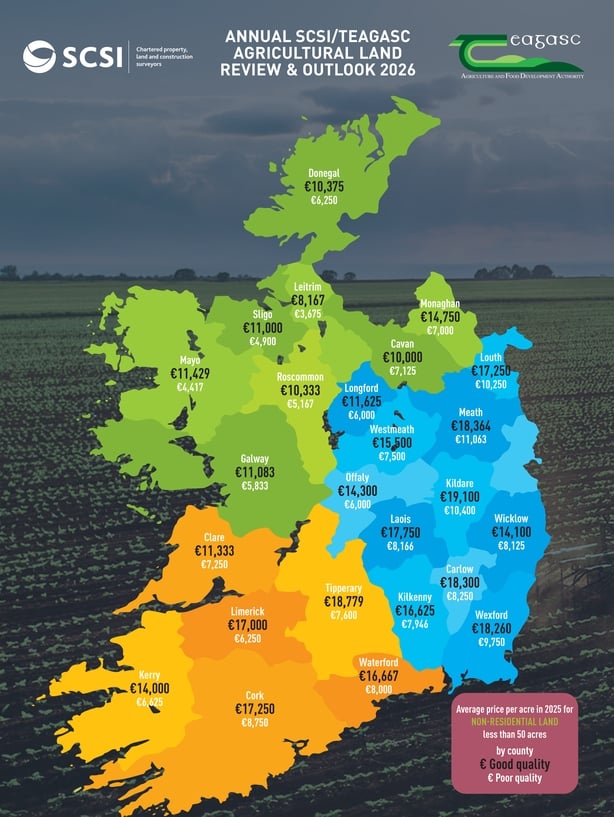
The survey found that Wexford has the most expensive land in the country with an average price of €19,226 per acre across the three main size holding categories. This was just ahead of Kildare on €19,200.
Leitrim has the lowest average poor quality land prices at €3,772 per acre across the three holding sizes.
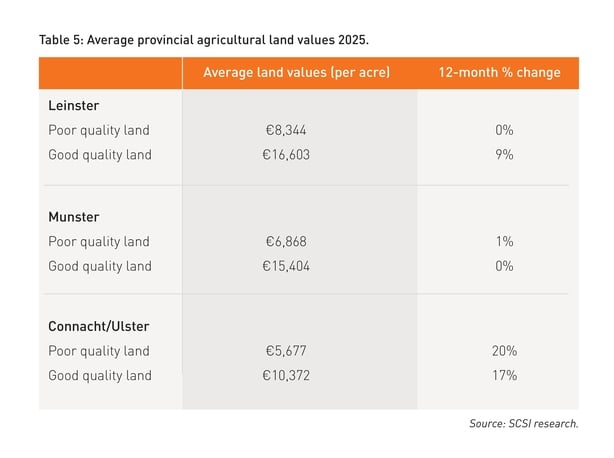
Meanwhile, Leinster has the highest average land prices with good quality land fetching €16,603 per acre - up 9% - while the average price for an acre of poor-quality land remained unchanged at €8,344.
In Munster average prices remained stable with an acre of good quality land fetching €15,404 an acre while the average price for an acre of poor-quality land is €6,868.
The SCSI said that while prices are lower on average in Connacht/Ulster, the region recorded the strongest annual growth rates.
Good quality land averaged €10,372 per acre, representing a 17% increase while poor quality land averaged €5,677 per acre, a 20% increase. Roscommon, Donegal and Monaghan were the counties which recorded the largest price increases, it noted.
On holdings of less than 50 acres, Kildare had the most expensive land at €19,100 per acre, with Tipperary second on €18,779 and Meath in third place at €18,364, just ahead of Carlow on €18,300.
Land Rental Prices
In Leinster (excluding Dublin), land rental prices remained relatively stable overall. Land used for grazing/meadowing/silage increased by 2% to €299 per acre, while land used for grazing only remained broadly unchanged.
Rental values for cereal crop land declined by 4% to €306 per acre, while land used for other crops such as maize sugar beet and beans, recorded a strong increase of 9% to €383 per acre.
But Munster recorded substantial increases across most land uses, reflecting strong demands for land in the region. Land for grazing/meadowing/silage increased by 19% to €350 per acre, while grazing-only land rose by 17%.
Cropping land also recorded strong growth, with rental values for cereal crops increasing by 23% and potato land increasing by 27%, indicating particularly strong demand for specialised crop production land.
In Connacht/Ulster rental values for grassland increased significantly with grazing/meadowing/silage land rising by 18% to €245 per acre and grazing only land also increasing by 18% to €210 per acre.
Dr Frank Harrington, Chair of the SCSI's Rural Agency and Discipline Lead of Real Estate and Valuations at TU Dublin, said that strong demand for agricultural land coupled with continued low supply is underpinning strong prices.
"According to the Central Statistics Office the share of agricultural land, which transacts for sale annually is only around 0.5% of agricultural area. Not surprisingly therefore this report finds that succession and probate sales are among the most common sources of land coming to market. In a competitive market dairy farmers continue to be identified by agents as the most active buyer group in the agricultural land market, followed by dry stock farmers and tillage farmers," he noted.
"While favourable conditions in the dairy and beef sectors supported increased sales activity during 2025, the report also highlights emerging constraints that are increasingly influencing decision making across the sector. Price volatility, rising input costs, regulatory requirements and wider geopolitical uncertainty are now central considerations for many farmers as they plan for the future," he added.
He also noted that farm consolidation is an ongoing trend, reflecting the operational efficiencies and long-term security larger holdings can provide within modern farming systems.
"Allied to this is the growing importance of long-term leasing which has become a central pillar of the Irish agricultural land market rather than a peripheral feature," he stated.
Dr Harrington said that while 2025 was a strong year overall for the market, this year will be more challenging with increased uncertainty expected to pressure farm profitability.
"Energy and fertiliser prices have increased sharply driven by the war in the Middle East. The heightened risks and uncertainty are expected to influence land market behaviour, with farmers adopting a more cautious approach to land purchases," he cautioned.
Teagasc economist Dr Jason Loughrey also said that while agricultural performance last year was strong overall, particularly in the dairy and cattle sectors, 2026 will be significantly more challenging.
"Last year, cattle enterprises recorded exceptional performance, with finished cattle prices rising by 39% and weanling prices increasing by 70%. Dairy farm profitability also improved, supported by higher milk prices - up 3% - and increased production - up almost 5% - with only modest increases in production costs. Sheep sector margins strengthened modestly, with higher lamb prices helping to offset rising input costs," he said.
"However, the outlook for Irish agriculture in 2026 is significantly more challenging, with unfavourable weather conditions, rising input costs, softer output prices and increased uncertainty expected to place pressure on farm profitability," he said.
"Disruptions to energy markets arising from the US-Israeli war with Iran have contributed to increases in fuel, fertiliser, machinery hire and other input costs, with knock-on implications for farm profitability," he added.
