


New figures from the Central Statistics Office show that both exports and imports of goods fell in February compared to the same month last year when companies were reacting to the threat of increased US tariffs.
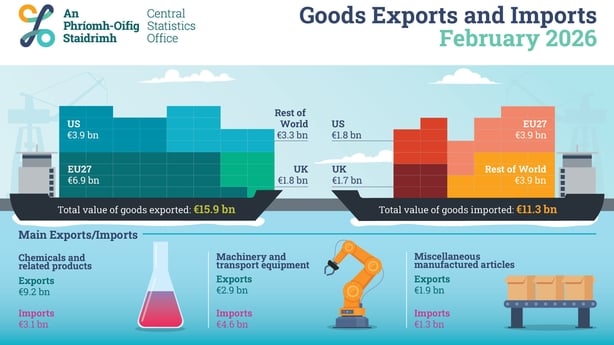
The CSO said that exports sank by 36.4% to €15.9 billion after what it said were "exceptionally" high export volumes in 2025.
Exports to the US slumped by 69.7% to €3.9 billion in February compared to €12.9 billion the same time last year as companies had frontloaded exports ahead of the expected imposition of US tariffs.
Despite the near 70% fall in exports to the US, that country remains Ireland's top import and export goods partner, the CSO noted.
Exports to the US accounted for 24.7% of total export trade in February of this year, while they accounted for 51.8% the same month last year.
Today's figures also show that imports decreased by 6.1% to €11.3 billion in February compared to the same time last year.
On a monthly basis, exports fell by 0.6% to €16.2 billion in February compared with January's exports of €16.3 billion, according to the CSO's preliminary figures.
Seasonally adjusted goods imports grew by 1.1% to €12.2 billion in February compared with January, it added.
Today's figures show that Ireland's top exporting partners in February were the US, the Netherlands and Great Britain, with Ireland exporting 24.7% (€3.9 billion), 17.7% (€2.8 billion) and 8.7% (€1.4 billion) of total export goods respectively to these countries.
Meanwhile, Ireland imported the highest value of goods from the US, Great Britain and China with these countries representing 16.1 % (€1.8 billion), 11.7% (€1.3 billion) and 8.5% (€962.4m) of the total import trade for the month.
Robert Purdue, Senior Client Portfolio Manager at global financial services firm Ebury (Ireland), said today's CSO figures show a steep year-on-year fall in Irish exports, but this largely reflects the exceptional spike seen in early 2025.
"When compared with 2024, export levels are broadly stable, suggesting the underlying picture is less severe than the headline decline implies," Mr Purdue said.
But he said the figures still point to a more challenging environment for exporters, adding that the impact of the Iran conflict is beginning to filter through, increasing global energy and fuel prices and adding volatility to trade conditions.
"This is already feeding into higher input costs for businesses and increasing pressure on margins. The conflict is also raising the prospect of tighter financial conditions, with inflation fears potentially prompting ECB rate hikes and higher borrowing costs for firms," he added.
Louise Kelly, Global Trade Strategy and Resilience Lead at Deloitte Ireland, said today's figures show continuing adjustment from last year's elevated levels and reinforce that current volatility reflects timing effects rather than a shift in underlying demand.
"The data remains shaped by the unwinding of 2025’s front-loaded pharmaceutical exports, with chemicals and related products still dominant, accounting for €9.2 billion of exports and continuing to drive much of the movement in the headline figure," she said.
"While the scale of change appears significant, it reflects a recalibration from an unusually high base rather than a weakening in export performance. Export performance this year is broadly flat, tracking in line with 2024 levels," she added.
"Over the coming weeks, we will be monitoring closely how US trade policy and geopolitical events continue to shape global trade flows," Louise Kelly said.
"We will also be keeping a close eye on the extent to which last year's front-loaded export activity continues to distort comparisons, and the impact of those geopolitical risks, particularly around key shipping routes, on supply chains and costs," she said.
"This is a reset after an exceptional year, with the real signal now emerging beneath the headline numbers," she added.
