


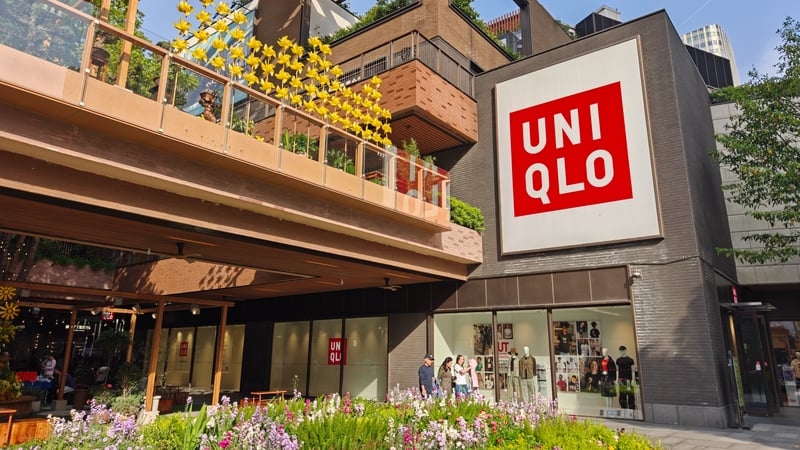
The Japanese owner of clothing brand Uniqlo has today raised its full-year forecast, flagging another record year, as international growth produced a stronger-than-expected jump in quarterly profit.
Fast Retailing said its operating profit rose 29.4% to 189.8 billion yen ($1.19 billion) in the three months to February from 146.7 billion yen a year earlier. That beat an average estimate of 161.6 billion yen from seven analysts compiled by LSEG.
The company raised its full-year operating profit forecast to 700 billion yen from 650 billion yen, putting the retailer on track for a fifth-consecutive year of record earnings.
"Estimates incorporate some impact from the Middle East situation, based on current considerations such as higher transportation costs in some markets," Fast Retailing said in a statement.
For its 2026 fiscal year, no major impact is expected from a production and logistics perspective, it said.
The company's second-quarter ended just before the start of US-Israeli air strikes on Iran, a conflict that has sent oil prices soaring and upended supply chains. Markets are now on tenterhooks amid uncertainty over the prospect of a permanent peace deal.
Investors will be looking at how the Iran crisis impacts costs for Uniqlo, known for its inexpensive fleeces and everyday basics, many of which are made with polyester.
Fast Retailing's Tokyo-listed shares closed down 0.5% ahead of the results.
Teijin Frontier, a Japan-based supplier to the company, said this week it would raise prices on polyester fibre by 20% due to higher oil prices.
Europe's retailers, including clothing giant H&M and UK supermarket chain Co-op, have already warned that a prolonged Middle East conflict could drive prices higher and dent consumer demand.
Fast Retailing is widely seen as a bellwether for consumer spending in Japan and mainland China, where it has almost 900 stores.
From a single store in the western Japanese city of Hiroshima in 1984, Uniqlo now has shops in more than 2,500 locations globally, and the franchise is rapidly expanding in Europe and North America as it looks beyond China, its largest overseas market.
Fast Retailing's domestic sales have been supported by a tourism boom driven by a weak yen, while growth in China has slowed due to weak consumer sentiment, prompting store closures and restructuring.
The global retailer's Asia-based supply chain last year came under pressure from wide-ranging and frequently shifting tariffs by the US, and it now faces the added hurdle of elevated costs from the Middle East conflict.
Tadashi Yanai, Fast Retailing's founder and Japan's richest man, has a long-standing aim to make his company the world's biggest clothing brand and has been outspoken on the risks from tariffs.
