


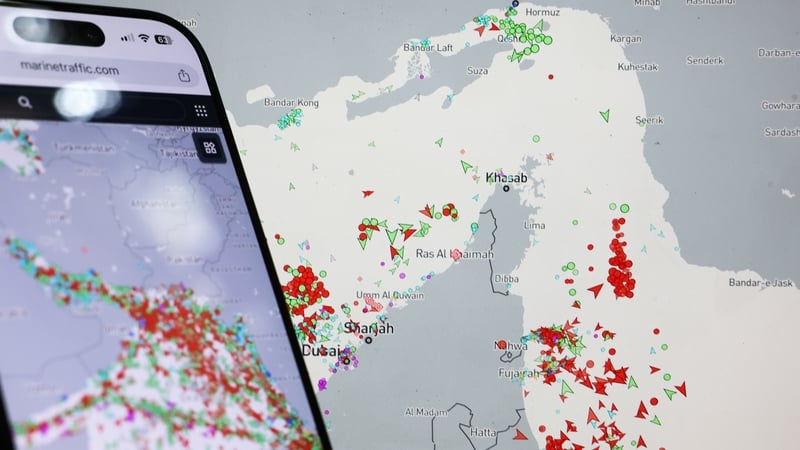
Oil prices rose nearly 5% as doubts over a fragile two-week Middle East ceasefire raised concerns that energy flows through the crucial Strait of Hormuz will remain restricted, with shippers hesitant to resume transit.
Brent crude futures were up $4.41, or 4.7%, at $99.14 a barrel close to 3 pm GMT, while US West Texas Intermediate crude rose $7.57, or 8%, to $99.15 a barrel.
Both benchmarks fell below $100 per barrel in the previous trading session, with WTI recording its biggest decline since April 2020, on optimism the ceasefire would result in a reopening of the strait.
However, Israel bombed more targets in Lebanon on Thursday, putting the ceasefire in further jeopardy after its biggest attacks of the war on its neighbour killed more than 250 people and threatened to torpedo Donald Trump's truce from the outset.
"Crude futures are taking back some of yesterday's losses as the Strait of Hormuz remains with just a small fraction of traffic, much less than the market anticipated yesterday," Dennis Kissler, senior vice president of trading at BOK Financial.
"The ceasefire agreements are in question as Israel had continued to strike Lebanon and Vice President Vance is enroute to the Middle East to continue the talks," Kissler added.
The Hormuz waterway connects supply from Gulf producers such as Iraq, Saudi Arabia, Kuwait and Qatar to global markets, and typically carries about 20% of global oil and gas supply.
"Even if shipments resume, the risks won't disappear overnight," said Susannah Streeter, chief investment strategist, Wealth Club. "Tankers may be forced to navigate mined waters and a heightened military presence, all of which will keep insurance premiums high and freight costs elevated."
The viability of the ceasefire is in question amid continued Israeli strikes on Lebanon yesterday, causing Iran to suggest it would be "unreasonable" to proceed with talks to forge a permanent peace deal.
Shippers yesterday said they needed clarity on terms of the ceasefire before resuming transit through the Strait of Hormuz. Iran has issued maps to guide ships around mines and showing safe paths for passage, Iranian media reported.
Commodities trader Glencore and Taiwan's state refiner CPC have chartered a tanker each to load Middle Eastern crude for Asia, while vessels in the Gulf are preparing to exit via the Strait of Hormuz.
Regional oil facilities remain under threat, with Iran striking sites in nearby countries after the ceasefire, including a pipeline in Saudi Arabia that has been used to bypass the blockaded Strait of Hormuz, according to an oil industry source.
Kuwait, Bahrain and the UAE also reported missile and drone attacks by Iran.
Meanwhile, Goldman Sachs trimmed its second‑quarter 2026 forecasts for Brent and US crude to $90 and $87 a barrel, respectively, after the ceasefire.
Previously, the bank forecast Brent and West Texas Intermediate (WTI) oil prices to average $99 and $91 a barrel, respectively.
