
Rising prices during the Ukraine energy crisis in 2022 and 2023 are still fresh in people's minds.
When bills went through the roof, it drove the first wave of solar deployment.
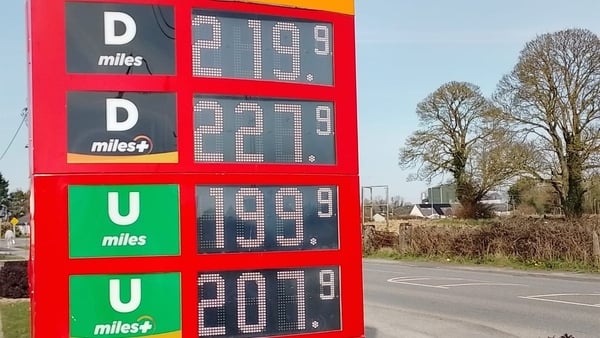
Now, watching prices at the pumps respond to the Middle East conflict, combined with the threat of other energy sources being vulnerable, consumers are once again looking for ways to future proof their homes’ electricity supply.
The CEO of Solar Ireland Ronan Power said people are - "moving as a matter of urgency towards solar".
They’ve seen a 38% increase in customers who were buying on the day, and sold within seven days has seen an 27% rise.
"People are looking to move fast, they obviously recognize that there's potentially something coming down the road and they're trying to protect themselves," he said.
The Government has introduced a €250m support package to offset soaring fuel prices, but Mr Power would recommend the Government take a longer-term view in terms of how to help protect people from energy shocks.
"The electricity you generate at home is the cheapest electricity you'll ever have, because you have no ESB costs, no Eirgrid costs, no cost of use, no PSO levy, you have nothing," he said.
"So that system is generating probably at six cents a kilowatt, while the average rate of power at the moment I think is around 37 cents."
Unused electricity generated by solar can also be sold back to the grid under the Microgeneration Support Scheme.
Up to €400 is exempt from tax, or €800 if two adults put both names on the household bill.
As of March 2026, the average electricity unit rate in Ireland is approximately 35-36 cent per kWh (including 9% VAT), according to price comparison site Selectra.
Household electricity consumption averages around 4,200 kWh per year, leading to estimated annual costs of over €1,400 to €1,600+ for many households depending on the tariff and supplier.
Mr Power noted the narrative in the press since the war started in Iran around the price shock and how long its going to take to come back down has put a sense of fear into people.
He believes that solar panels in homes that can cover 40-50% of the electricity and have a warranty for 25 years are what consumers are looking at to future proof their bills and supply.
"There's likely to be another one of these ripples over the next two and a half to three decades.
"I think people are looking at a longer-term view to say if this comes again, at least I know half of what I'm paying is already taken care of and won't go up. The other half is still at the behest of macroeconomics."
The Minister for Climate, Energy and the Environment, Darragh O’Brien, confirmed that SEAI grants for domestic rooftop solar would remain at €1,800 for 2026 under the Microgeneration Support Scheme in the budget.
"The grants have a key role," said Mr Power.
Early adopters of schemes like this are usually people who have more available money to spend.
Mr Power flagged that as the system moves on from early adopters, people who need the panels to move away from the energy poverty line need to be supported.
In his opinion the €250m Government package is looking at dealing with the current shock but he doesn’t think they’re looking long term enough in terms of how that money is spent.
He said Solar Ireland will be advocating for an allocation of that fund to increase the grants so that rather than dealing in the now, they’re helping people insulate themselves for the next 20 to 30 years.
Electricity prices are stable for now, however, electricity prices directly track gas prices.
Gas suppliers in Ireland book deliveries about 12 to 18 months in advance at fixed prices.
This means it could be some time before we see any increase if any in either gas or electricity.
While a good hedging strategy means we're technically going to be insulated from some of the immediate effects, Mr Power warns that if this conflict becomes sustained, then energy providers will have no choice but to pass on some of that to the consumer.
Ohk Energy
"We’ve seen a significant increase in interest since the Middle East conflict began," said Ohk Energy CEO, Conor Foley, .
He said during the Ukraine energy crisis, there was a major spike in residential solar installations because electricity prices rose so sharply and so quickly.
However, this time, they’re seeing something slightly different but just as strong.
The company is reporting a surge in enquiries right across the board - solar panels, batteries, heat pumps and full home‑energy upgrades.
It's generally a move away from fossil fuels and towards energy independence and certainty, explained Mr Foley.
"People are reacting to volatility, they want stability, they want energy independence, and they want to future‑proof their homes against unpredictable price swings," he commented.
He also noted that they are seeing a strong trend among their existing customers who installed solar over the last few years.
"Many are now upgrading, adding more panels or investing in battery storage, to increase their self‑consumption and reduce reliance on the grid," he said.
"It’s a clear sign that customers want deeper energy independence and long‑term protection from price volatility."
Abhaile Solar & Electrical Ltd
The demand Abhaile Solar & Electrical Ltd is seeing for solar combined with battery backup and whole-home protection is not coming from people who want to be green.
The Galway based company said it is coming from people who want to be secure.
It said they are two very different conversations, and the second one is the one they are having every day now.
"The families coming to us now are not early adopters," said Co-founder and Director Juliana Erkkonen.
"These are ordinary people who sat at a kitchen table, looked at a bill that had doubled, and made a decision they were never going to feel that exposed again," she noted.
"Every time there is instability in the world, whether it is Ukraine or the Middle East, we feel it on our electricity bills here in the west of Ireland. People have made that connection, and they are acting on it," she said.
The company said everything shifted when energy prices spiked after Ukraine, adding that something shifted in the way Irish homeowners think about electricity.
It said people weren’t just ringing to ask about grants, payback periods of doing their bit for the environment, they were ringing because something had broken in their trust of the system.
The co-founders highlight how unfolding events in the Middle East has reminded people just how fragile the energy supply consumers depend on every day really is.
They are seeing families decide to take back control of something that has felt completely outside their hands for years.
Co-founder and Lead Installer Donal Gibbon said rural households are in a different position to people in cities.
"When the grid goes down out here it can stay down," he said.
"What I am hearing from customers now is not just about money, they want to know that their home will keep running regardless of what is happening in the world.
"That shift in thinking is new, and it is real. In over 30 years in the electrical trade I have never seen homeowners this motivated to take energy into their own hands."
A1 Energy Solutions
Any time there is a question about where people are going to get their power from, it creates a surge in interest, whether it be storms, the Iran crisis, and then the economic incentives, according to company director at A1 Energy Solutions Conor O’Brien.
"The conflict has raised an awareness that buying in your energy from an external source is not as reliable as we all assumed, and that it is massively beneficial for householders, whether there's a crisis or not, to have battery storage on their home that they can access in the event that there is a power cut or power not available," said Mr O’Brien.
He said whenever there's a new economic incentive announced, then there’s typically another surge as well.
These surges include when VAT was removed from solar panels, and when the government legislated that the electricity providers had to reimburse consumers for exported electricity.
After regulations changed to allow installers give people off-grid functionality, the company saw a big surge in people looking for solar power.
Mr O’Brien said the product they install allows people with solar, in the event of a power cut, to flick a switch on their fuse board.
"We can power their house from the batteries and continue to charge the batteries using the solar panels, which we were never able to do two years ago," said Mr O’Brien.
Pure Volt Solar
Both conflicts in Ukraine and the Middle East have led to significant spikes in enquiries with PureVolt Solar in the domestic market.
"Volatility in the global energy market has definitely left people with a strong desire to have greater control over their own energy supply," said Managing Director Ian Murphy. "Solar offers them predictability and peace of mind."
Irish internet searches for "solar panels" increased by 56% in September 2022, when Russia indefinitely suspended Nord Stream 1 gas supplies to Western Europe.
At the time, PureVolt Solar said domestic solar enquiries were coming in faster than they could answer them.
Following recent events in The Middle East, the company has seen an almost identical spike with search volumes increasing by 46% and enquiry rates unseasonally high since the New Year.
In January 2026, PureVolt said requests for domestic solar quotes were up 54% year-on-year and the trend looks set to increase still further as they head into spring.