


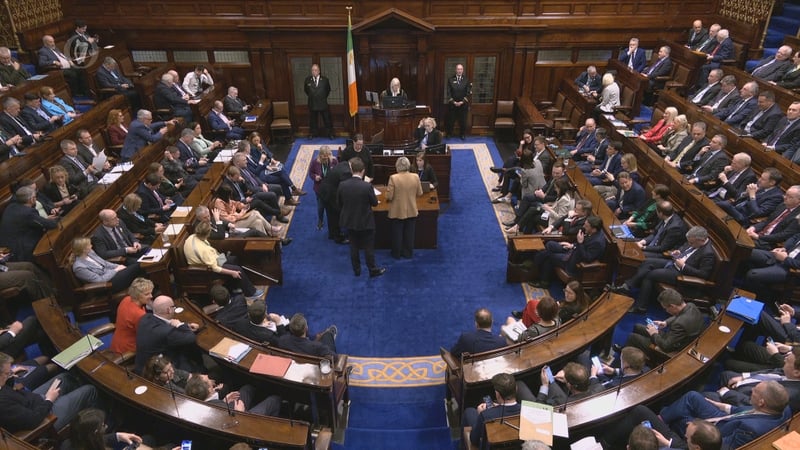
The Dáil has voted to cut excise by 15 cent per litre on petrol and 20 cent per litre on diesel from midnight.
118 TDs backed the Financial Resolution with 39 opposing it.
The measures agreed by Cabinet and passed by a Dáil vote this evening will see excise duty on diesel cut by 20 cent and by 15 cent on petrol until the end of May.
The Fuel Allowance will be extended by four weeks.
A Government spokesperson said tonight: "It is extraordinary that after weeks of calling for action to help with rising fuel costs Sinn Féin actually voted against reducing excise duty on petrol and diesel from midnight tonight.
"They were the only Opppsition party to vote down measures to reduce the price at the pumps for motorists in the Dáil this evening.
"While this Government is focused on targeted measures to support those that need it, Sinn Féin is once again more interested in performative political stunts than providing real support for people faced with rising prices due to the ongoing geopolitical turmoil."
However, a Sinn Féin spokesperson said "we were clear that half measures weren't enough".
"Sinn Féin voted against Fianna Fáil and Fine Gael tonight. Their proposals on petrol and diesel didn’t go far enough and they abandoned households relying on home heating oil.
"Our amendment, which they opposed, would have cut diesel by the maximum and cut petrol by the same amount and would have removed excise entirely from home heating oil.
"That’s the type of support that workers and families needed tonight. We won’t settle for anything less," it said.
The Government has been accused of not doing enough to help those struggling to deal with rising energy costs as a result of the war in Iran.
The Social Democrats' deputy leader Cian O'Callaghan told the Dáil that families at breaking point are now being forced to choose between eating and heating.
The Labour leader Ivana Bacik also stated that the Government's intervention did not go far enough.
However, Taoiseach Micheál Martin insisted the approach was a balanced one and said the Government has to hold something back for now - because it does not know what is around the corner amid such global uncertainty.
Diesel to fall by 22 cents, petrol to fall by 17 cents
The measures will see the price of diesel fall by a total of 22 cent a litre, and petrol by a total of 17 cent a litre.
In addition, a two-cent per litre National Oil Reserves Agency (NORA) levy on petrol and diesel will be paused for two months, however, this will require additional legislation.
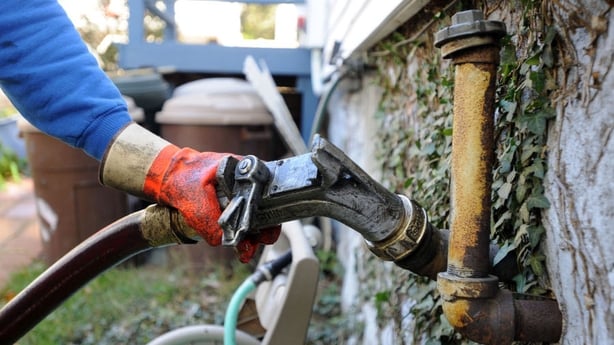
The NORA levy is also applied to home-heating oil, and will reduce the price of that fuel by two cents a litre.
The Government measures also include a VAT-inclusive three-cent per litre cut in excise on green diesel, and a temporary increase in the maximum rebate allowable under the Diesel Rebate Scheme, which is administered by Revenue, to 12 cent per litre (from 7.5 cent per litre) until 30 June.
Heating payments to social welfare recipients will be extended for four weeks and there will be enhancements to a rebate programme for hauliers.
The overall package, which will also include targeted energy supports for pensioners, carers and people with disabilities, is set to cost €235m.
Government's actions have to be sustainable - Martin
Mr Martin said the measures are "targeted and temporary" and will be reviewed subject to market developments.
The Taoiseach was asked about the fact that motorists will still have to pay a lot more for their fuel even after the excise cuts are applied.
"There are limits to what governments can do in response to a crisis of this kind and we want to ensure what we do is sustainable," he said.
He said it is not known how long the war will last and the turbulence that goes with it in the energy markets.
"We are never going to be in a position, where we will, as a Government, be able to compensate everyone for the damaging impacts of the war on the energy markets, but what we can do is try and ease the pressure," he said.
The Tánaiste and Minister for Finance said he expects the excise cut to be passed on quickly to consumers by fuel sellers.
"It's very clear here. People were very quick to up the prices, they need to put them down as quickly," said Simon Harris.
He said he does "logically accept" that there may be a lag with passing on the cuts with small, remote petrol stations compared to large urban ones, but said he has heard that the industry expects "the large majority to see the benefit passed on within a few hours".
Mr Harris said everyone has to act in good faith on this and the Competition and Consumer Protection Commission has a role to play in monitoring the situation.
However, Sinn Féin Spokesperson on Finance Pearse Doherty described the Government's proposals as a "series of half measures" that is "not acceptable".
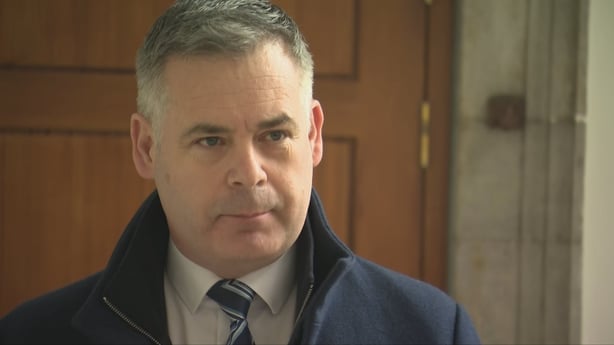
Mr Doherty called for an excise cut to the maximum amount in diesel, as well as the removal of excise from home heating oil, the fuel allowance to be extended by 13 weeks and to bring forward energy credits.
He said: "That's the type of comprehensive package that we should be seeing from Government.
"But unfortunately, we have half measures and a Government that was really dragged to this place who didn't want to support people, but have no problem supporting and handing hundreds of millions of euros of tax cuts to developers, to banks that are making billions of profits and pay less than 1% of profits.
"Yet, at the same time, people have been left for the last four weeks high and dry, and now they come forward on Tuesday with a series of half measures, and it's not acceptable."
Read more: How the Govt's excise cuts will impact the cost of fuels
Labour Party Spokesperson on Finance Ged Nash said his party supports the measures being introduced by the Government, adding that "the response needs to be a mix of financial measures for hard-pressed commuters, some for workers and small businesses across the country, but also a policy intervention".
He said that "we need to return now to a real focus on enabling people to work from home to ensure that we get the benefits of remote work and that workers aren't overly penalised by having to get into their cars or use expensive public transport on a daily basis."
Additional reporting: Joe Mag Raollaigh and Harry Manning
