


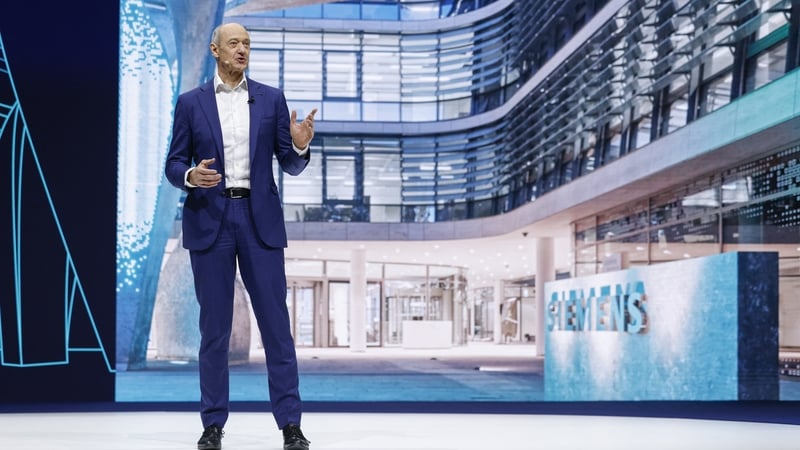
German industrial giant Siemens said today that the Iran war has led to customers holding back on new investments as prices increase for raw materials and energy.
The war has nearly halted shipping through the Strait of Hormuz, which handles about 20% of global oil and liquefied natural gas flows, as well as damaged major energy facilities in the Gulf. Brent crude futures have jumped 56% since the start of the conflict.
"Growth is throttled because of price increases. You see customers holding back their investments. For example, oil and gas customers or petroleum customers who were planning maybe a new plant - so it means investments are slowing down," CEO Roland Busch told reporters today.
Busch was speaking on the sidelines of the annual Siemens Tech Summit in Beijing, where the company announced it would expand its industrial artificial intelligence partnership with Chinese tech giant Alibaba.
Siemens will provide 26 new services spanning industrial infrastructure, automation and AI-powered applications to Alibaba Cloud customers.
But Busch noted that some Chinese partners have been reluctant to share real-world factory data crucial for training and fine-tuning its models due to concerns about IP issues.
"Most of our foundational models, they are so far trained on publicly available data, they haven't seen industrial data yet. This is a big step up to tune models," he said.
"We want data to travel across borders and the Chinese government, at least for industrial and machine data, has allowed the possibility (for data) to travel across borders," he added.
China has imposed strict cross-border data transfer laws for national security purposes, but some European firms have been granted exemptions on a limited case-by-case basis.
Busch said Siemens developers prefer to use Chinese open-source AI models over their closed-source US rivals for certain tasks related to training industrial AI models because of their cheaper token cost and customisable parameters.
A token is the smallest unit of data processed by AI models.
Six out of the top ten most widely used large language models worldwide are Chinese, according to the token usage ranking scoreboard of OpenRouter, a unified public interface for AI models.
Some Western think tanks have warned about the security risks of reliance on Chinese open-source models, as well as their political bias towards Chinese government positions.
Chinese open-source AI models, led by Qwen and DeepSeek, have gained significant traction in the US, with some estimates suggesting that around 80% of US AI startups now use them.
