

The deputy governor of the Central Bank of Ireland has said that Ireland "will have an important role to play" in progressing the digital euro project when it takes over the EU presidency in the second half of this year.
The European Central Bank is promoting a digital euro - a public initiative to make a digital version of cash that would work across the eurozone and strengthen the resilience and sovereignty of the bloc.
The digital euro is often described as a "digital version of cash". It differs to the ways people currently pay for items electronically, in that it would not involve the use of private companies and would sit as an alternative to them with its own app and digital wallet when established.
Central Bank deputy governor Vas Madouros believes the digital euro will be a positive development for the Irish consumer.
Speaking on RTÉ's This Week, he said: "The digital euro would be free for basic use; it would be available both online and offline; it would be available for person-to-person transactions, online transactions, as well as at the shop; it will be designed explicitly with an inclusive mindset.
"This combination of factors doesn't exist at the moment, and it would exist with a digital euro."
What is the Digital euro?
Vas Madouros described the digital euro as the "evolution of money".
"Most people are already using digital payments," he said, "the difference with the digital euro is that it will be issued by the European Central Bank."
Dr Christy Petit, assistant professor of EU banking and finance law at DCU, described the digital euro as a "public digital means of payment; the digital equivalent of cash."
In the eurozone, cash is created by the ECB and distributed via ATMs and cashback. Once it is in your pocket, no one knows what you do with it.
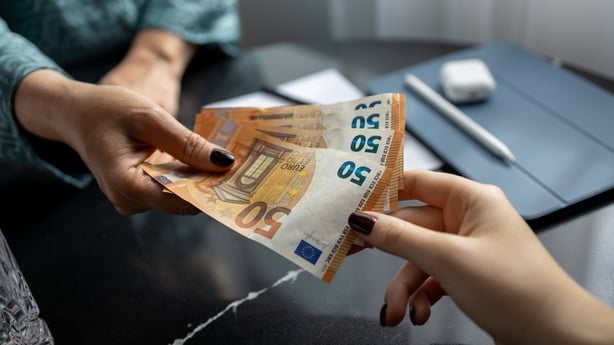
"We cannot use cash online," Dr Petit explained, "we are using other entities that are allowing us to pay online, banks, financial institutions, financial services providers."
All of these online methods require the use of private companies, most of which are not based in the EU.
The digital euro would be public digital infrastructure to facilitate electronic transactions without the need to use a private company.
It would act like cash in that it would be issued by the ECB, it would offer more privacy than a purchase with a private company, and you wouldn't be able to buy anything on credit with it.
Like cash, there would be no fees for consumers who use it.
Just as you would withdraw cash from an ATM, in order to use digital euros you must transfer money from your bank account into a digital wallet.
There will be a limit on how much money will be allowed in that wallet at any one time.
Mr Madurous said that the digital euro will increase economic resilience by providing increased options to pay, but also because people will be able to pay with digital euros offline.
"This is another mechanism of the design that would strengthen our collective resilience, which is important because we live in an uncertain world as we see these days and weeks," he said.
Is the Euro resilient?
There are several arguments as to why the digital euro project is needed including privacy, geopolitical tensions and economic sovereignty.
As eurozone countries, and Ireland in particular, shift away from cash, consumers are forced to use private companies to make digital purchases.
In 2019, 53% of transactions in Ireland were cash at the point of sale. By 2023, this had dropped to 27%.
Two US-based payment companies, Visa and MasterCard, accounted for nearly two-thirds of card transactions in the eurozone in 2022 according to the European Central Bank.
"The fact that we have non-European solutions and services is not ensuring resilience." Dr Petit said.
She gave the example of a blackout or a business deciding to withdraw its service; right now there is no back-up solution apart from cash.
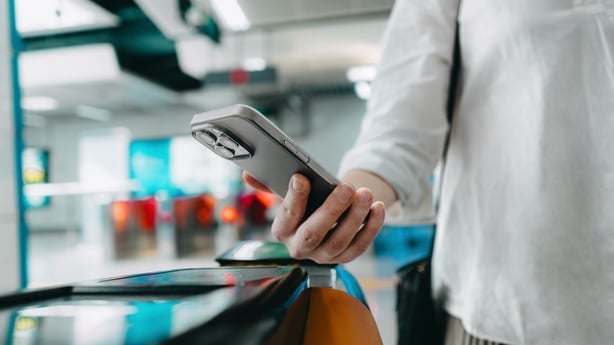
Ireland is one of six eurozone countries that has no domestic digital payment schemes. When domestic schemes do exist, the ECB says that they are declining in use.
Neither the Central Bank of Ireland nor Banking and Payments Federation Ireland had Irish-specific data on the usage of MasterCard and visa by Irish consumers. A 2025 report by the UK's Payment Systems Regulator found over 95% of transactions using UK
issued cards are made using a payment system owned by either MasterCard or Visa.
This has the potential to cause disruption when geopolitical tensions escalate.
For example, when Russian launched a full-scale invasion of Ukraine in 2022, sanctions were placed on Moscow. Visa, MasterCard and PayPal all stopped working within the country.
Card payments are the main electronic payment method in the EU.
In 2022, international card schemes accounted for approximately 61% of euro area card transactions.
The extent of reliance on non-EU card systems varies depending on the member state. Ireland doesn't have a domestic card payment scheme and people are also more likely to pay electronically than with cash.
Other popular ways to pay for items such as Apple Pay, Google Pay, and PayPal are also all-American firms.
However, war isn't the only scenario where the eurozone's resilience could be tested. During the Iberian blackout last April, digital payments failed leading to a dramatic fall in consumer spending.
Because the digital euro is designed to also work offline, this would be an advantage it will have over private payment providers.
Wero was set up in 2024 by the European Payments Initiative as an alternative digital payment system and is used in Belgium, France and Germany, however it is not available in Ireland.
The ECB isn't the only central bank around the world that is looking at creating a digital version of its currency that would not require the use of private companies.
Dr Petit says that Brazil and Canada are also working on their own version and the ECB is actually leading innovation on this.
Digital euro and Irish presidency of EU Council
Minister of State Robert Troy has said that the digital euro would be a "priority" for Ireland when it holds the EU presidency in the second half of this year.
The European Parliament is expected to agree its first position on the digital euro in May. Ireland will take up the EU presidency for a six-month term on 1 July.
Piero Cipollone, the ECB executive board member in charge of the digital euro project was in Dublin last week. Speaking to RTÉ's Morning Ireland said: "Ireland at this point in time is very important.
"As you know, next semester, Ireland will hold the presidency of the European Union.
"We hope that Ireland will be in charge of leading the trilogue between the Commission, the Parliament, and the member states in order to close the legislation," he said.
We need your consent to load this rte-player contentWe use rte-player to manage extra content that can set cookies on your device and collect data about your activity. Please review their details and accept them to load the content.Manage Preferences
Dr Petit agrees that Ireland will hold the EU presidency at a critical time.
"When holding the presidency of the council, Ireland will be able to chair, will be able to set the agenda, will be able to facilitate and foster compromise on those texts," she said.
In a statement to This Week, the Department of Finance said the digital euro file is "one of a number of important legislative files that we hope to progress under the Irish Presidency."
A vote on the digital euro is due in the European parliament in the coming months. It's unclear if the project has the support of the majority of Europe's 720 MEPs, although it does have the backing of member states.
If all goes as planned, the earliest Irish consumers could be using the digital euro is 2029 or about two-and-a-half years after the legislation has been enacted.