


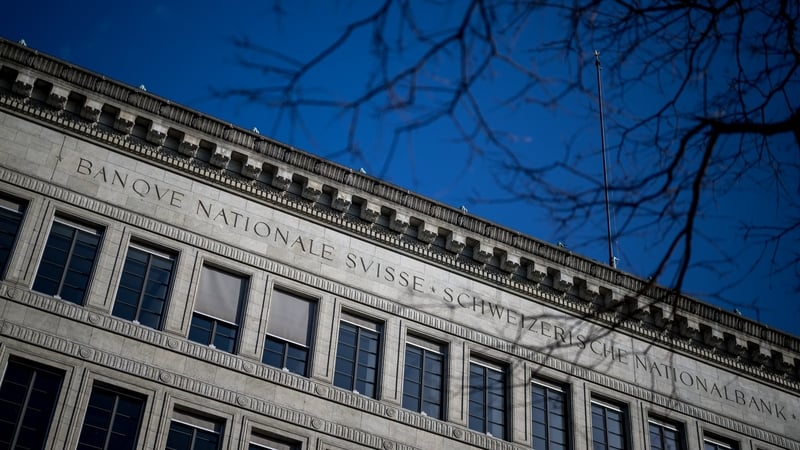
The Swiss National Bank kept its policy rate on hold today in the face of uncertainty over the Iran war, and signalled readiness to intervene to curb a recent surge in the Swiss franc fuelled by a flight to safety amid the global turmoil.
The SNB maintained its benchmark interest rate at 0%, the lowest among major central banks, as expected by a wide majority of analysts polled by Reuters.
The decision came on a busy day for central banks, after the US Federal Reserve last night kept rates unchanged, highlighting unusually high uncertainty as policymakers take stock of the impact of the US and Israeli war with Iran.
"Given the conflict in the Middle East, the SNB's willingness to intervene in the foreign exchange market has increased," the central bank said in a statement.
"The SNB thereby counters a rapid and excessive appreciation of the Swiss franc, which would jeopardise price stability in Switzerland," it said.
Sweden's central bank also held rates today as did the Bank of England. The ECB is also expected to do the same later in the day.
The franc has remained near 11-year highs against the euro in recent days, as inflows intensified by the US-Israeli strikes on Iran pushed up the currency, which acts as a safe haven in times of global turbulence.
The franc gained 14% against the dollar in 2025 and continued to rise this year, while it is up nearly 2.5% against the euro so far in 2026.
The SNB earlier this month responded with a rare verbal intervention, saying its willingness to intervene in the foreign currency markets had increased.
Marked appreciation in the franc makes imports cheaper, threatening to push inflation below the SNB's target range of 0 to 2%, while also making Swiss exports less competitive.
Swiss annual inflation was just 0.1% in February and January, but SNB Chairman Martin Schlegel has said even a short period of negative inflation would not be a matter of concern.
At the same time, such low readings give the SNB some leeway to hold off on hiking rates to counter price pressures from surging energy costs, especially given that petroleum products have a low weighting in Switzerland's consumer price basket.
"It wasn't a surprise the SNB didn't change its interest rate as it is waiting to get more evidence of the impact of the economic shock of the Middle East conflict before deciding what to do," said GianLuigi Mandruzzato, an economist at EFG Bank.
"The SNB will be keenly watching the impact of rising energyprices on inflation as well as the value of the Swiss franc,whose recent appreciation I think they will prefer to tackle with forex interventions," he said.
Read more
ECB keeps rates on hold as Iran war clouds outlook
Bank of England keeps UK interest rates on hold
Swedish central bank leaves policy rate unchanged at 1.75%
