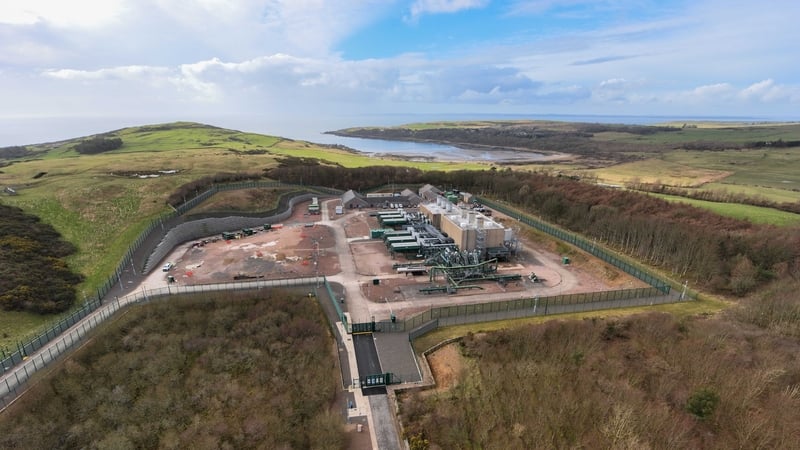
Gas Networks Ireland has announced plans to spend €200m to decarbonise its two compressor stations in Scotland - at Beattock and Brighouse Bay - a development which it says will decrease its greenhouse gas emissions by 42%.
Chief Executive of Gas Networks Ireland David Kelly has said the electric motor drives planned will improve the capacity and the resilience of the infrastructure particularly in volatile energy markets.
Speaking on RTÉ's Morning Ireland, he explained that Ireland gets most of its natural gas from the UK.
"Ireland derives 80% of its gas requirements via the UK, with the remainder being supplied by Corrib and through the production of indigenous biomethane.
"But two-thirds of that gas is used for electricity production. And half of our electricity is coming from it."
He said that the €200m investment reduces Gas Networks Ireland's greenhouse gas emissions by 42%, and it improves the resilience and capacity of the subsea infrastructure.
The system will go live by 2030 assuming consents are granted, he said.
In relation to pricing, he said that Gas Networks Ireland has no part in deciding pricing.
"Our role in terms of the overall pricing regime is minimal, actually. We form a very small part of it, but we are acutely aware of what the supply companies and the retailers, if you like, charge customers and affordability is a massive issue.
Wider European networks
"We're very lucky in some ways in that on this side of Europe, we are reliant on the UK. The UK has strong interconnection across the North Sea, Norway into Central Europe, and we are reliant on the UK today, but the UK is reassured and is reassuring us through our contacts that security of supply is in good place."
However, he said pricing is based on hedging by supply companies.
We need your consent to load this rte-player contentWe use rte-player to manage extra content that can set cookies on your device and collect data about your activity. Please review their details and accept them to load the content.Manage Preferences
"They'll buy early and they'll buy at scale. And then over time the prices, if they continue to rise, that price will be passed on to customers.
"But as to when that happens is typically determined by the companies themselves."
He added that anything that keeps energy affordability down is to be considered.
"Certainly, we work with Government and obviously we're highly regulated, and we play a role in that regime. My sense would be that this is a really important issue for Government.
"They're wide awake to it. And certainly, Minister O'Brien personally chairs an energy affordability task force, and we play a part in that as well.
"So, I'd be inclined to think that this would be something the Government would look favourably upon."
In relation to gas supplies, Mr Kelly said in the medium to long term, if this situation continues, "it is very concerning".
"Overall, I would say where we are in terms of western Europe, the interconnectedness of our state, the relations we have with very diversely set up countries, and I have to call it out, the important role of Norway means that our risks, whilst they're still there, they're less than somewhat compared to other parts of Europe, that's for sure."