


New figures from the Central Bank said the weighted average interest rate on new Irish mortgages at the end of January stood at 3.5%, unchanged from December and down 32 basis points from the same month last year.
Today's figures show that the equivalent euro area average was 3.39%.
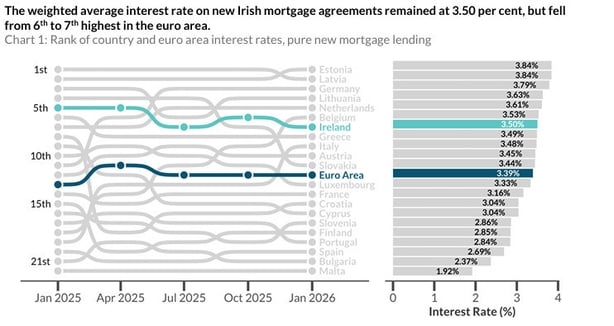
The Central Bank noted that the average rate in Ireland exceeded the euro area average by 11 basis points, the smallest difference since November 2023.
Although the average interest rate on new mortgages in January was unchanged from December at 3.5%, Ireland fell from 6th to 7th highest in the euro area.
Estonia and Latvia had the highest average new mortgage rates in January with rates of 3.84, followed by Germany at 3.79% and Lithuania at 3.63%.
Malta continued to have the lowest rate at 1.92%, followed by Bulgaria at 2.37% and Spain with an average mortgage rate of 2.69%.
The Central Bank said the average interest rate on new fixed rate mortgage agreements, which make up 90% of the volume of new mortgages, was 3.44% in January, unchanged from the previous month and down 16 basis points from January 2025.
Meanwhile, the verage interest rate on new variable rate mortgage agreements stood at 4.09% in January, 8 basis points down from December and 32 basis points lower in annual terms.
It also noted that the total volume of pure new mortgage agreements reached €739m in January, 9% up on the same time the previous year.
Commenting on today's figures, Trevor Grant, chairperson of Irish Mortgage Advisors, said that borrowers need to be mindful that there could be a limit to the extent to which the cost of Irish mortgages will continue to fall into the future, particularly against the backdrop of the current conflict in the Middle East.
Mr Grant said the Middle East conflict could set in train a series of motions which will see mortgage rates rising, rather than falling.
"There are growing concerns about the possible impact of the Middle East conflict on mortgage borrowers. A prolonged war in the Middle East could lead to a substantial spike in euro zone inflation and the European Central Bank could increase its interest rates to combat that, with many mortgage borrowers coming under pressure as a result," he said.
"While oil prices have fallen in recent days, they are still elevated since the crisis erupted and if this continues, many homeowners will likely be faced with the double whammy of higher mortgage repayments and the higher energy and other day-to-day bills," he added.
Trevor Grant also said that while the conflict in the Middle East has increased fears of ECB rate rises in the future, that competition and not the ECB is actually the main influence on home loan rates in Ireland.
He said there is still plenty of competition out there amongst lenders for borrowers to take advantage of, with a number of lenders cutting their mortgage rates since the start of the year.
"Furthermore, with the PTSB sale process now well in train, a takeover of PTSB in the coming months could lead to more intensified competition in the market. A new owner of PTSB might decide to challenge the other banks and this could lead to lower mortgage rates for borrowers," he said.
"It's hard to know how long the Middle East conflict will last but if it drags on and inflation continues to rise, there may well be merit in borrowers fixing their mortgage as doing so will help shield them from potential interest rate rises," he added.
