


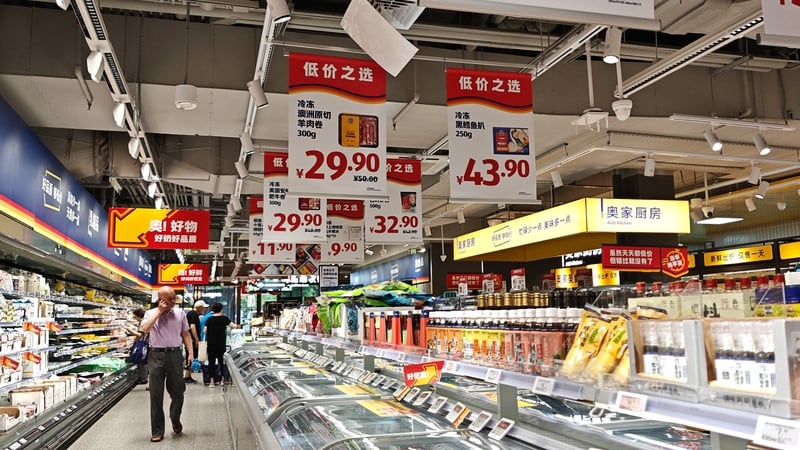
China's consumer prices rose last month at the quickest pace in three years, official data showed today, thanks to the Lunar New Year break and a rally in oil prices and Middle East tensions rose.
Beijing wants to make domestic consumption the main driver of its economic growth and shift away from traditional drivers such as exports and manufacturing.
But results have been muted, with people unwilling to spend as the economy lags.
China's consumer price index, a key measure of inflation, came in at 1.3% in February, according to the National Bureau of Statistics (NBS).
That marked the biggest year-on-year jump since January 2023, when prices rose 2.1%, and topped the 0.9% increase forecast in a Bloomberg survey.
It also marked an acceleration from the 0.2% rise recorded in January and December's 0.8%. But it is still well below the government's 2% target for the year.
Local authorities across China had vowed to encourage domestic spending ahead of the Lunar New Year holiday, which fell in February and typically sees travel and shopping expenditure spike.
The increase was also stoked by rising oil prices as concerns about tensions in the Middle East built up ahead of the US-Israel strikes on Iran on February 28. China is heavily reliant on the region for its oil needs.
But analysts said the pick-up would not be long term.
"Tensions in the Middle East will push inflation higher for as long as global energy prices remain elevated," Zichun Huang of Capital Economics wrote in a note.
But the "easing of oil price deflation and volatility in food and tourism prices over Lunar New Year" are "temporary", she added.
With the government outlook "disappointing in terms of boosting domestic demand, any inflationary pickup will unwind once tensions ease", Huang said.
China's top leaders last week set a goal of 4.5-5% annual economic growth for 2026, the lowest target since 1991 excluding the Covid pandemic, according to AFP research.
Premier Li Qiang told lawmakers at an annual political gathering that China would target around 2% annual inflation this year - in line with its 2025 goal.
While vowing to create more jobs and boost consumption, he acknowledged that the country was facing "quite a few problems and challenges" in economic development.
Meanwhile, prices at the factory gate - stuck in negative territory since October 2022 - fell at a slower rate last month, NBS data showed.
The producer price index showed a drop of 0.9% in February, the slowest pace of deflation since July 2024 and smaller than the 1.4% decline in January.
