
Bankers have long been part of an elite of professions – along with lawyers, politicians and clampers – that the general public has very little sympathy for.
Part of that is likely down to the kind of gatekeeper status they have in society.
To a large extent we have to trust them with our money, and we have to jump through their hoops if we want to get some money to get a car, go to college, do up the house… or even buy one in the first place.
And, of course, they charge you a fair amount for the privilege, even after they say yes.
But the interest and irritation around bankers' pay today is really a hangover of the financial crisis; that’s when bankers really became the villain in Ireland, and when the issue of their pay was catapulted into the limelight.
We know that banks’ reckless and unsustainable practices were a major contributor to Ireland’s crash – which of course led to austerity for everyone else as we were asked to bear the brunt of their mistakes.
And it cost the Irish taxpayer €64 billion in the bailout.
But beyond that it led to years of lost opportunities for the country, a brain drain, stress and grief for individuals and families, a years-long drought in infrastructural and housing investment that the country is still trying to catch up with today.
There was also the Mortgage Tracker scandal that followed, and even complaints to this day that banks are not doing enough to support businesses looking to survive and thrive.
So you can appreciate why, even after 18 years, people might still be a bit irked by the idea of a banker getting a handsome pay out.
What kind of pay-outs did Celtic Tiger bank boss get?
While bankers’ pay largely went under the radar during the heights of the Celtic Tiger years, the entire country quickly became very aware of it as things began to sour. And it turned out that some were earning phenomenal sums of money bankers - even into the downturn and bailout.
And they’re huge sums even by modern standards.
For example Brian Goggin, who had worked at Bank of Ireland for 40 years and became its CEO in 2004, earned almost €4m in 2006.
Even without adjusting for inflation, that would make him one of Ireland’s best-paid executives today.
And while his compensation package did fall slightly as the bank’s performance slipped, it remained high. Even in the 2009 results, which marked his final year as an executive, he was paid more than €3m (almost half of that was a payment in lieu of him seeing out his full term).
Bear in mind, this was after the State had already invested €2 billion into the bank to help prop it up.
Eugene Sheehy was AIB’s boss in the final years of the Celtic Tiger and into the crash – at the peak of his tenure in 2007 he was getting paid more than €2m.
The year he stepped down – again, in 2009, after the State had pumped €2 billion into AIB – he got a pay packet of around €890,000.
The CEO of Irish Life & Permanent – now PTSB – Denis Casey, was getting more than €1m before the crash.
After he resigned in 2009, it emerged that he had gotten a total pay-off worth almost €4.6m.
And then of course you have the likes of Michael Fingleton at Irish Nationwide – he got more than €2m in 2006 alone. Even when it was losing hundreds of millions of euro and on the verge of collapse in 2008, he took a €1m bonus.
Meanwhile Anglo Irish Bank’s David Drumm was paid as much as €3m a year at the height of the Celtic Tiger.
That was 18 years ago - so why is bankers’ pay back in the news now?

This week we had annual results from the three main banks here – Bank of Ireland, AIB and PTSB.
And they showed that, even if the country hasn’t, they’ve fully shaken off the ill effects of the financial crisis.
Between them they had profits of €3.6 billion last year – and their shareholders will be getting around €3.5 billion through dividends and share buybacks. (Most of that figure is coming from AIB and Bank of Ireland - PTSB are still operating at a much smaller scale).
But really the fact that they’re back in profit isn’t news – that’s been the case for a number of years now.
What has changed – and why bankers pay is back in the news - is the fact that they are no longer subject to the bankers’ pay cap.
That was introduced after the bailout, limiting executive pay to €500,000 and essentially banning bonuses, in order to ensure bankers couldn’t start making millions again while the State remained on the hook.
The cap was removed from Bank of Ireland in 2022 – because the State was no longer a shareholder in that bank at that point. Last year, when the Government sold up the last of its stake in AIB, it removed the cap there too.
(It also removed the cap for PTSB at the same time – even though it’s still majority State-owned – in order to ensure an even playing field.)
For the moment the State has retained an effective €20,000 cap on bankers’ bonuses.
Regardless, the lifting of the cap means that – after years of a lid being kept on it - we’re now seeing the pay of many bankers jump.
So at AIB, CEO Colin Hunt’s total package – including benefits and pension contributions - went from €644,000 in 2024, to €793,000 last year.
That’s a 23% increase in a year.
This year Colin Hunt's salary will rise to €1.35m – so that’s a more than doubling in the space of two years.
But it could actually quadruple – because this year AIB has also introduced a new 'Fixed Share Allowance’ which could give Hunt up to €1.35m worth of shares in the bank, depending on the group’s financial performance.
The Fixed Share Allowance scheme is also being used by Bank of Ireland and effectively acts as a work-around to an ongoing cap on bankers’ bonuses. For both banks, executives must hold onto their shares for at least five years before they can sell them on.
For context, regular AIB workers recently agreed to a 3.5% pay rise.
Its 2025 results show personnel costs of €966m which, split across 10,207 staff, would indicate an average worker compensation of more than €94,000.
At PTSB, meanwhile, Eamon Crowley’s total pay package rose to almost €713,000 last year – compared to just under €600,000 in 2024; a near 20% increase.
Last year, PTSB staff agreed to a 4% pay rise. Its results indicate an average of €76,000 was paid to its workers last year.
The Chief Financial Officers at both banks have also enjoyed a pay bump following the lifting of the cap.
Given that Bank of Ireland moved out from under the pay cap back in 2022 its CEO Myles O’Grady didn’t see the same kind of jump last year - but he was still handsomely rewarded.
He was paid around €1.86m last year – with close to €1m of that coming in the form of a salary, and more than €710,000 coming from its own Fixed Share Allowance plan.
Its results indicate the average full time worker earned just under €87,600 last year.
What is the argument for such significant pay packets?
Better pay packets for bankers isn’t a bandwagon many outside of the industry are likely to jump on. That's especially true when many savers feel their are being short-changed by their bank - all while mortgage interest rates sit above the European average.
But from the banks’ point of view, the argument for some time has been that – as enormous as these pay packets may be compared to the average earner – a big company with lots of money on the line has to offer big pay packets in order to attract the people best equipped to manage that.
Because nowadays the three Irish banks aren’t just competing with each other for talent – they’re also competing with the many multinational financial firms which have major operations in Ireland.
According to data from the European Banking Authority, back in 2022 an Irish-based investment banker earned €24m in one year. Two others earned €6-7m, one earned just under €6m. In total 37 people in Irish investment banking earned more than €1m in one year.
Now they are extreme examples – and investment banking is a different beast to retail banking… arguably the personality type that flourishes in investment banking is the exact opposite of what you want in a retail setting.
But it does show you how much money is potentially on offer to some in the sector – and what regular banks have to compete in terms of compensation.
But beyond the local scene, Irish banks also now have to compete with banks across Europe – as well as the fast-growing, so-called neo-banks that might be able to lure people in with rapidly appreciating stock options.
The disadvantage the pay cap put on banks here was arguably most evident in 2015, when AIB’s then CEO David Duffy left the bank to take up a role at Clydesdale and Yorkshire Bank.
It was a considerably smaller bank in terms of assets and even profits at that stage - however it was able to give Duffy a pay packet worth more than £1.3m in his first year there.
But it’s also worth remembering that banks aren’t just competing with financial firms – they’re also competing with all big Irish and international firms. Myles O’Grady, for example, left Bank of Ireland to work at Musgraves before coming back to lead the bank.
And while the focus tends to be on CEO pay, bank bosses argue that it is about pay across their organisation.
The argument goes that, if your CEO is getting €500,000 a year, then the other people in the so-called C-suite - the chief financial officer, the chief operations officer - are going to get a bit less than that. Then the next layer of management is on less again, and so on all the way down the chain to the entry level.
They say that this, along with the €20,000 cap on bonuses, puts them at a disadvantage when trying to attract talent at all levels.
And given how important functions like IT, security and data analytics are to banks today – they say they need to ensure their pay offer can compete even with deep-pocketed multinationals like Google, Meta or Amazon.
How do Irish bankers’ pay rates now compare to those in other countries?
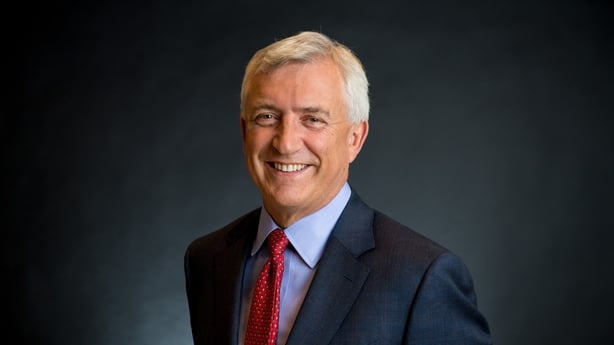
When asked about their boosted salaries this week, both Colin Hunt and Eamon Crowley referred to their respective remuneration committees – and said their rate of pay was based on their recommendation, and the board approval.
In turn, those remuneration committees will say that they base their figures on market rates – in other words they look at what’s being offered by other big firms – other banks, other big Irish companies and so on – and see what kind of rate of pay their bosses tend to get.
In its annual report AIB went to great lengths to explain how it came to that €1.35m figure for its CEO – with lots of graphs showing average bands of pay within Irish firms, those listed on the FTSE in London and European banks.
According to its data, the salary it’s offering its top brass is actually in the ‘median-to-lower quartile’ of what’s on offer from other European banks, and is well below the average when you include potential bonuses.
Digging into the accounts of a few mid-sized banks in Europe suggests that that is the case.
David Duffy, for example, earned around €15m over eight years at Clydesdale Bank (which eventually became Virgin Money). That would be an average of €1.9m a year – and his shareholding in the bank meant his money more than doubled once Nationwide bought the company.
Anas Abuzaakouk is CEO of Austrian Bawag Group – which is one of the players said to be considering a takeover bid for PTSB.
Its revenues are around half that of AIB – and yet his pay packet was much, much bigger than Colin Hunt’s. In 2024, he had a total compensation worth €6.14m.
Although, as somewhat of a counter-point, Denmark’s DanskeBank is more than twice the size of AIB in terms of revenues, much more assets under management, but its CEO’s pay packet was equivalent to €3.3m.
That is not hugely above the potential top-end of what Colin Hunt could earn this year, providing he gets the rewarded with the maximum amount of shares possible.
What about other Irish CEOs?
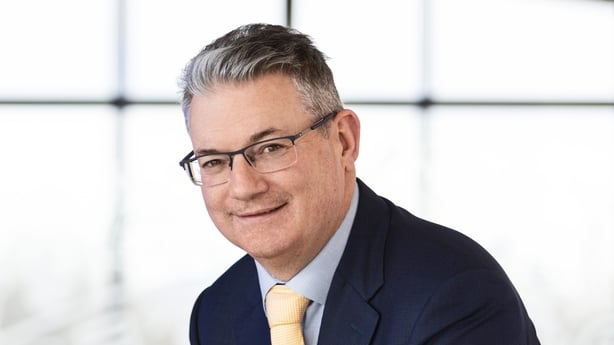
If you cast a relatively broad definition for Irish firms it turns out that, even with their recent increases, bank bosses are far from the best paid CEOs in the country.
Jim Mintern, the CEO of CRH – which is Irish headquartered but is listed in, and makes most of its money in the US, had the potential to earn up to $13m last year, if certain performance targets were hit.
Peter Jackson, the CEO of Flutter Entertainment – better known to us as the parent firm of Paddy Power – he earned the equivalent of €19.5m in 2024.
Closer to home and Edmond Scanlon – the CEO of Kerry Group – had a total package worth more than €6m in 2024.
Glenveagh CEO Stephen Garvey got a total package worth €2.7m in 2024, while Michael Stanley at Cairn Homes had a package worth €2.3m (we don’t have their 2025 pay details just yet).
Meanwhile Ryanair boss Michael O’Leary got €3.8m in its 2025 report – through a mixture of salary, bonuses and shares.
He’s also in line for a €100m bonus, if he stays with the company until 2028.