The domestic economy grew by 4.9% last year which was significantly faster than had been expected, new figures from the Central Statistics Office show today.
The strong performance was partly driven by rising personal spending which was up 2.9%, the CSO said.
There was a very large 12.3% increase in Gross Domestic Product last year - a measure of economic growth which includes the contribution from multinationals.
The figures mean Ireland's economic growth was far above other EU countries which all had GDP growth of less than 4%.
The part of the economy which was dominated by foreign owned companies expanded by a significant 25%.
That was partly driven by a large rise in net exports which were up €22.9 billion as multinationals increased exports ahead of the US increasing tariffs last year.
Modified investment was up 10.9%.
Today's figures show building was up 9.1% with construction of new homes up 19.4%.
Kieran Cullane, statistician with the CSO, said the figures were also driven by increased construction of data centres.
They also reveal that government spending was up 4.1%.
The figures are preliminary and will be updated later this year.
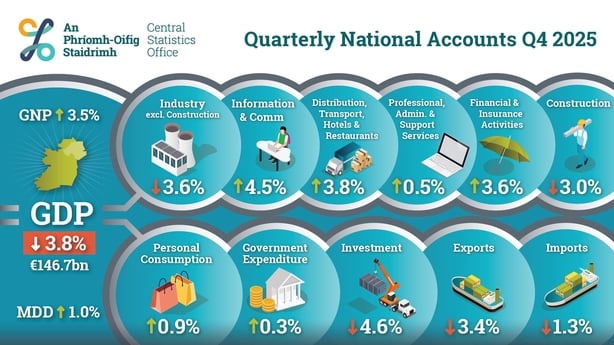
The CSO's figures for the last three months of last year show GDP fell 3.8% and the domestic economy expanded by 1%. The quarterly figures are frequently more volatile than annual figures.
Tánaiste and Minister for Finance Simon Harris said today's CSO figures confirm that, despite external headwinds, the domestic economy grew strongly last year.
"While the headline figures may somewhat overstate the economy's underlying growth, I am encouraged that consumer spending grew by a solid 3% last year," Mr Harris said.
"This reflects rising real incomes and the strength of our labour market, with a record 2.83 million people in employment at the end of 2025," he noted.
He also said that encouragingly, building and construction investment recorded robust growth, up 9% last year reflecting the solid momentum in the residential sector.
"While today's figures are positive and reflect the resilience of the Irish economy, we cannot become complacent. Indeed, recent developments clearly illustrate that uncertainty is likely to be a feature of the economic landscape for some time," he cautioned.
"The conflict in the Middle East is potentially a significant headwind to global growth and risk to the inflation outlook. The impact on commodity prices will, of course, hinge on the duration and extent of the disruption in supply," he said.
He added that the Department of Finance continues to monitor international developments closely.