


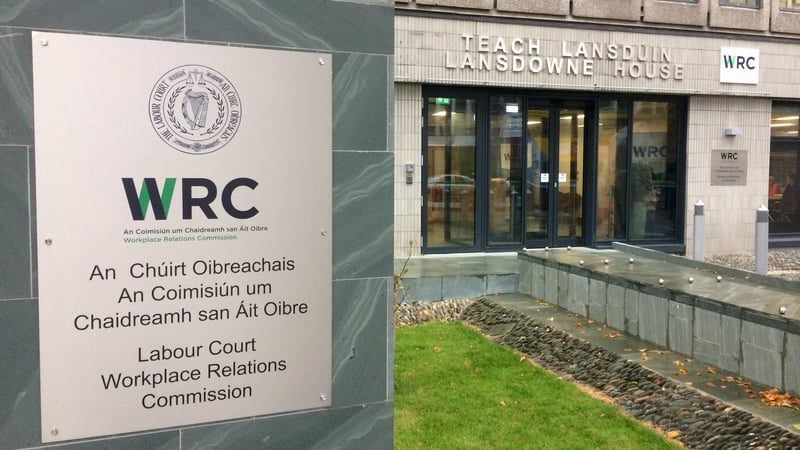
A Workplace Relations Commission adjudicator has launched his own WRC case against the State, alleging he suffered gender-related discrimination when he failed to get an interview for a role where all three advertised positions were filled by women.
Lawyers for the adjudicator also submitted that comments were relayed to their client that the attitude of the director-general of the WRC towards him and a colleague was negative and that they would not be given any further interviews.
The State has argued that the case can be summed up as "sour grapes".
The claim was aired as the tribunal launched hearings yesterday into a series of complaints by the adjudication officer, Séamus Clinton, under the Employment Equality Act 1998, the Protection of Employees (Provision of Information and Consultation) Act 2006, and the Protected Disclosures Act 2014 against the Department of Enterprise, Tourism and Employment.
He alleges he suffered discrimination on the basis of his gender when he was not shortlisted for interview for a competition to fill three posts for regional managers overseeing the WRC's conciliation and mediation services (CAMS) in October 2024.
Mr Clinton's complaints are that he suffered and continues to suffer detriment at work, and that this is linked to acting as a staff representative, for reporting a relevant wrongdoing, and as penalisation for raising a discrimination complaint. His claims are denied by the State.
The tribunal heard Mr Clinton was one of ten applicants - five men and five women - to apply for the three senior posts in CAMS.
Only one man was shortlisted - with neither Mr Clinton nor his colleague, Andrew Heavey, invited for interview - and ultimately three women were appointed, according to data obtained by Mr Clinton on foot of a request for data under workplace equality law.
Giving evidence, Mr Clinton said he was well qualified for the post and was "completely flummoxed" to learn in November 2024 he would not be getting an interview in view of his background in the trade union sector and as a WRC adjudicator.
"You could knock me over with a feather. I couldn't believe I wouldn’t get an interview for a role that in my mind I had been previously operating at," he said.
In a legal submission, his counsel Michael Kinsley BL, appearing instructed by Áine Curran of O’Meara Geraghty McCourt, said there were "changes made in the course of the competition" which "had the effect of advantaging female applicants who were already employed in the conciliation and mediation service".
He proceeded to complain about this under the relevant statutory provisions for challenging the fairness of a civil service recruitment process, the tribunal heard.
Mr Clinton's evidence was that he received a phone call from another WRC adjudication officer and fellow civil servant, Andrew Heavey, recounting that he had been told by another official that she had overheard WRC director-general Audrey Cahill speaking about him and Mr Clinton.
Mr Kinsley submitted that the comment relayed to his client was that "the attitude of the director, Ms Cahill, towards him and Mr Heavey is negative and they won't be given any further interviews".
"Mr Heavey will give evidence he had a conversation with Ms Cahill in which he asked her about this, and it wasn't denied," he added.
"The communications in relation to the director-general; obviously if that comes into being, and I'm restricted from competitions or there's an animus against me, that's something that might lead to a career change," he later added.
Stephen Hanaphy BL, for the State, said in a submission: "This case can be summed up in two words: sour grapes."
"The suggestion the complainant was discriminated against is nonsense and that’ll be proven to be such. Just because no males were appointed to the position here is not proof of discrimination," counsel said.
At the opening of the proceedings today, he said he would be seeking a witness summons for the other official who had recounted Ms Cahill's alleged remark to Mr Heavey. Adjudication officer Brian Dalton said he would grant this when he got the details in writing from Mr Clinton's legal team.
Mr Kinsley said that starting in 2023, Mr Clinton and Mr Heavey were both involved in an application seeking that WRC adjudication officers employed directly by the civil service be re-graded from the ordinary assistant principal officer payscale to the higher assistant principal officer grade.
Mr Clinton and Mr Heavey were subject to a "marked hostility from the Department and from management" arising from the re-grading application, Mr Kinsley said. Mr Clinton's case is that he was penalised for acting as an employee representative during this process. The State disputes that he meets the definition of an employee representative.
Mr Clinton set out his career path from working at a local authority to taking up work for the public sector trade union IMPACT - now Fórsa. He climbed the ranks to assistant general secretary at the union and had a salary of €90,000 before joining the WRC, where he earns over €70,000, he said.
While he had asked when he joined the civil service to be placed on a higher point on the assistant principal pay scale, he had accepted the base rate.
He also said there had been a later undertaking on the part of the Department to review his pay that was "reneged upon" in what he called "ongoing victimisation or penalisation".
Mr Kinsley said when Mr Clinton made submissions on his complaints last December, they included individualised data setting out "the success rate[s] of various mediators" working for the WRC, including for himself, in terms of the female applicants for the regional manager posts, and the male candidates who were not selected.
Mr Clinton's evidence was that the head of CAMS accused him of a "data breach" by submitting what was perceived to be "personal information", and terminated his access to an internal WRC mediation case management system for a time.
"I haven't done a mediation since," he said - adding later that this could be the subject of a further complaint.
"The reason I’m looking back on my whole civil service career is because effectively everything that's happened may mean I've no opportunity of being promoted again, for some reason, whether for pursuing the claim or making complaints about the recruitment process, that I’m seen as a troublemaker, or that I’m not entitled to raise these issues - and I have no future within the civil service," Mr Clinton said.
The case has been adjourned until March 6, when Mr Clinton is to be cross-examined, and Mr Heavey is expected to give his evidence.
