
The US has today imposed a new tariff of 10% on all goods not covered by exemptions, the US Customs and Border Protection said, the rate first announced by President Donald Trump on Friday rather than the 15% he promised a day later.
Reacting to the US Supreme Court ruling that threw out tariffs it deemed were illegally justified on grounds of an emergency, Trump initially announced a new temporary global tariff of 10%.
He said on Saturday he would increase it to 15%.
But in a notice described as intended to "provide guidance regarding the February 20, 2026 Presidential Proclamation," CBP said that, aside from products covered by exemptions, imports would "be subject to an additional ad valorem rate of 10%."
The move added to confusion surrounding US trade policy, with no explanation offered in the notice for why the lower rate had been used.
The Irish Exporters Association said the new 10% US tariff is expected to be in addition to existing duties which were in place prior to Donald Trump's second term.
The Government is still awaiting clarity on the new tariffs following the decision by the US Supreme Court last week to strike down President Trump's executive orders.
Officials in Ireland are seeking confirmation regarding whether the new 10% rate would be in addition to duties under "Most Favoured Nation" arrangements under the World Trade Organisation rules.
These duties vary from one sector to another.
Speaking on RTÉ’s Morning Ireland, Simon McKeever, CEO of the Irish Exporters Association, said the new 10% tariff is likely to be "layered", meaning it is added on top of other existing tariffs on certain sectors.
Despite the uncertainty, Mr McKeever said that Irish exporters are not putting their business on hold.
However, unlike firms in the US, he added, Irish companies are unlikely to receive refunds for US tariffs now deemed illegal by the Supreme Court.
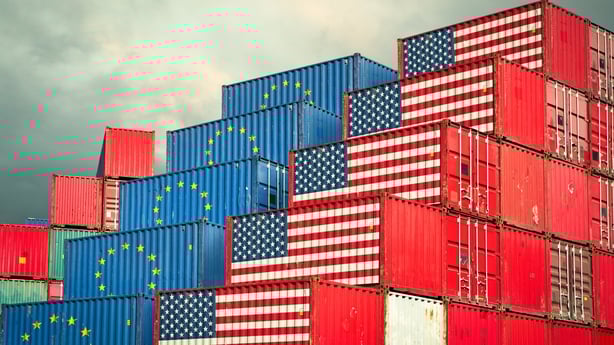
EU officials are also seeking clarity of the status of the bloc’s trade deal with the US.
Observers question whether the agreement would be undermined by Friday’s Supreme Court decision in the absence of Congressional approval.
Under the terms of the trade deal between the EU and the US aircraft, certain chemicals and semiconductors were excluded from the blanket tariffs. The pharma industry also avoided levies.
The Financial Times quoted a White House official as saying the increase up to 15% would come later. Reuters could not immediately confirm this.
"Remember that Trump is delivering the State of the Union address tonight, so it's possible we might get a better sense of the next steps on tariffs," Deutsche Bank said in a note.
"Net-net we still think the effective tariff rate will fall this year and that the world post-SCOTUS will see lower tariffs than the pre-SCOTUS world," its analysts said, using the acronym for the Supreme Court of the US.
Despite the fact that a 10% tariff is less punitive than had been expected, traders cited uncertainty about the trade outlook as one reason why European shares opened lower today.
The new tariffs took effect at midnight, while collection of the tariffs annulled by the Supreme Court was halted. They had ranged from 10% to as much as 50%.
It remains unclear whether and how companies will be refunded for tariff payments made under the regime annulled by the Supreme Court.
The Section 122 law allows the president to impose the new duties for up to 150 days to address "large and serious" balance-of-payments deficits and "fundamental international payments problems."
Trump's tariff order argued that a serious balance-of-payments deficit existed in the form of a $1.2 trillion annual US goods trade deficit, a current account deficit of 4% of GDP and a reversal of the US primary income surplus.
Trump warns against reneging on trade deals
Trump warned countries yesterday against backing away from any previously negotiated trade deals with the US, warning he would hit them with much higher duties under different laws.
Japan said it had asked the US to ensure its treatment under a new tariff regime would be as favourable as in an existing agreement. The European Union, Britain and Taiwan all indicated a preference to stick to their deals too.
Carsten Brzeski, global head of macro at ING, noted that even with the 150-day limit of the current set of measures, the trade uncertainty was unlikely to go away soon.
"Because the next thing that he (Trump) could do is always, with the interruption of one day, theoretically endlessly extend by 150 days," he said.
China meanwhile urged Washington to abandon its "unilateral tariffs", indicating it was willing to hold another round of trade talks with the world's largest economy, the country's commerce ministry said in a statement today.