
A new State-backed savings scheme is on the way for those fortunate enough to have money to invest, amid warnings it must not be a tax break that's primarily useful to the wealthy.
The project would be different from the SSIA accounts which ran until 2002, when deposits were topped up with a 25% giveaway from the State.
Instead, the new initiative is more likely to offer savers a range of funds invested in the stock market, which will deliver limited tax-free returns.
Minister for Finance Simon Harris told RTÉ's This Week that he will introduce the scheme, but the specifics are still to be worked out.
Ireland is lagging behind many other European countries which already have state-backed accounts to encourage investment.
Here, thousands of consumers have their savings in bank accounts that achieve lower returns than money invested in the stock market.
In fact, Irish banks make enormous profits from offering low rates to Irish depositors.
One calculation suggests they paid just 0.25% interest on their entire stock of deposits in the first six months of this year, far below inflation, which is now at 2.7%. So, the value of savings is being eroded.
If Ireland follows other European countries, consumers could put money into a variety of funds with different risk profiles.
At present, Irish investors are taxed at 33% on any gain on shares and 38% on many funds.
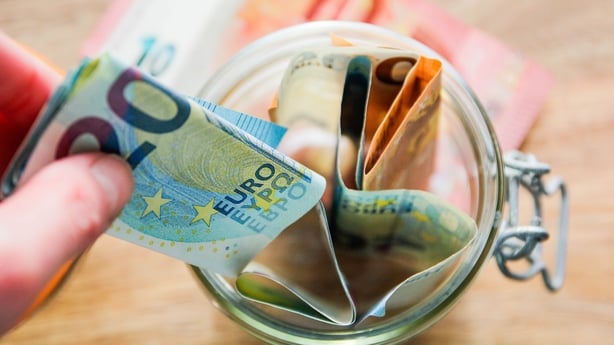
It is likely the Department of Finance would consider giving tax-free returns up to a certain point and gains beyond that would be subject to a new levy.
Michael Healy, managing director of financial group IG in the UK and Ireland, which handles 900,000 of these investment accounts in Britain, says any scheme "needs to be accessible for a broad range of people but not a tax break for the ultra-rich."
Usually, there is a cap on how much can be invested. In the UK it is limited to £20,000 per annum.
He adds these schemes "reduce dependence on the State pension. It is a win-win for government and consumers."
Similar schemes are operating or under way in Poland, Sweden, France, Japan and Canada.
Ireland is beginning to move in tandem with the EU in introducing a pan-European financial market to mobilise investments across the bloc, called the Savings and Investment Union.
"Participation rates in other markets are high. In Sweden it was introduced in 2012 and 30% of the country's GDP is in these accounts now," Mr Healy said.
Introducing such a scheme is advocated by the banks, which is unsurprising as they are likely to make money from it.
The Government will need to design the project carefully to ensure the fees charged by financial institutions are transparent and do not eat into investors' returns excessively.
Another pitfall for the Coalition is that it needs to be cautious about encouraging people to invest in stock markets.
In 1999 thousands of investors were badly burned when they poured money into the State's privatisation of Eircom, now called eir.
Its shares briefly rose before falling dramatically following a stock-market flotation wiping out the savings of thousands.
The adage of not putting all your eggs in one basket is important when investing.
Most funds are likely to be across a broad range of companies, in different regions such as the US, EU and Asia, and in different sectors such as tech, pharma and manufacturing.
This generally helps to ensure investors are insulated against the vagaries of the markets but only if they keep the money there for a period of years, so it won’t be a 'get-rich-quick' scheme.
It is possible the Department of Finance could offer a cash deposit option too, as happens in the UK.
But the plan to introduce such a new investment scheme has critics.
Savers will be people who already have some money, and the Government intends to give them a tax break.
Trinity College Dublin economist Dr Barra Roantree said: "Courting household deposits with tax breaks is therefore inevitably going to amount to tax cuts for the highest-income households who hold lots of deposits, not the 'squeezed middle' who - however torturously defined - don’t have a whole lot of deposits crying out to be invested."
He argued the scheme "will do little to increase savings and investment, but instead just benefit existing higher-income savers along with their accountants and banks."
Another consideration is that there will be some tax foregone by the State at a time when there are concerns about Ireland being over-reliant on money paid by multinationals.
But Minister Harris's position is that the project would solve the problem "of hard-working people doing the right thing - and that is saving - but not being rewarded for it."
The initiative will be a key priority over the "next two budgets," he says.
During the 2024 General Election, Fine Gael suggested a savings account for children and it is possible a later version of the scheme could be targeted at under-18s.
Meanwhile, the first accounts availing of the new scheme could be opened in 2027.