


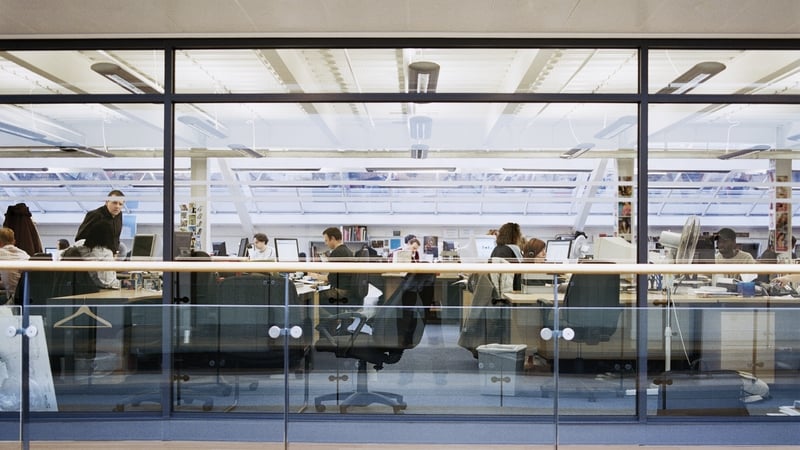
The number of employees who are working from the office is at its highest level since before the Covid-19 pandemic amid a further drop in the number of people working from home.
The number of people working from home dropped by 15,900 last year, the equivalent of 1.6% of the workforce. The total now stands at 956,700.
The figure for those who never work from home rose by 74,200 people, to 1,865,600.
However, an associate professor at the University of Limerick's (UL) business school has said employees who feel they can work effectively at home "should have a right to do so".
Professor Sarah Kieran, who works in UL’s Department of Work and Employment Studies in the Kemmy Business School, described a discussion around increased rights for those who work from home as a really important conversation.
Speaking on RTÉ’s News At One, Dr Kieran said: "I think it is moving in the right direction. It is very nuanced though."
The Labour Party has proposed legislation to give more rights to employees with regards to working from home as part of its Work Life Balance (Right to Remote Work) Bill 2026.
However, the Government confirmed in the Dáil that it will oppose the bill.
We need your consent to load this rte-player contentWe use rte-player to manage extra content that can set cookies on your device and collect data about your activity. Please review their details and accept them to load the content.Manage Preferences
Dr Kieran said stakeholders like the Labour Party, trade unions and advocacy groups "play a really critical role in moving the conversation along".
She described Labour Enterprise Spokesperson George Lawlor’s comment that "this Government continues to cling to a model of work that no longer reflects reality" as "very true".
She said the model of work in the last 50 years "does no longer reflect reality".
"But I might change the word clinging to grappling," she said, adding that there are many factors that should be taken into account.
"There are a lot of economic and social factors that are very real for employees in relation to commute times, commute costs, affordable housing that is pushing people out of our cities," she said.
However, Dr Kieran said if everybody worked from home, "the economic livelihood of our cities" would be "decimated".
"It is trying to find the balance between the two," she added.
Dr Kieran said employees themselves doing the job knows this balance best.
"You are not going to get a nurse fighting for remote working but likely, if you have an employee that feels highly effective working from home, then they should have a right to do so," she said.
She said she is not an expert on legislation but added that the "sentiment" of Labour’s bill is "absolutely right".
"Because a right to request doesn’t really mean anything at the end of the day," she said.
She added that figures from the Workplace Relations Commission relating to work from home cases "is certainly indicating that it is not adding any value to the conversation".
"But pushing organisations towards grappling with this issue is a good thing to do," Dr Kieran, adding that in her line of work, she sees senior leaderships figures in the business world "grappling with how to manage this".
"But it definitely needs to move in the direction that the Labour Party are proposing," she added.
