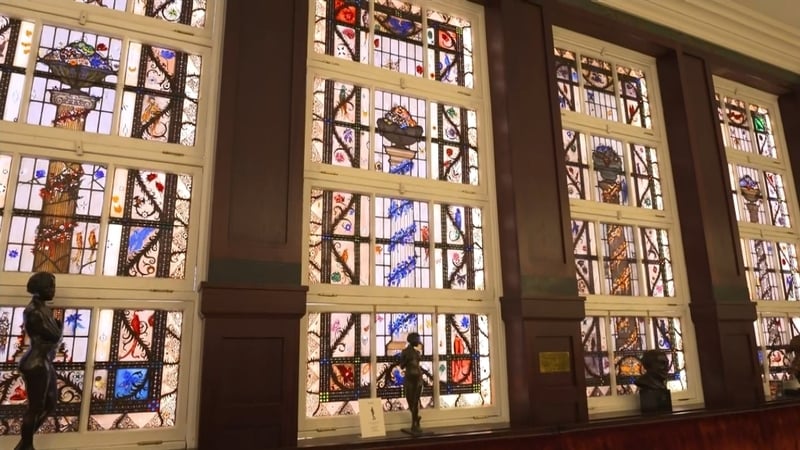

The Supreme Court has ruled that the six Harry Clarke stained-glass windows in Bewley's Café on Grafton Street in Dublin are the property of the building's owner.
The six works by the renowned illustrator and stained glass artist, are estimated to be worth €1 million and have been at the centre of an ownership dispute between developer Johnny Ronan's company RGRE Grafton Limited, which owns the building, and the tenants, Bewley's Café.
The Ronan Group had argued the six windows were part and parcel of the premises. Bewley's had argued they were not windows but moveable artworks and not part of the structure of the premises.
The dispute centred around four panels called 'The Four Orders' and two separate panels called 'Swan Yard'.
The Court of Appeal ruled in 2024 that the works were "windows as a matter of law".
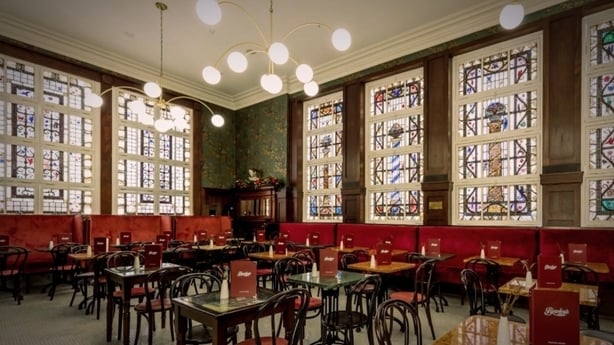
The Supreme Court today dismissed Bewley's appeal and upheld the Appeal Court’s decision.
In a statement, Bewley's Café said it was disappointed with the judgment. It said their wish to transfer the Harry Clarke artworks into public ownership through a donation to a suitable institution could no longer be fulfilled.
The Ronan Group said it welcomed the ruling.
It said the court had agreed with the company's long held belief that the iconic windows were an integral part of the fabric of the building and "not some arbitrary fixture that a tenant can remove at a whim".
It said the ruling had brought to an end what it described as the "lengthy and sometimes farcical series of legal efforts" to establish that the windows existed as separate entities to the building for which they had been commissioned.
The group's chief Executive, Rory Williams, said they should never have been forced to go as far as the Supreme Court to recover what he said was "self evidently" their property.
He said they were happy to move forward in their relationship with Bewley’s Café, knowing visitors would continue to enjoy the "magnificent works of art" in their proper setting in perpetuity.
Harry Clarke, who died in 1931, is widely regarded as Ireland's greatest stained glass artist. His windows can be seen in churches across the country and further afield. But the most frequently viewed windows are those he made for Bewley's Café.
They were commissioned by Ernest Bewley in 1927 for his new "Oriental café". Ernest Bewley owned the site but the café was to be operated by a company called "Bewley's Oriental Café Limited". The cost was £460 for all six and they were installed in 1928.
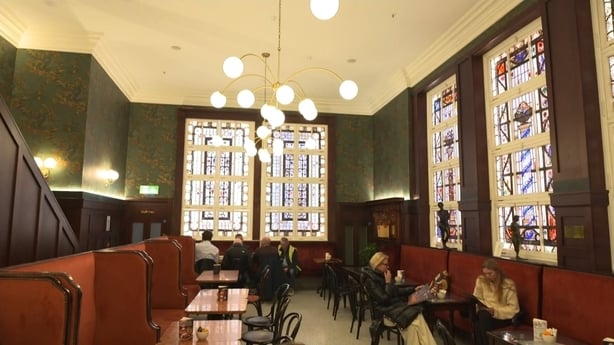
The central issue in what were described as "hard fought proceedings" was whether the windows were "part and parcel" of the structure of the premises or whether they were ornamental fixures belonging to the tenant and installed purely to create a particular aesthetic.
Senior Counsel, Bernard Dunleavy for the Ronan Group, told the High Court in 2022, that it reminded him of the Christmas cracker joke of "when is a window not a window: when it's ajar".
In this case he said it was a question of "when is a window, not a window: when it’s an objet d'art".
Also at issue was whether or not Bewley’s Café had actually paid for the windows at the time.
The High Court ruled the four "Four Orders" windows were part of the structure of the premises and belonged to the Ronan Group.
But it ruled the two panels called the "Swan Yard" were ornamental and belonged to Bewley's.
The High Court based this decision on a finding that there was "double fenestration" - that there were clear glass windows installed behind the ornamental Swan Yard panels - which were not meant to function as windows.
This was rejected by the Appeal Court which ruled in a majority decision that all six were windows and belonged to the landlord.
We need your consent to load this rte-player contentWe use rte-player to manage extra content that can set cookies on your device and collect data about your activity. Please review their details and accept them to load the content.Manage Preferences
That decision has been upheld by the Supreme Court which also found there was insufficient evidence from 1927 and 1928 records to show that the tenant - Bewley's Oriental Café - actually paid for the windows, as opposed to Ernest Bewley personally.
Giving the Supreme Court's decision, Mr Justice Maurice Collins said the Harry Clarke pieces were capable of performing all the functions of windows - including lighting and ventilation.
He pointed out that ventilation was a significant issue for the café in the late 1920s as it was heated by two open fires, patrons were allowed to smoke and there was a boiler in operation in the room.
He said the design of the windows was in keeping with Ernest Bewley’s vision of an "oriental café" but he said their purpose was not solely ornamental and they had multiple panels which could be opened for ventilation.
He said they were specially commissioned and designed to be an essential part of the fabric of the premises, embodying Ernest Bewley's vision.
The judge said Bewley's had failed to prove that it paid for the windows at the time and this was also fatal to any claim of ownership.