


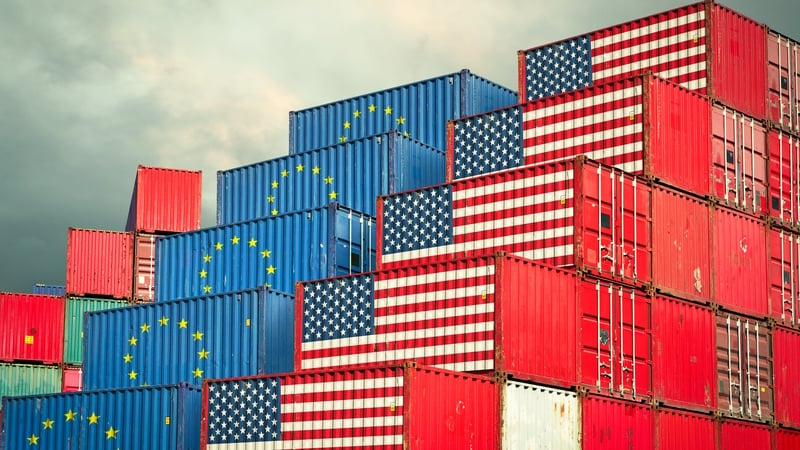
The EU's trade surplus kept shrinking, data showed today, as tariffs weighed on exports to the US and rising Chinese imports crowded out domestic production, highlighting existential threats to the bloc's economic model.
Shifting trade and political relations with the world's biggest powers have been squeezing Europe for years, and leaders met yet again yesterday to brainstorm about ways to survive aggressive economic rivalry from the US and China.
The European Union's trade surplus fell to €12.9 billion in December from €13.9 billion a year earlier as machinery and vehicle sales, the engine of export growth for years, kept falling, and chemicals sales were also down.
Exports to the US, the bloc's biggest export market, fell by 12.6% from a year earlier, pushing down the surplus by a third to €9.3 billion, while the bloc's trade deficit with China rose to €26.8 billion from €24.5 billion.
Exports have been volatile since the US announced a raft of tariffs in early 2025 but, smoothed for this volatility, the trend shows significantly lower sales as higher prices force US importers to either cut purchases or source their products from elsewhere.
Economists say it will take years for Europe to regain this lost market, leaving a large gap in the economy as net exports have been the key plank in growth and the euro zone is now facing years of expansion barely above 1% per year.
Still, the domestic economy appears to be resilient to the trade shock for now as AI-related investments and domestic consumption are kicking into higher gear, keeping GDP growth at a modest but still respectable rate.
In the final quarter of 2025, the euro zone grew by 0.3%, in line with a preliminary estimate, Eurostat said in a separate release.
In another hopeful sign, employment in the euro zone rose by 0.2% over the previous quarter, holding steady from three months earlier.
Some optimism is also fuelled by rising domestic spending, particularly in Germany, where the government is boosting investment into defence and infrastructure, two long-neglected areas.
This spending is slow to pick up pace but should already lift second quarter figures and be at full speed by the end of the year.
The bloc's external economic challenges could also kick start long-stalled reform efforts at home and the European Central Bank estimates that breaking down external barriers could offset trade lost to US tariffs.
