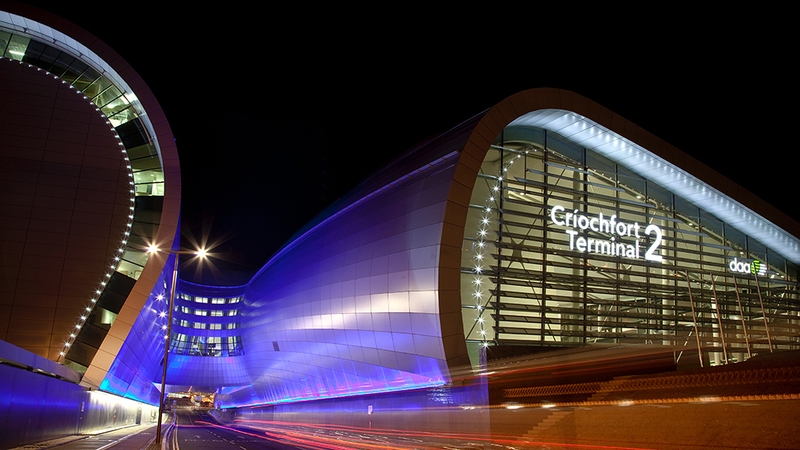

The 32 million passenger cap at Dublin Airport "may be taken into account" when allocating take-off and landing slots, according to an Advocate General of the European Court of Justice.
It comes after draft legislation to remove the contentious restriction was approved by the Cabinet earlier this week.
The new law, when enacted, will empower the Minister for Transport Darragh O'Brien to make an order to revoke or amend the existing cap and to preclude any future passenger cap from being introduced.
The initial Opinion from the ECJ refers to judicial review proceedings taken by a number of airlines, including Ryanair and US lobby group Airlines for America, and Dublin Airport operator daa over the use of aircraft slot limits at the airport.
The legal action was taken challenging the Irish Aviation Authority's imposition of passenger capacity limits at the airport, based on a 2007 planning permission condition as part of the construction of Terminal 2 that restricted annual passenger numbers to 32 million, due to concerns over congestion on access roads.
The restriction was suspended after the High Court referred legal questions raised in the case in December 2024 to the Court of Justice of the European Union for determination.
Manuel Campos Sánchez-Bordona, the advocate general dealing with the case in Europe, said it is his view that "an annual passenger limit imposed by a planning authority may be taken into account when allocating slots at an airport with capacity problems".
He said the technical, operational or environmental factors affecting airport capacity "are not only physical or material factors, as the air carriers suggest, but also the legal constraints imposed by the rules which, directly or indirectly, affect the use of the airport".
In his Opinion delivered in Luxembourg this morning, he said in his view, "compliance with the limit of 32 million passengers a year can be classified as one of the operating constraints".
"The fact that the constraint in question comes from a State planning authority does not mean that it ceases to be an operational constraint. What is decisive is that it restricts airport 'operational capacity'," he added.

"It is therefore a relevant factor for the objective analysis of the possibilities of accommodating the air traffic," Mr Campos Sánchez-Bordona said.
Secondly, the Advocate General said he considers that the historical slots "are not property rights, but authorisation to use airport infrastructure, and that they cannot be granted in disregard of the airport's capacity as defined in the coordination parameters".
He is also of the view that the elimination or reduction of those slots in order to comply with the capacity of the airport does not compromise the freedom to conduct a business.
In relation to a question on the power of the airport managing body to order closure of the airport to comply with the limit of 32 million passengers a year, Mr Campos Sánchez-Bordona said he is of view that the question is inadmissible.
He said the closure of the airport to comply with a requirement known well in advance "would be an excessively drastic and detrimental measure not provided for in the regulation".
An Advocate General's legal opinion is not binding, but it is often reflected in the court's final judgement on a case.
The ECJ said it is the role of the Advocate General to "propose to the Court, in complete independence, a legal solution to the cases for which they are responsible".
The judges are now beginning their deliberations in the case, with a ruling expected in the coming months.
Aer Lingus, Ryanair 'strongly disagree' with Advocate General Opinion
Aer Lingus said it "strongly disagrees" with the Advocate General's Opinion that the IAA was entitled to take account of the passenger cap when determining capacity at Dublin Airport.
The airline said regardless of the ultimate outcome of these legal proceedings, "it is incumbent on the Government to now immediately accelerate the enactment and commencement of the legislation which will enable the Minister for Transport to remove the passenger cap and provide the certainty that is required for the Irish economy".
Ryanair said it "fundamentally disagrees" with the Advocate General’s Opinion.
The airline said the view of the AG "creates an appalling vista that air traffic at an airport can now be regulated or constrained because of road infrastructure outside the airport", which is describes as "absurd".
"The road infrastructure around Dublin Airport has been transformed since 2007, yet the stupid 32 million cap still remains because of Government inaction."
The Ryanair Group Chief Executive has renewed his call on the Taoiseach Micheál Martin to "pass this urgent legislation before he visits the White House on St Patrick’s Day".
Michael O’Leary said Ireland cannot wait until the end of the year for the legislation to be passed, because he said today’s Advocate General’s Opinion "may enable the IAA to reimpose this 32 million cap".
He claimed such a move "would not just stop Dublin Airport growing but would require the existing airlines to reduce traffic by up to 6 million passengers annually".
The operator of Dublin Airport said it "notes" today’s opinion by the AG.
A spokesperson for daa said it "hopes the final ECJU decision will bring much-needed clarity to the various regulatory regimes impacting aviation in our island nation".
The commercial semi-state company said the "decisive action by the Irish government this week to progress legislation to remove the cap once and for all, together with daa’s €2 billion infrastructure plan to future-proof Dublin Airport’s capacity and facilities, are vital steps in ensuring Ireland’s connectivity, jobs and economic success".