


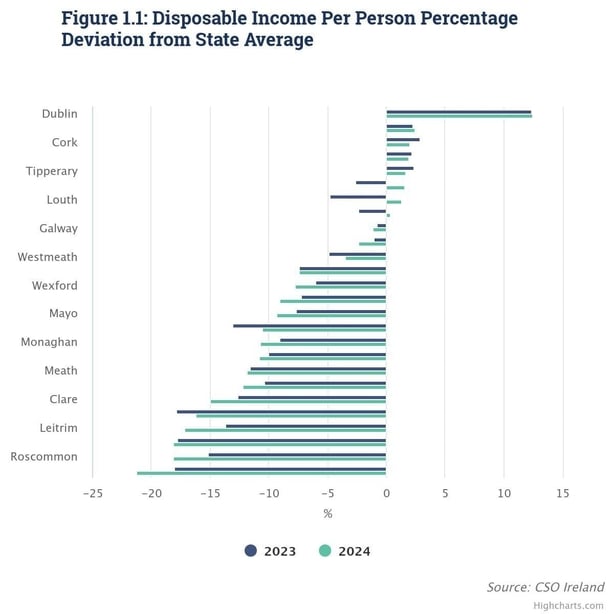
New figures from the Central Statistics Office show that disposable income in Dublin City and County remained the largest nationally in 2024.
Disposable income in Dublin accounted for €52 billion of the State total, which was up 9.9% from 2023, the CSO said.
According to the CSO, disposable income is the amount of money left for an individual to spend after receiving social benefits and paying tax and social charges.
The CSO said the Midland region (Laois, Longford, Offaly, and Westmeath) continued to have the lowest levels of disposable income in 2024. The income of this region accounted for €8.8 billion overall and was 14.5% below the national average per person.
Today's figures show that Dublin's disposable income per person stood at €33,889 in 2024, which was 12% higher than the national average of €30,139.
The next county with the highest disposable income per person was Limerick at €30,879 per person, followed by Cork at €30,748.
Longford recorded the lowest disposable income per person in the State in 2024 at €23,725, which was 21% below the national average.
The county with the second lowest disposable income per person was Roscommon at €24,685, followed by Donegal at €24,686.
Meanwhile, Dublin City and County also recorded the highest Gross Domestic Product (GDP) per person in Ireland at €182,305, followed by the South-West region at €162,983 and Kildare at €81,859.
The Information & Communication sector was the largest contributor towards GDP in Dublin, while Manufacturing contributed most towards GDP in the South-West and Kildare.
The lowest GDP per person in the State was recorded in Longford at €28,689, followed by the Border region at €32,617 and Laois at €32,717 where the public sector remained the strongest contributor towards GDP.
