


Australia's central bank was forced to reverse course and raise interest rates today as it struggles to bring inflation under control in a supply-constrained economy, leaving markets wagering further hikes would be needed this year.
The Reserve Bank of Australia now joins the Bank of Japan as the only other developed-world central bank tightening policy at the moment.
Markets are still priced for rate cuts in the US, UK and Canada, while the European Central Bank is widely expected to be on an extended pause.
Wrapping up the February policy meeting, the RBA raised interest rates by 25 basis points to 3.85% in a unanimous decision, delivering the first hike in two years and coming just six months after its last cut in August.
The central bank added it was uncertain whether financial conditions were restrictive.
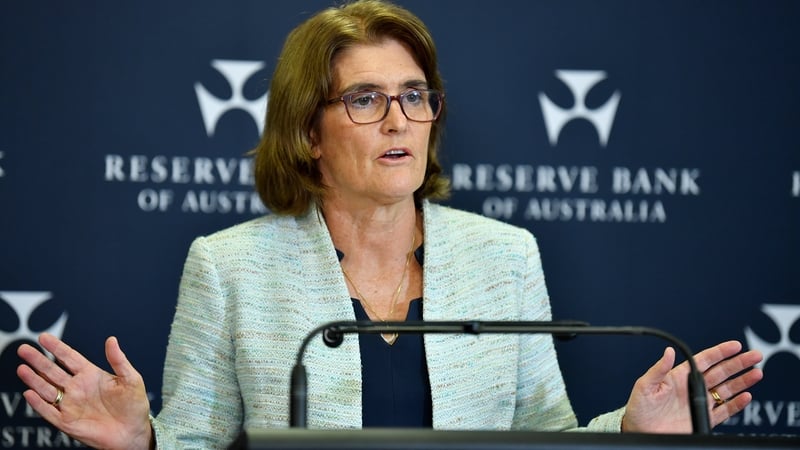
However, Governor Michele Bullock would not be drawn on the prospects of more rate rises even though the RBA's new economic forecasts were based on more policy tightening to bring inflation back to the target band of 2% to 3%.
"I don't know if it's in a (tightening) cycle. Certainly it is an adjustment, and the board would be actively monitoring (data)," said Bullock at a post-decision briefing.
"We are in a position where we think we might be around neutral in terms of financial conditions," she added.
Markets had wagered on a 78% probability of a hike today given inflation surprised on the high side in the fourth quarter, while unemployment hit a seven-month low in December.
"While part of the pick-up in inflation is assessed to reflect temporary factors, it is evident that private demand is growing more quickly than expected, capacity pressures are greater than previously assessed and labour market conditions are a little tight," the RBA's board said in its policy statement.
"The board judged that inflation is likely to remain above target for some time and it was appropriate to increase the cash rate target."
The Australian dollar extended earlier gains to be up 0.9% to $0.7002 while three-year government bond yields jumped eight basis points to 4.3%.
Investors ramped up bets for a follow-up hike in May, which is now priced around 75%. Markets expect an additional total tightening of 40 basis points this year.
More hikes coming?
The RBA did not raise interest rates as aggressively as its international peers when inflation was running hot due to its desire to preserve gains in the labour market.
That approach may yet test policymakers. The central bank's three rate cuts last year saw inflation rear its head again, forcing it to pivot towards a hawkish stance late in 2025 and prompting market bets of an earlier-than-expected start to the tightening cycle.
Consumer price growth has surprised on the upside for two quarters in a row now, and is well above the RBA's target band of 2% to 3%. Underlying inflation, the central bank's preferred measure, ran at a quarterly pace of 0.9% in the fourth quarter, lifting the annual pace to the highest in over a year at 3.4%.
The RBA now expects it to pick up to 3.7% by June before falling back to 2.6% by mid-2028, above the 2.5% midpoint of the target band. That was based on technical assumptions of over two rate rises this year before today's decision.
Bullock said the board judged that timeframe was not an "acceptable" outcome.
The recent flow of data has reinforced the case of a capacity-restrained economy, with a surprise fall in the unemployment rate to a seven-month low of 4.1% suggesting the labour market may have started to tighten again.
Robust consumer spending, record-high housing prices and easy credit availability for households and businesses added to the case that financial conditions might not be restrictive at all.
Sally Auld, chief economist at the National Australia Bank, suspected this was unlikely to be a "one-and-done" scenario for the RBA.
"We continue to forecast a follow-up 25bp hike in May, although risks are biased to an earlier hike and the possibility of more than just a modest 50bp recalibration," she added.
