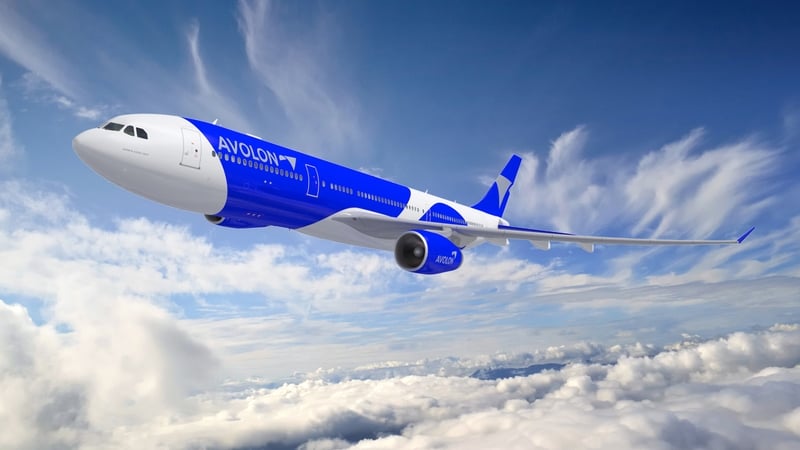

Global airline profits will reach $41 billion this year, according to analysis by aircraft leasing firm Avolon.
In its 2026 outlook, it predicts the industry will benefit from strong demand and favourable fuel prices, which will help it to continue to recover from the impact of the pandemic.
Leading that growth will be India, the United Arab Emirates and Saudi Arabia, it predicts.
Avolon is one of the three Irish leasing companies that together own and lease out about a sixth of the world's passenger aircraft.
"What we've seen is that there's a handful of emerging countries that are benefiting from growing middle class populations, improving demographics, as well as the strength of a global connecting business models, " said Jim Morrison, chief risk officer at Avolon.
"So those three countries hold orders for 3,000 aircraft today, of which 900 are going to be delivered over the next three years," he said.
In Europe, meanwhile, airlines continue to enjoy favourable market conditions.
"Airlines in Europe actually led the world in profitability in 2025 and are expected to do so again in 2026," he said.
We need your consent to load this rte-player contentWe use rte-player to manage extra content that can set cookies on your device and collect data about your activity. Please review their details and accept them to load the content.Manage Preferences
The European aviation market is also increasingly defined by consolidation, with Air France-KLM increasing its stake in Scandinavian airline SAS, and Lufthansa growing its hold on Italy's ITA.
Overall, though, despite strong demand in multiple markets, the aviation industry is set to be limited by the backlog in orders for new aircraft at manufacturers Boeing and Airbus.
That means that many carriers will not be able to fully benefit from growing demand - but aircraft leasing firms will.
"What we've seen in the aircraft manufacturing space is, during the pandemic period, production rates dropped, and so that's led to 4,000 aircraft that weren't built this decade," he said. "So there's a strong undersupply of new aircraft that's underpinning our business models going forward."
But there are also some headwinds facing the industry - including growing geopolitical uncertainty.
"We are seeing uncertainty in the world around us - we're seeing political risk, we're seeing geopolitical risk as well, too," he said. "But this is an industry that survived through the 9/11 challenges, survived through Covid, survived through interest rate increases as well.
"Really resiliency and durability of aviation is part of our unique selling point," he added.
Fears of a recession in the EU and US have also receded somewhat, which will help to support demand for aviation.
Meanwhile the pressure on airlines to cut emissions appears to have lessened - in part due to the Trump administration's undoing of many green initiatives - however Mr Morrison said improving environmental impact of the business remained a priority.
"The industry is still very focused on improving its carbon intensity and adopting the latest and greatest technology to do so," said Mr Morrison.
"The new technology aircraft that are delivering today, from Airbus and Boeing, are the best way for aviation to continue to reduce its carbon intensity," he added.