


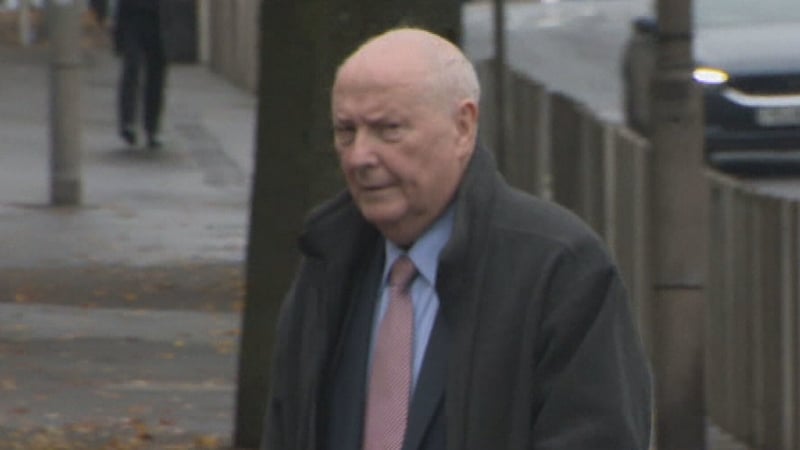
A businessman charged with fraud arising from the proposed sale of the Northern Ireland loan book has opted not to give evidence at his trial, a court heard today.
A defence barrister representing Frank Cushnahan told trial judge Madam Justice McBride "My Lady, the defendant calls no evidence."
Following this admission, the senior judge asked Frank O'Donoghoe KC if he had "advised your client that the stage has now been reached at which he may give evidence and if he choses not to do so ... the jury may draw such inferences as appear proper from the failure to do so?"
Mr O'Donoghoe replied "I have."
The fraud trial, which commenced at Belfast Crown Court last September, is now in its final stages.
The 84-year old accused, from Alexandra Gate in Holywood, has been charged with and denies a single count of fraud.
The alleged offence relates to the sale of the Northern Ireland property loan book held by the National Assets Management Agency (NAMA).
The agency was set up in the Republic of Ireland in 2009 following the property crash and banking crisis and its purpose was to take over billons of euro of property development debts held by a number of banks.
Cushnahan was one of two people appointed as an external member of the Northern Ireland Advisory Committee (NIAC) which was set up by NAMA to advise in respect of the property debts in Northern Ireland.
He sat on the committee from May 2010 until his resignation in November 2013.
It is the Crown's case that Cushnahan was "heavily involved" with American investment firm Pimco, who were potential purchasers of the Northern Ireland loan book, and that he was under a legal duty to disclose any conflict of interests he had which he failed to do.
The charges he faces, and which the jury have to decide on, is that between April 1 and November 7 2013 he dishonestly failed to disclose to the Northern Ireland Advisory Committee and the National Asset Management Agency information which he was under a legal duty to disclose, namely that he was providing assistance to Pimco with the proposed purchase of the Northern Ireland Loan Book from NAMA, with the intention, by failing to disclose the information to make a gain for himself or another.
After the jury of nine men and three women were informed that Cushnahan was not giving evidence, this concluded the defence case.
Following this, Crown barrister Jonathan Kinnear KC addressed the jury and presented them with the prosecution's closing speech.
Telling the 12 members they were the "judges of the facts", Mr Kinnear said it was now their task to "sift through the evidence" they have heard in the trial and to reach a verdict on the charge of fraud.
The Crown barrister told the jury "there are five key questions that you have to answer" which he set out.
The questions are:
- Did Cushnahan provide assistance to Pimco with the proposed purchase?
- Did Cushnahan fail to make a disclosure to NIAC/NAMA?
- In failing to make that disclosure, did Cushnahan intend to make a gain for himself or another?
- Was Cushnahan under a legal duty to make the disclosure?
- Did he act dishonestly?
Mr Kinnear also raised the issue of Cushnahan opting not to give evidence to the jury.
Whilst the prosecutor said Cushnahan was "not compelled" to do so, he suggested to the jury there were "a number of questions you may think you would like to have heard answers to."
These questions, Mr Kinnear suggested, included why Cushnahan allegedly did not tell anyone at NAMA or NIAC about his involvement with Pimco and whether this was because he wanted a share of the success fee from the proposed deal.
Saying it was the Crown's case that Cushnanan was "silent" about this in 2013, Mr Kinnear said his continued silence in 2026 was "deafening."
