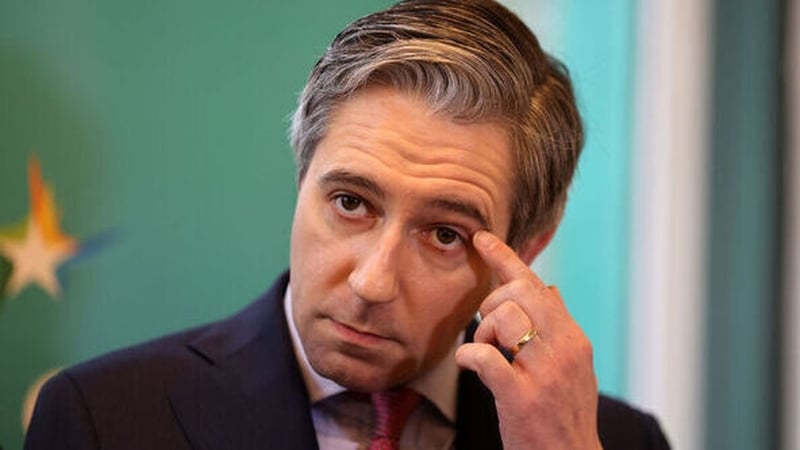

The most serious accusation Simon Harris faces as Minister for Finance is that he is overseeing a bonanza which is being squandered.
He is almost two months in the job since Paschal Donohoe swapped Government Buildings for a senior role in the World Bank in Washington, DC.
Simon Harris is becoming more familiar with his brief, which he will hold until November 2027, when he will assume the role of Taoiseach under the Coalition's Programme for Government.
Over the next two years, the economy is forecast to continue powering ahead. But predictions can be wrong.
This week's exceptionally strong Exchequer Returns for 2025 showed the challenge he and Minister for Public Expenditure Jack Chambers face.
The country is awash with cash. But many people do not feel the benefit partly due to the higher cost of living.
For a politician such as Simon Harris, it will be tempting to fix that by taking a populist course and agreeing to expenditure plans put forward by other ministers.
Unemployment remains low, inflation appears to be easing and the threat of enormous US tariffs on Ireland's pharma and computer chip exports have receded.
While most categories of tax collected by the State are up, money paid by multinationals surged 17% last year to an enormous €33 billion in 2025.
Simon Harris said corporation tax accounts for about a third of all revenues collected by the State.
The tax will rise significantly this year judging by Ireland's recent economic growth figures which are an early indicator of how much will be collected from multinationals.
The Department of Finance estimates about half of that money relates to activity in Ireland. In other words, the rest is vulnerable to suddenly drying up.
The officials in the Department have helpfully published scenarios illustrating what would happen to Ireland's economy if that flow of money did come to a halt. If corporation tax receipts fell, there would be a €14 billion deficit by 2030.
Civil servants on Merrion Street have not forgotten the nightmare of the financial crisis when massive reductions in spending had to be introduced at the same time as taxes were hiked to shore up the public finances.
A vocal critic of the Government's excessive reliance on corporation tax is Seamus Coffey, the chairman of the Irish Fiscal Advisory Council.
Mr Coffey argues that despite the surge in money from multinationals, the proportion of corporation tax being saved is declining.
The Government set up two long-term funds into which €24 billion will have been saved by the end of this year.
At a packed press conference this week in the Department of Finance, Simon Harris was asked about the criticism from Mr Coffey.
He responded that as well as saving money into the two funds, the Government was also planning to run surpluses and invest in infrastructure.
It was a good answer because nobody can argue with badly needed spending on infrastructure, and surpluses are no harm either.
The problem is that in the past the largest increase in spending has been on current expenditure such as wages. Between 2019 and 2024 current expenditure rose from €60 billion to €89 billion while capital spending increased from €7 billion to €15 billion.
This week Simon Harris also ruled out investing more in the State's two long-term funds despite having the ability to do if he wished.
But the most significant concern is that the Government is not being sufficiently disciplined about the public finances.
Over recent years, expenditure has surged beyond spending ceilings announced in the Budget.
Last year the Government promised to turn over a new leaf. But the Coalition has already crashed through its expenditure ceiling, which it published in the Budget just three months ago, with an overrun of €4 billion.
Last month the Government published its Medium Term Fiscal plan as required by the EU. It effectively ties Ireland to spending limits.
But the Coalition's plans included extraordinary increases in spending with a 7% rise in 2026 and 6.5% in 2027.
These are the second highest increases in expenditure in the EU and more than double the expenditure of similar-sized countries.
It is Simon Harris's job to protect the public finances to ensure they will be able to withstand any economic shocks.
But with less than two years to go in the job and the gold rush of money showing little sign of drying up, it will be politically tempting for him to make noises about being prudent - while doing little to curb massive increases in spending.