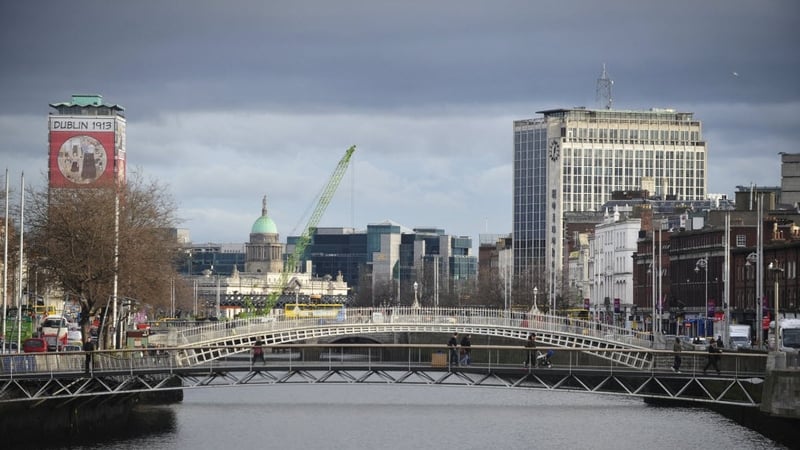

Domestic demand will grow by 2.8% next year, Ibec's latest Economic Outlook has forecast.
That compares to estimated growth of 3.4% this year.
The business representative group said that the growth would be fuelled by a continued up-tick in consumer spending - thanks to a rise in household incomes.
"Inflation is fairly in line with the kind of 2% for the last two years and we expect 2% again next year or thereabouts - and then wages are growing ahead of that," said Gerard Brady, chief economist with Ibec. "So we're seeing more people and more people in employment despite a slowdown in the growth rate of employment."
He said that slowdown in employment comes on the back of a remarkable period of jobs growth in the country - with around half a million jobs created in Ireland over the past six to seven years.
Mr Brady said jobs growth had moderated to around 50,000 this year - and would ease again to 30,000 next year - but that still put Ireland ahead of most other European countries.
The report says that the Irish economy has also benefitted from the fact that the vast majority - 78% - of exports to the US are currently exempt from tariffs.
However this situation is far from settled - representing one of a number of uncertainties in the coming year.
"It's still a lot of uncertainty out there in the global economy about what might happen next," he said. "What we've seen this year is that geopolitics are now driving the economy as much as actual economics and the fundamentals."
Another uncertainty was the fact that the full effect of tariffs had not yet been felt by companies - however the impact of interest rate and tax cuts are also yet to trickle through too, and he suggested those two factors could balance each other out.
We need your consent to load this rte-player contentWe use rte-player to manage extra content that can set cookies on your device and collect data about your activity. Please review their details and accept them to load the content.Manage Preferences
However Mr Brady said it was now clear that uncertainty was going to be a hallmark of the economic landscape for some time to come.
"I think it's really, really difficult for businesses to plan and the current environment is not going to change," he said. "There was maybe a period back in April where we thought about, well, once the uncertainty ends, we'll get on with our lives.
"I think the uncertainty is here to stay for a period of time and tariffs are here to stay, regardless of what happens in the US. That's unlikely that a future US government will fully roll back tariffs."
Another element of uncertainty is what direction the aritificial intelligence industry takes in the coming year.
A huge amount of global growth has also been driven by investment in the sector - much of it US-focused.
Mr Brady said Ireland stands to benefit from this, though it is also exposed to the potential risks in the event of it being a bubble.
"Nearly half of US growth this year has been just AI physical capital investment and things like fabs, the semiconductor factories and things like energy to support those factories and also data centres. It's remarkable," he said. "There will be trillions of dollars of investment in AI that all relies on, at some stage, the companies doing all that investment, making a profit from it, and the markets believing that they're going to make a profit from it.
"So there's a lot of potential for uncertainty out there from that source."
However he also suggested that there would be significant, if currently unseen, long-term benefits from the vast AI investment - even if the technology itself does not live up to the hype.
"It wouldn't be the first bubble that we ended up with much better infrastructure and a much better global economy," he said. "We saw it with the dotcom bubble - hundreds of thousands of kilometers of fiber was built that had no customer at the end of it - and then that was the basis on which the internet grew in the 2000s.
"So these things can be good even if they're in the short term very volatile."