

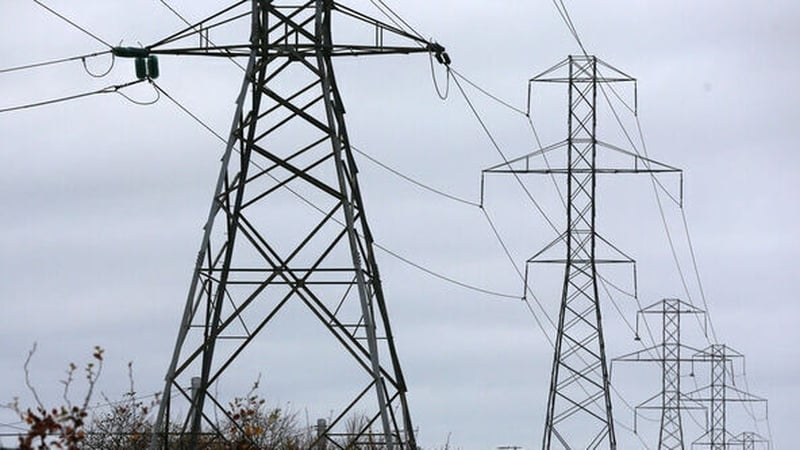
The Sinn Féin leader has said that households hammered by energy costs now face even higher bills to fund the upgrade of the national grid.
Mary Lou McDonald said that already a million households are dealing with higher bills this winter and all the while the Government has not laid a glove on the energy companies.
Electricity users will face price increases next year of up to €1.75 per month on bills to pay for a major upgrade to the national grid, which could cost almost €19 billion.
Speaking during Leaders Questions in the Dáil, Ms McDonald said that the upgrading of the national grid is important but it beggars belief that this will lead to another price hike for households.
She called for the onus to be put on the mega profit making energy companies to pay for this.
In response, Taoiseach Micheál Martin insisted that investment in the national grid is essential and it will copper-fasten every job in the country.
He acknowledged the pressure which households are under and said that the VAT reduction on electricity has been extended.
Mr Martin added that more people are going to be paid the fuel allowance between September and April.
He also said that resources must be targetted at lower income families.
The regulator for the sector, the Commission for Regulation of Utilities (CRU), has sanctioned increased spending of an initial €13.8bn by ESB Networks and EirGrid, the body which manages the electricity network.
If the two organisations meet regulatory targets, the CRU will allow the spending increase to €18.9bn over the coming five years.
Initially, €1 will be applied to bills every month before VAT. But this could rise to €1.75 if spending is allowed to rise to €18.9bn.
Domestic users will pay 55% of the costs and businesses 45%.
Network tariffs charged to electricity users make up 25% to 30% of an average customer's bill.
The upgrade to the grid will facilitate the building of 300,000 new homes by 2030, the connection of one million electric vehicles and 680,000 heat pumps to the grid.
We need your consent to load this rte-player contentWe use rte-player to manage extra content that can set cookies on your device and collect data about your activity. Please review their details and accept them to load the content.Manage Preferences
It will also be used for electrification of public transport projects, including Dublin’s MetroLink and increased use of electric buses.
The grid will be upgraded to prepare for climate change and storms, and reinforced to handle increased power from wind and solar power.
The State is investing a total of €3.5bn and between €4bn and €5bn will be raised on the bond market.
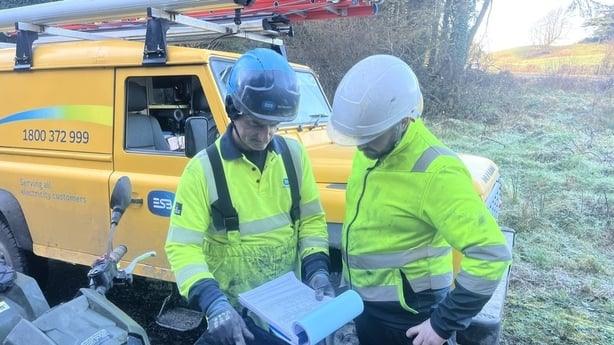
It will result in 520 different capital projects. Among them will be 29 major transmission infrastructure projects, 27 major distribution substations, 80,000 pole replacements and hundreds of kilometres of overhead and underground lines.
Minister for Energy Darragh O'Brien said the investment "would be the largest investment in the electricity grid since rural electrification".
Minister for Finance Simon Harris said while households are likely to be paying more in their bills to help cover the upgrade, the "prize" in return is an energy supply that is resilient and one that will lead to "cheaper energy" in the future.
Speaking on his way into Cabinet, he acknowledged that electricity bills are high but said they took several actions to help people in the budget and that more people now qualify for the fuel allowance.
Mr Harris said this investment in the national grid is about providing energy security and it will lead to lower prices in the future for consumers.
He said funding will come from the State and the bond market.
However Social Democrats TD and party spokesperson on energy Jennifer Whitmore has said that a further increase in electricity bills is "really concerning".
Speaking on the plinth, she said that while investment in the national grid was important, there was also a significant need for an investigation into price gouging.
Ms Whitmore has reiterated calls on the Government to introduce a "targeted energy support" measure, where €400 would be be provided to the 40% lowest income households during the energy crisis.
Not enough surplus being saved, says Irish Fiscal Advisory
Seamus Coffey, Irish Fiscal Advisory Council Chair has said that Ireland is in a good position in terms of public finances, but that not enough of the surplus is being saved, rather it is part of planned spending by the Government.
He said that there are record numbers in employment and spending continues to rise, but the key factor to this is corporation tax receipts.
He added that in 2026, the Government is forecasting €35 billion in corporation tax which is an "enormous amount of money", but almost all of it is being spent.
He said that the planned Government surplus is €5 billion, meaning next year just 17% of bumper corporation tax receipts will be saved.
He recognised that there are pressures in health, education, housing and infrastructure but that these should be dealt with all the time on a constant basis, not just when the Government has bumper corporation tax receipts.
CRU says it will monitor ESB Networks, EirGrid
The CRU said it will monitor ESB Networks and EirGrid's delivery to ensure customers’ money is spent responsibly.
There are currently almost 300,000 electricity users in arrears and the Government did not include one-off credits in October’s Budget.
Latest figures from the Central Statistics Office show electricity prices have increased by 5% over the past year.
The CRU’s Commissioner Fergal Mulligan said: "Changing supplier is one of the fastest and most effective ways for customers to lower their energy bills."
He said people who move to the lowest tariff could have saved almost €2,500 over the past four years.
"Customers could also move to a Time of Use tariff which you can avail of if your smart meter has been installed, to use less expensive electricity at different times during the day that suits their needs," he added.
He said there were also projections in place for vulnerable consumers.
We need your consent to load this rte-player contentWe use rte-player to manage extra content that can set cookies on your device and collect data about your activity. Please review their details and accept them to load the content.Manage Preferences
Speaking on RTÉ's Morning Ireland, Mr Mulligan compared the upgrade to the building of the Ardnacrusha power station over 100 years ago.
"The demand on our network is growing exponentially," he said.
"We are growing in terms of having electric vehicles, heat pumps across our homes, and microgeneration in all our homes is becoming a new norm.
"So, the investment is there to cater for all that new growth, as well as climate resilience."
ESB Networks said today's plan will allow ESB Networks to build on and accelerate the significant progress achieved during the previous price review which included the connection of over 186,000 homes, farms and businesses, the addition of 2.1 GW of utility scale renewable generation and the installation of over 1.8 million smart meters.
Nicholas Tarrant, ESB Networks Managing Director, said the the final determination endorses the scale of ambition put forward by ESB Networks in its business plan.
"It will help pave the way for a more resilient, reliable and sustainable energy future for Ireland, supporting housing, jobs and climate action.
"We look forward to working in collaboration with our stakeholders, industry colleagues and all of society to deliver this historic and transformative investment in Ireland's future," he added.
Siobhán O'Shea, EirGird's Chief Infrastructure Officer (Interim) said: "It is critical we have a clean, secure power system that supports increasing societal and economic growth".
