


Security gaps are putting Ireland's national and economic success at risk, according to new research from the Institute of International and European Affairs (IIEA) and Deloitte Ireland.
The study said Ireland's global economic profile makes the country "a high-value intelligence target."
The Minister of State with special responsibility for European Affairs and Defence said that Ireland's Triple Lock is out of date and not fit for purpose.
Thomas Byrne said: "The idea that Russia, which is breaching the UN Charter, very fundamentally in a way that's killing lots of people, can then have some say over what we've decided in our Dáil, I just fundamentally disagree with it."
He was speaking at the launch of the Deloitte Ireland and IIEA report.
Mr Byrne said that right across the continent there were hybrid threats in the information space seeking to divide societies across Europe.
"We have seen this Russian shadow fleet moving across Europe, doing things that they shouldn't be doing. We've seen drones as well, and some of them have been linked to Russia. We see in Lithuania there are helium balloons being flown in from Belarus, which is under the control of Russia, which are extremely dangerous to air traffic and have caused the closure of their airport on numerous occasions."

Mr Byrne said he accepted that Ireland was coming from behind when it comes to defence, but this was now changing.
"We have a plan for the Defence Forces, which we are now putting into action, and we're putting in place, quite frankly, some of the basics, such as a radar system, a sonar system, so that we know what's going on, increasing our aircraft, increasing numbers in the in the Defence Forces as well."
'Actively targeting' companies
The White Paper also warns that foreign Intelligence Services are "actively targeting companies in Ireland."
It said organisations in technology, financial services, aviation leasing and cybersecurity based here are now "routinely encountering signs of foreign state-backed espionage."
The authors said Ireland's exposure as it prepares for the EU Presidency next year was highlighted last week when unidentified drones were spotted off the coast of Dublin around the same time that Ukrainian President Volodymyr Zelensky's plane landed at Dublin Airport.
The research, entitled "Secure Together: Enhancing Ireland's Security and Resilience in a Time of Heightened Geopolitical Risk" examined Ireland's geopolitical risk environment, including the risks to society, prosperity, and the corporate and business community.
The publication followed two roundtable engagements and interviews involving senior representatives from government agencies, financial services, communications, energy infrastructure, technology, aviation, academia, and think tanks.
It said while Ireland sits on the edge of Europe, the country is "at a focal point on its risk map" and it concluded that Ireland faces escalating hybrid and geopolitical threats.
In terms of energy infrastructure, an attack on the electricity grid was cited as a leading concern, with a high risk of kinetic attacks on gas pipelines and electricity interconnectors seen to be "particularly acute."
It also said a lack of gas storage leaves Ireland exposed during geopolitical shocks.
We need your consent to load this rte-player contentWe use rte-player to manage extra content that can set cookies on your device and collect data about your activity. Please review their details and accept them to load the content.Manage Preferences
From a communications perspective, the paper said Ireland is a key communications node, as the country is home to over 30% of all EU data.
Around three-quarters of all subsea cables in the Northern Hemisphere pass near or through Irish waters, linking global financial markets and cloud services.
As a result, the participants said subsea data cables are at risk by sabotage at sea or on land, while the targeting of undersea gas connections could trigger communications blackouts across Europe.
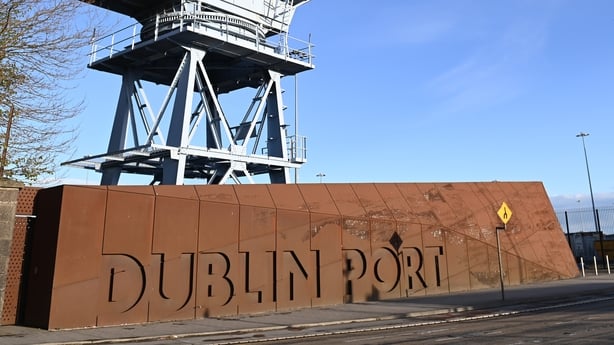
Concerns were also raised that Dublin Port "represents a significant single point of failure in the national supply chain, and that food would start to disappear from shop shelves within three days if there was a material adverse event there".
In terms of cybersecurity, the paper said State-backed cyberattacks pose threats to a wide range of areas including health services, utilities, internet, communications systems and social media availability, as well as food supply chains, which it said can have "an immediate and lasting impact."
It also found that almost 90% of Irish companies have already suffered financial loss or operational disruption due to cyberattacks, "with many now dealing with certain state-backed activity not just cybercrime."
The participants raised concerns that public debates on defence and security in Ireland "often collapse into neutrality versus NATO arguments."
The authors of the paper said the more pressing need is for "a national conversation focused on practical defence and national resilience."
The paper said the EU's ReArm Europe programme, which will unlock €800 billion in defence spending, "presents a significant opportunity for Irish companies and SMEs to contribute capability and technologies, and leverage the economic benefit for Ireland."
Irish businesses working with dual-use technologies such as cybersecurity, robotics, AI, radar and satellites, and other technology organisations can not only access substantial financial support, but play a leading role in keeping Ireland and Europe safe.
The paper concluded that the growing deployment of the tools of hybrid warfare including disinformation, espionage, sabotage, assassination plots, and attacks on critical infrastructure by hostile States "put Ireland's social wellbeing, economic prosperity, and the lives of individuals at risk."
"It is now widely accepted that Ireland cannot continue with an incremental approach to national security and defence, while maintaining a reputation as a good partner in Europe, and as a safe and stable place to do business," it stated.
It has called for rapid and agile transformational change, which it said is "essential to maintain our reputation and relevance."
The recommendations in the paper include expediting the development of an overarching National Security Strategy, which it said would serve to "create greater direction, alignment, and synergies between existing and future strategies pertaining to security and resilience."
It said there is a need for political leadership and alignment, adding that politicians across the spectrum need to "provide leadership and act decisively in order to enable the diverse range of responses required to meet the scale of the challenges which the State faces."
The other recommendations include enhancing support capacity and capability at Government level, and it said the Government should examine means to increase public awareness and build a shared understanding of the threats which Ireland faces.
It has also recommended that the Government should examine the development of a strategy to support Ireland’s defence industry and dual-use sector.
Shane Mohan, partner and National Government & Public Services Leader in Deloitte Ireland, said too often national conversations on defence and security in Ireland "fall into silos."
"What we urgently need now is a practical conversation about how we can build national resilience," he added.
Mr Mohan said Ireland, as a small island nation in an important geographic location, is "under threat in this hybrid warfare environment."
"National security and defence require a whole-of-government and a whole-of-society approach to build resilience," he said.
"If we don't do this, it threatens not just our national security, but it could damage our economic prosperity, as businesses may look towards European member states that can provide a more secure environment to locate operations," he stated.
The IIEA Director General said a nation's sense of security is "foundational to its prosperity, social vibrancy and national harmony."
Alex White said the ongoing "aggression by Russia against Ukraine, coupled with the growing prevalence of disinformation, sabotage, and cyberattacks, means Ireland’s security can no longer be regarded as assured."
He said the White Paper, compiled by the IIEA and Deloitte, "synthesises the perspectives of key stakeholders in Ireland's national security and outlines how to strengthen Ireland’s position in a changing world."
"Inevitably there will be diverse opinion on how we best achieve this, but ensuring Ireland continues to be a place of peace, prosperity, and dignity is a responsibility we all share and one that must remain at the forefront of our efforts," he added.
