


After three consecutive interest rate cuts, investors now confront an uncertain US monetary policy outlook for the year ahead, clouded by persistent inflation, data gaps, and an impending leadership change at the Federal Reserve.
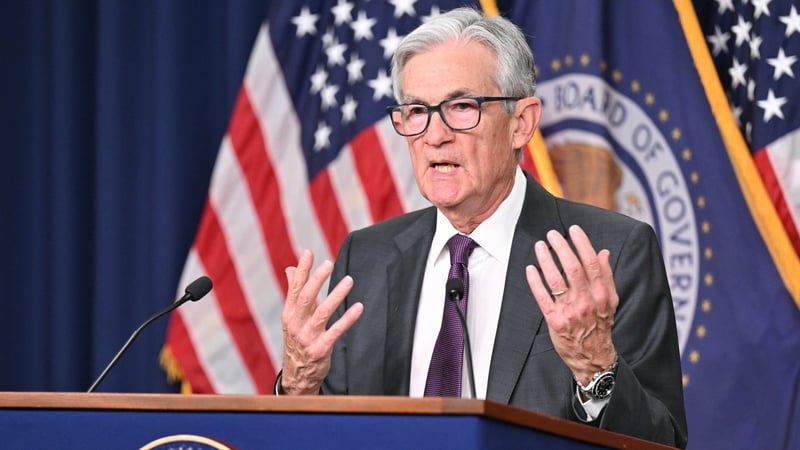
The US Federal Reserve cut interest rates by a quarter-percentage point last night in an uncommonly divided vote.
But it signaled it would likely pause further reductions in borrowing costs as officials look for clearer signals about the direction of the job market and inflation that "remains somewhat elevated."
The Fed's projection for a slower easing path contrasts with market expectations for two 0.25% cuts in 2026, which would bring the fed funds rate to about 3%. Policymakers see only one cut next year and one in 2027. Yesterday's cut brought the policy rate to a range of 3.5%-3.75%.
The Fed's updated projections showed six policymakers preferring no rate cut this year, and seven anticipating no further cuts in 2026.
How monetary policy evolves from here will hinge on economic data that is still lagging from the impact of the 43-day federal government shutdown in October and November. This comes as the US heads into a midterm-election year likely to focus on economic performance, with President Donald Trump urging sharper rate reductions.
"I think the guessing game of what the Fed does next is going to be getting a lot more difficult next year," said Art Hogan, chief market strategist at B Riley Wealth.
Investors face uncertainty over next year's monetary policy as inflation trends and labour market strength remain unclear.
The Fed's dual mandate - employment and price stability - is fueling internal debate at the Fed.
The flow of economic data should gradually normalise after the recent government shutdown, but uncertainty remains.
"The Fed's guidance probably tells us less than usual about the interest rate outlook, for two big reasons," Bill Adams, chief economist for Comerica Bank, said in a note.
"First, they know less than usual about the current state of the economy because the shutdown delayed the release of economic statistics. Second, the Fed's guidance doesn't account for how its approach will change after Chair Powell's term ends in May," he said.
White House economic adviser Kevin Hassett, seen as the front-runner to be the next Fed chair, told the WSJ CEO Council this week there is "plenty of room" to cut interest rates further though a rise in inflation could change that view.
Trump said yesterday that the Federal Reserve's interest rate cut was small and that it could have been larger.
"This one just feels to me, at least looking forward into 2026, that there are still lots of unanswered questions that are out there that pertain to the direction of the economy and the direction of interest rates in the future," Schutte said.
Ignore the noise
For some investors, the wisest move is to stay the course and avoid knee-jerk reactions.
"You're about to get an awful lot of financial noise between now and the end of next year ..." said Alex Morris, chief investment officer at F/m Investments.
While investors may still have to grapple with the possibility of better-than-expected growth or higher inflation in the year ahead, those scenarios were seen as unlikely to trigger a tightening in monetary policy, he said.
"(It's) not so much that you need to be so worried that you should duck and cover," said Morris, who has been advocating for bond investors to extend duration.
Powell said the Fed's next move is unlikely to be a rate hike, given that is not the base case reflected in new projections from central bank policymakers.
Meanwhile, stock market investors do not appear too worried about the prospect of a pause in rate cuts. While lower rates have helped lift stocks to new highs, further easing, especially if driven by economic deterioration, may be unwelcome.
