


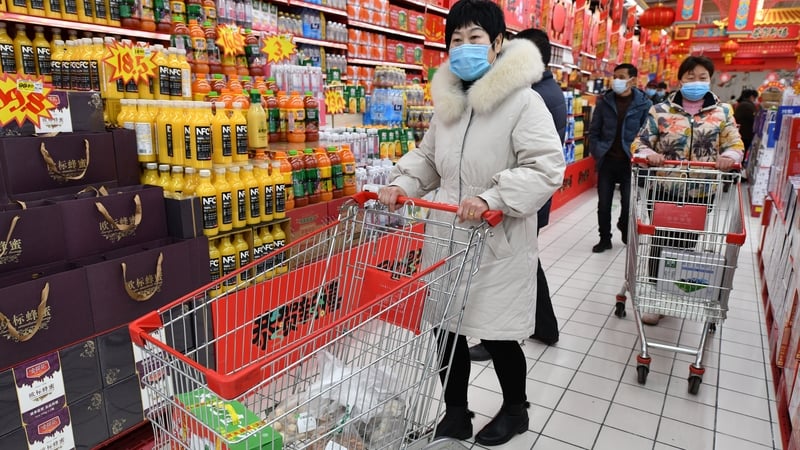
China's annual consumer inflation accelerated to a 21-month peak in November, mainly driven by food prices, while factory-gate deflation deepened, with underlying trends suggesting domestic demand remains weak and unlikely to recover in the near term.
The $19 trillion economy is on course to meet Beijing's growth target of "around 5%" for the year, buoyed by policy support and resilient goods exports.
But economic imbalances have worsened this year as US President Donald Trump's global trade war has added to persistently soft consumer demand, putting the onus on policymakers to step up stimulus measures.
China's consumer price index (CPI) rose 0.7% from a year earlier, National Bureau of Statistics data showed today, matching a 0.7% expansion in a Reuters poll of economists. It had increased 0.2% in October.
The pickup in consumer inflation was mainly driven by rising food prices, which increased 0.2% year-on-year after dropping 2.9% in October.
But annual core inflation, which excludes volatile prices of food and fuel, was unchanged at 1.2% last month. On a monthly basis, CPI dipped 0.1% compared to a 0.2% rise in October and a forecast gain of 0.2%.
Factory-gate deflation has also dragged on for three years in China, hobbling the world's second-biggest economy, even as the government has stepped up a campaign to curb industrial overcapacity and made calls on key sectors to scale back cut-throat competition.
The latest data showed few signs of a recovery in the deflationary impulse.
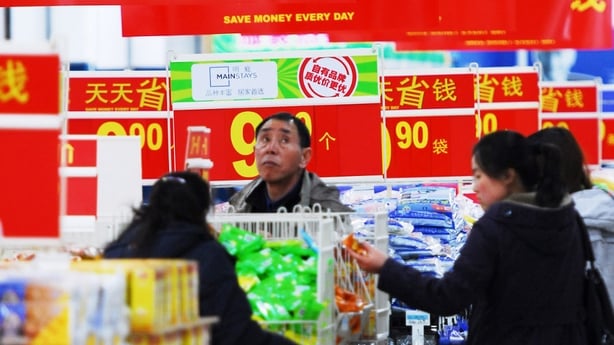
China's producer price index (PPI) fell 2.2% year-on-year in November, compared with a 2.1% fall in October and worse than the forecast for a 2.0% drop. The index was up 0.1% from October.
"China's latest inflation figures indicate an economy that is warming up on the surface but is still battling deep-seated deflationary pressures underneath," said Zavier Wong, market analyst at investment firm eToro.
"Manufacturers are still cutting prices to shift excess supply, and that persistent decline highlights how weak demand conditions remain," he added.
Most analysts expect deflationary pressures to linger next year.
Falling prices of everyday items underlined the challenge authorities face as firms, hobbled by low demand, try to lure buyers with discounts.
Total spending on fast-moving consumer goods such as packaged food and drinks, toilet paper and toothpaste in China grew 1.3% year-to-date, supported by a 2.4% decline in average selling price, according to a report by Bain & Co earlier this week.
Analysts say the government needs to stabilise the faltering property sector, lower the youth unemployment rate and build a better social safety net to encourage spending to foster sustainable longer-term growth.
In the near term, however, more policy support is required to inject confidence, they said.
The country's top leaders have pledged to better balance supply and demand and signalled a shift toward supporting household consumption and restructuring the economy over the next five years.
The Politburo, a top decision-making body of the ruling Communist Party, vowed on Monday to keep expanding domestic demand and support the broader economy with more proactive policies in 2026.
"With recent attention being placed on getting 2026, the first year of the next five-year plan period, off to a good start, this will likely necessitate another wave of policy support in the early months of next year," said Lynn Song, chief economist for Greater China at ING.
The economist pencilled in 20 basis points of rate cuts in 2026.
