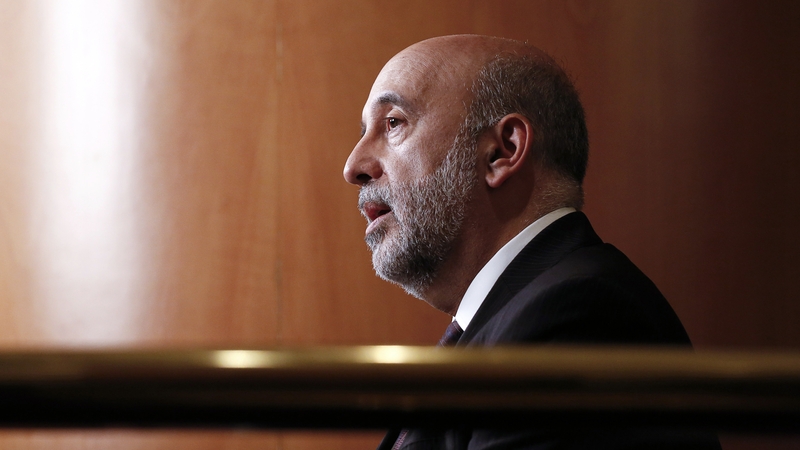

The Governor of the Central Bank Gabriel Makhlouf has warned Ireland needs to include security considerations in its planning for economic resilience in future.
He comments came after employers group Ibec urged the Government to increase spending on defence and security.
A speech by Mr Makhlouf due to be delivered on 10 December at the Royal Irish Academy read "as we address the country's housing, transport, telecommunications, energy and water needs, we also need to plan for the shocks that could be created by bad actors".
It added: "Security considerations need to feature increasingly in our planning for economic resilience."
It was something the Central Bank had started with its focus on the "operational resilience of the financial system," it read.
However, the event at the Royal Irish Academy on Dawson Street in Dublin was disrupted by activists from the Ireland-Palestine Solidarity Campaign.
The group accused the Central Bank of facilitating the sale of Israeli war bonds by transferring them to Luxembourg.
Earlier employers group Ibec called for increased investment in defence and security, with the representative body saying vulnerabilities in those areas are critical issues for business.
Ibec said the ongoing global conflicts require "increased efforts" to ensure Ireland can protect itself and the businesses that operate here.
It said robust security is the "bedrock for business, ensuring security of supply, the ability to transact, and confidence in the rule of law."
The call coincides with the publication of Ibec’s latest paper, setting out some of the priorities of Irish business for Ireland’s upcoming EU presidency.
The paper focuses on security and defence, which the group have described as "essential elements for future-proofing European resilience in the context of global instability."
The group said the geopolitical shocks of recent years have confirmed that "competitiveness cannot be separated from security."
"The ability to protect, adapt, and innovate has become an economic imperative," it added.
Ibec's chief executive Danny McCoy said the world has "changed fundamentally" in the last five years.
He said Europeans realise that "our defence and security infrastructure is very vulnerable to external attack."
"Defence is not just about militarisation. However, we cannot simply avoid militarisation when the rest of our European Union colleagues - the Union, which is the domain for our economic success and prosperity - are increasing their capabilities," he said.
"We must be part of a secure Europe," he added.
We need your consent to load this rte-player contentWe use rte-player to manage extra content that can set cookies on your device and collect data about your activity. Please review their details and accept them to load the content.Manage Preferences
Mr McCoy said such a position "does not involve abandoning our neutrality, and we need to ensure, in having realistic conversations about our defence capabilities, that we do not conflate the two".
"However, neutrality does not mean being defenceless. Being part of the defence of Europe is to make our contribution, and this can be in non-lethal aspects like radar systems and cybersecurity," he stated.
He said Ireland needs to ensure it has the people and the capabilities "to defend us in our seas and in our air."
"While the Government has committed to achieving Level 2 of the Commission on Defence Forces' ambition by 2028, a truly comprehensive national defence capability would necessitate aiming for the Level 3 capability within that timeframe rather than beyond it, which requires an investment of approximately twice the current policy commitment," according to Mr McCoy.
He said businesses rely on Ireland’s ability to protect its undersea cables, grid connection, energy and to defend against cyber threats.
"We saw with the visit of President [Volodymyr] Zelensky last week and with Ireland’s EU Presidency fast approaching, that our vulnerabilities are going to become more scrutinised internationally," Mr McCoy said.
"In the future world of investment, the realities of business will require a country to be able to prove that it can defend and secure its assets. So, this is of paramount national importance, not just in protecting ourselves but also ensuring future prosperity," he said.
The employers group said dual use technologies, cybersecurity, and critical-infrastructure protection are "the intersections where European competitiveness and security meet."
It said for business, those issues are "no longer peripheral concerns, they impact investment, trade, and technology flows every day."
Ibec said business regards resilience as "a key factor underpinning competitiveness."
"Neutrality should not prevent Ireland and Irish business from playing an active role in shaping a European approach to resilience that "balances competitiveness and open markets with security and defence," it added.