


New figures from the Central Statistics Office show that the enforced deprivation rate decreased for the second year in a row, down to 14.8% in 2025 from 15.7% the previous year.
People are defined as experiencing enforced deprivation if they live in a household that cannot afford two or more of the 11 basic deprivation items that are considered to be the norm for other households in society.
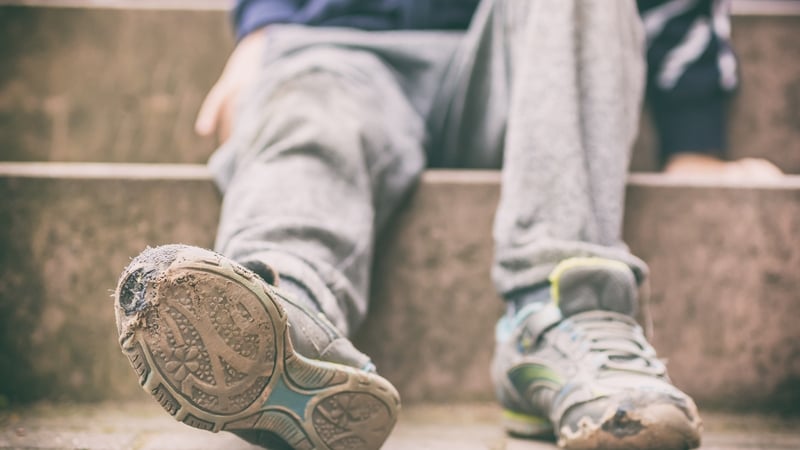
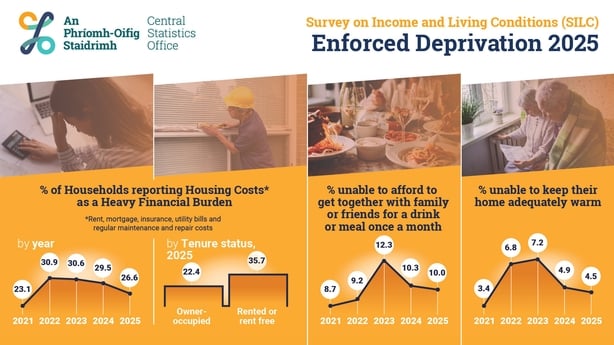
These include being unable to afford to get together with family or friends for a drink or meal once a month, being unable to afford to keep their home adequately warm, being unable to afford two pairs of properly fitting shoes in good condition, being unable to afford a meal with meat, chicken, fish, or vegetarian equivalent or being unable to afford new - not second hand - clothes.
Today's CSO figures show the groups most likely to experience enforced deprivation this year were those living in single-adult households with children under 18 (49%); unemployed (41.7%); unable to work due to long-standing health problems (39%); and those living in rented or rent-free accommodation (31.6%).
They also reveal that 44.8% of households said they had at least some difficulty in making ends meet this year, down slightly from 46.2% in 2024 and from 50.4% in 2022.
The CSO noted that nearly 6% of households missed two or more mortgage or rent payments in the past year.
Analysis by tenure status shows that 12.4% of households that rented had great difficulty in making ends meet in 2025 compared with 3.5% of owner-occupied households.
At the end of a typical month in 2025, the CSO said that 36.8% households did not have money to set aside, while an additional 5% needed to draw money from savings, and 2.8% needed to borrow money.
In 2025, 26.6% of households regarded housing costs as a heavy financial burden, down on the 2024 rate of 29.5%, the CSO added.
