



New figures from the Central Statistics Office show that Irish people are online and relying on technology and digital services more than ever.
The CSO's latest Household Digital Consumer Behaviour report, which was carried out in the second quarter of this year, reveals that email regained its top spot position (95%) as most popular internet activity having lost out to finding information about goods or services last year.
Internet banking or mobile banking (including PayPal, Revolut and Apple Pay), moved into second place at 94%, up seven percentage points on 2024.
The CSO said that more than seven in ten internet users aged 75 years or over used internet banking, with similar usage for men (71%) and women (73%).
Finding information on goods and services was in third position at 92% this year.
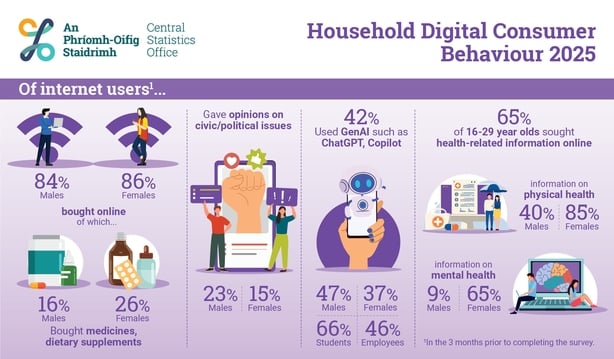
The CSO said that internet users were also seeking health-related information online with 68% using online resources to inform themselves, which was unchanged from 2024.
Women (77%) were far more likely than men (55%) to go online to look up information on physical health related issues, it noted.
Shopping online remained popular at 85%, unchanged from when the survey was last carried out in 2024, with little difference between the number of men (84%) and women (86%) purchasing online.
The online buying of clothes (including sports clothing), shoes, or accessories (including bags and jewellery) remained the most popular purchases at 70% of internet users in 2025 - down seven percentage points when compared with 2024.
There was a notable difference between the number of men and women buying clothes, shoes, or accessories online at 83% of women buying online compared with 56% of men. Men were likely to buy sports goods online at 27% compared with 21% of women, the CSO said.
Meanwhile, the use of streaming services for films, series, or sports (Netflix, Amazon Prime, Disney+, GAA+, and Sky Sports, etc.) increased in 2025 with 71% using these services, up two percentage points on 2024.
Ordering of ready-made food online such as takeaways slipped slightly with 45% of internet users ordering ready-made food online in 2025, down from 46% in 2024.
Households with children were more likely to order takeaways (52%), and meal-kits, recipe boxes, groceries (18%) online in 2025 than households with no children, today's report shows.
The CSO said that social networking - using WhatsApp, Snapchat, Instagram, TikTok and X - continued to increase in 2025, with 75% of internet users communicating in this way, up from 73% in 2024, and 71% in 2023.
Women were more likely to use instant messaging such as Skype, Messenger, Viber, etc. in 2025, at 90% compared with 87% of males.
It added that the use of internet telephoning/video calls on the likes of WhatsApp, FaceTime, Microsoft Teams, Skype, and Zoom, remained high in 2025 at 84%, up from 81% in 2024 and 76% in 2023.
42% of internet users also said they had used GenAI in some form during the three months prior to completing the survey, the CSO said.
This was more prevalent for younger people aged 16 to 29 years as 65% of this age group used GenAI tools compared with 15% of internet users aged 60 to 74 years, and just 6% aged 75 years and over.
But today's figures show that the booking of travel and events online decreased in 2025.
The CSO said that 57% internet users had booked tickets online to events including concerts, cinema, sports events and fairs - down from 59% in 2024.
61% of internet users had also booked travel tickets online including air travel, bus, rail, and taxi in 2025, compared with 66% in 2024.
48% had booked accommodation online though a travel agent, a booking website, or direct with a hotel or accommodation provider website, down from 51% in 2024, the CSO added.
