
Donegal tweed could soon be granted special geographical protection by the European Union under a newly-launched scheme.
The European Commission this week began allowing producers to apply to register product names under a new Geographical Indication scheme for craft and industrial goods.
It means that companies would have to meet certain criteria - including a real link to a geopgrahical area - in order to sell products using a registered name.
In its announcement the commission specifically cited Donegal tweed as an example of the type of product that could qualify.
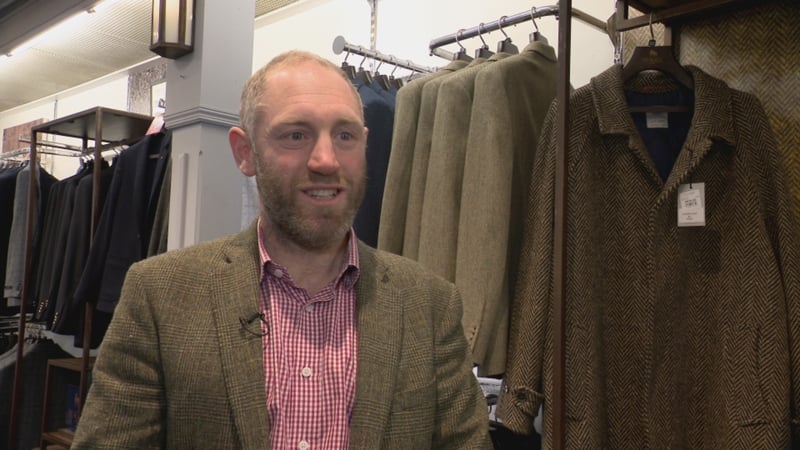
"It's a terrific moment for the industry here within Donegal after many years of working behind the scenes," said Patrick Temple, chair of the Donegal Tweed Association and CEO of Magee Weaving.
"We started the process back in 2013 and working positively towards it now and being able to submit applications now that the legislation is in place at a national level and an EU level," he said.
Europe already offers special protection to many different types of food and drink through its Protected Designation of Origin indication.
Products registered under that indication include Irish whiskey, champagne, feta cheese and parma ham.
We need your consent to load this rte-player contentWe use rte-player to manage extra content that can set cookies on your device and collect data about your activity. Please review their details and accept them to load the content.Manage Preferences
Mr Temple said extending this kind of protection to other crafts will offer reassurance to consumers and producers alike.
"If it does go in place it will give clarity to the customer that, if something says it's Donegal tweed, they'll known it's genuinely a Donegal tweed woven within Co Donegal," he said.
According to the Donegal Tweed Association, the origins of the county's industry go back to the 1800s, with the Donegal variety having a specific style.
"The definition of Donegal tweed is when you've got the colourful fleck spun into the yarn and it's woven in a plain weave, or twill, in Co Donegal," Mr Temple said. "So it's the charactaristic and the manufacturing techniques that have been developed within Donegal over the last couple of hundred years which is synonymous with the region."
The new European scheme comes as craft producers from around the country descend on Dublin's RDS for this year's Gifted fair, which runs until Sunday, 7 December.
While Mr Temple's company has a sizable presence in physical retail, as well as a strong online operation, he said that events like Gifted remain very important to the business.
"It pays great tribute to the many individual crafters and small artisan manufacturers, workshops and groups who are often working with natural fibres or natural raw materials, which are generally-speaking, better for the environment," he said.
"It provides a lovely arena for people to do their Christmas shopping with genuine articles, whether they be ceramics, glass, textiles."
Online sales have become more important to firms like his - especially since the peak of the pandemic - however he said that predictions sales would shift entirely online have been wide of the mark.
"Online is still a very big driver," he said. "But it is in conjunction with seeing the physical product".
"Years ago everyone was saying it's all going online - yes online is extremely important but I think it has to be a double-headed approach with physical, conventional shopping," he added.