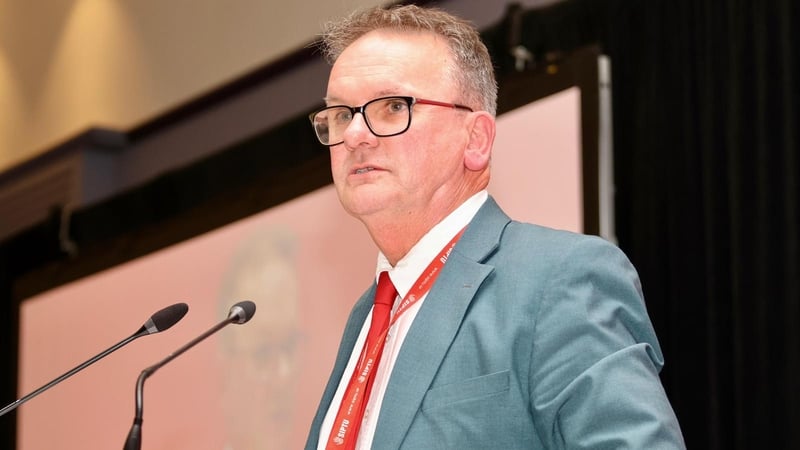

The incoming General Secretary of the country's largest trade union, SIPTU, has warned of significant periods of industrial unrest because the cost of living crisis is "screwing workers".
John King, who will take over the top job next year, said the Government has abandoned the interests of working people.
"We have a situation whereby we've got way too many people in work poverty, with people having to make choices between heating and eating," Mr King said.
"There will inevitably be pressure for wage demands, in order for workers to be able to survive, so inevitably, I believe, it will lead to significant periods of industrial unrest," he added.
The current public sector pay deal runs until June 2026.
"We know our members want a public service agreement, but not at any price," Mr King said.
"And unless there's an acceptable agreement that delivers on pay and conditions of employment, it could well be that there would be significant industrial rest in the public sector," he added.
SIPTU conference
Mr King was speaking at the SIPTU biennial conference which is taking place in Galway this week.
The first motion to be passed urged the Government to introduce tougher regulations to protect workers from online abuse.
"Recent incidents, such as the Dublin riots and the Government's water services transformation have seen
our members carrying out their roles as public servants, or union activists, subjected to abusive and threatening behaviour which was either organised or promoted through online platforms," the motion states.
"Such behaviours which, if carried out on the street, would not be tolerated, or indeed legal, continue on social media, primarily because online platforms effectively operate a 'self-regulation’ system, which is completely inadequate and urgently needs to be addressed through Government action," according to the motion.
Another motion on the protection of union members calls on the Government to introduce legislation that provides for significant financial penalties and prison terms for employers who disregard workers’ rights.
On whistleblowing, delegates heard calls for SIPTU to support a campaign which highlights the importance of whistleblowing in the health service and seeks strong protections for those who step forward.
More than fifty motions are being debated over the course of the conference on issues including pay, pensions, housing, outsourcing and the cost of living.
Also up discussion are concerns over the delayed introduction of a living wage, a proposal to give unions a greater say on sale of assets by semi-state bodies, and calls for the reintroduction of tax relief on trade union subscriptions.
We need your consent to load this rte-player contentWe use rte-player to manage extra content that can set cookies on your device and collect data about your activity. Please review their details and accept them to load the content.Manage Preferences
EU Directive
Delegates at the conference have welcomed a decision by the European Court of Justice to uphold key elements of an EU directive on workers' rights.
The court confirmed the validity of large parts of the Directive on Adequate Minimum Wages, including a requirement for member states to promote collective bargaining.
Collective bargaining is the process of negotiation between employers and employee representatives such as trade unions.
"This is a key moment for workers across Europe, as the court has confirmed our fight for fair wages can continue on firm legal ground," said SIPTU Deputy General Secretary Ethel Buckley.
"The legal certainty is here, the time for delivery is now," Ms Buckley said.
The European Court of Justice annulled some elements of the directive, including a provision listing the criteria that must be taken into account by member states with statutory minimum wages when setting and updating those wages, as well as the rule preventing those wages from being decreased when they are automatically indexed.
"The workers of Europe would simply not have understood why the EU had the power to cut wages and to decentralise collective bargaining after the financial crisis but not the power to provide a framework for advocate minimum wages and higher collective bargaining coverage rates," said Professor Roland Erne, Professor of European Integration and Employment Relations, UCD.