


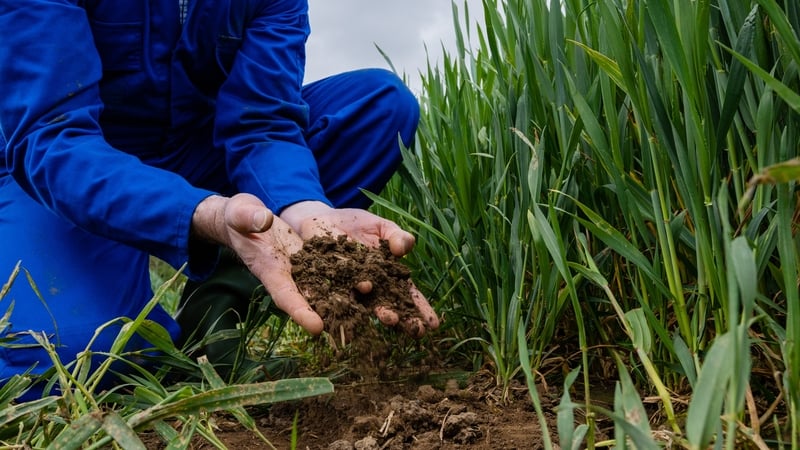
Up to 2,000 farmers gathered at Corrin Mart in Fermoy in Co Cork last night to campaign for the retention of the nitrates derogation.
The nitrates derogation would allow Irish farmers some relief from the strict EU rules aimed at protecting watercourses from agricultural pollution caused by fertiliser and animal waste.
Ireland is now the only EU country seeking this derogation - arguing that fields can absorb more fertilisers due to the country's longer growing season.
EU Environment Commissioner Jessika Roswall will visit Ireland this week, when the matter will be raised again.
Minister for Agriculture Martin Heydon said today that "we are reaching endgame" on the renewal of the EU nitrates derogation.
Speaking on RTÉ’s Morning Ireland, he said his officials are putting together a proposal in relation to the habitats directive, which is part of the criteria for being granted a derogation.
He said that the additional administrative costs of that will be borne by the Department of Agriculture.
"We need our farmers to continue to have a derogation while we carry out what is a very onerous undertaking in terms of that assessment process," he said.
"We are reaching an end game in these negotiations that have been my number one priority since I was appointed as Minister for Agriculture, Food and Marine back in January," he added.
"It's been a number one priority, not just because we have 7,000 farmers operating in derogation around the country, but because it gets to the heart of our agricultural activity, what our farmers do, the length and breadth of the country," he said.
We need your consent to load this rte-player contentWe use rte-player to manage extra content that can set cookies on your device and collect data about your activity. Please review their details and accept them to load the content.Manage Preferences
Mr Heydon said that the engagement with the European Commission "has been very intensive".
"We presented to the Nitrates Committee, which meets four times a year. We presented at that in March, June and most recently in September. The next meeting is due in December," he stated.
In relation to water quality, he said that "ultimately by European standards we have a good water quality and recent Teagasc research has shown the declining levels of nitrogen in our waterways in the south, in the southeast and the east where the most intensive agricultural activity is happening".
He said this shows that the additional measures taken by the country's derogation farmers are undertaking are working.
Meanwhile, the President of the Irish Farmers' Association said today that farmers have done great work in improving water and Ireland has the fourth based ground water quality in Europe.
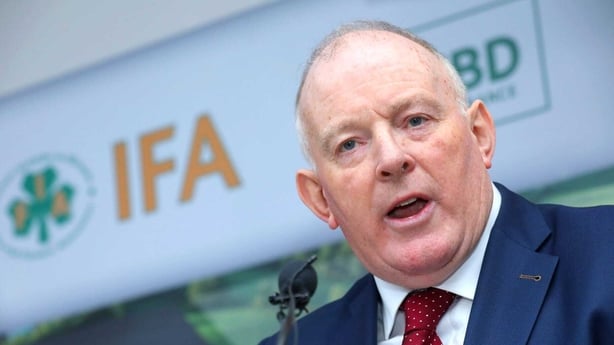
Francie Gorman said it is important that the nitrate derogation, which was given to recognise the grass based system in Ireland and how farmers here graze their stocks, continues.
He told RTÉ'S Today with Philip Boucher-Hayes, that farmers have put a huge amount of effort into improving farming practices and this is backed up by a huge investment from the co-op sector that processes the milk.
Mr Gorman said all farmers need to be compliant with the slurry spreading dates regardless of whether they have a derogation.
He pointed out that agriculture is not the only sector that has an impact on water quality.
The other pressures on water quality including urban waste water treatment plants, the runoff from towns and cities and our roads into our rivers, is not taken into account, he said.
Mr Gorman said farmers are not looking for a free pass but they do want fair play.
He said there is a huge issues with planning in the country and farmers who apply for slurry storage are subject to serial objectors holding up the project.
This needs to be addressed, he added.
Mr Gorman said a situation where "7,000 dairy farmers could left to hang out to dry" cannot be countenanced.
This is the one sector that can bring home the next generation of farmers to farm, he said, and the Government must ensure the derogation is kept.
