Ryanair's CEO has urged the transport minister to resolve the passenger cap problem at Dublin Airport before a general election is called, by signing a letter directing the aviation regulator to continue issuing new airline slots while the matter is going through the planning process.
Michael O'Leary said Eamon Ryan would not be taking any political risks by doing so as he is not seeking re-election.
Mr O’Leary said Ryanair’s legal advice from a senior counsel is that the Minister for Transport has the power to make such a direction to the Irish Aviation Authority (IAA) under Section 10 of the Aviation Regulation Act 2001.
"It will resolve the cap, he has the power to send that letter, and that letter would simply tell the IAA to approve extra slots for all the airlines at Dublin Airport," he said.
The Government, including minister Ryan, have repeatedly said it is not legally possible for it to intervene in the planning process around Dublin Airport.
"It is not interference in the planning process, the daa planning application to Fingal will proceed, but at least don’t hinder growth at Dublin Airport, hinder growth in tourism and growth in jobs, while that planning process continues," he said.
He said it was clear now that the issue will end up in the courts in the Spring of next year and one of the key elements of that, he added, will be that the minister has this power.
"The sad thing is he won’t exercise that power," he said.
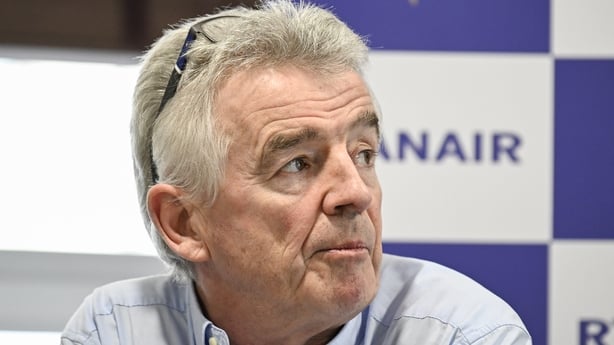
Mr O'Leary said of the 220,000 extra seats that Ryanair would be putting on to bring people home through Dublin for Christmas, 50,000 will now be going to Belfast and the balance won't be offered at all because of the cap.
He added that already at this point air fares for Christmas are 30% higher than they were at this point last year.
Mr O’Leary claimed that the IAA wants to continue to authorise additional slots and so too does the airport operator, daa.
He said Ryanair traffic has only grown by 1% in Ireland so far this year but most of that was through Shannon and Cork where Ryanair had itself take action to boost passenger numbers.
The airline boss reiterated his view that most passengers coming to Ireland do not want to arrive at a regional airport, contrary to the view proffered by members of the Government.
Mr O’Leary added that Ryanair is going to try to make this an election issue if it is not resolved before then.
He said the cap is a clear contravention of EU law and predicted that when the US Department of Transport realises that US airlines cannot add extra flights into Dublin, they may restrict flights by Irish airlines into America.
He also claimed that Ryanair will be the biggest beneficiary of the cap as it will have "materially higher air fares all winter long" and will be making much more profit at Dublin Airport.
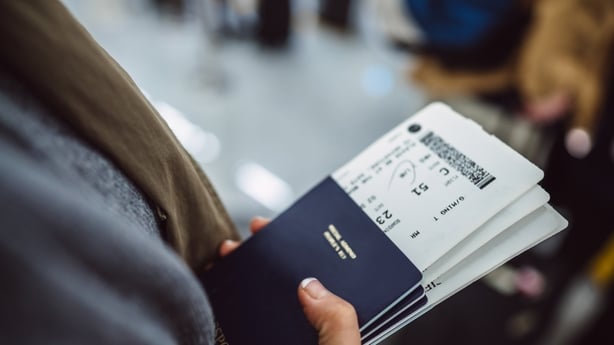
Ryanair has said it expects to begin phasing out the use of paper based boarding passes and check-in desks in airports by the middle of next year.
CEO Michael O'Leary said around 80% of its passengers now travel using the mobile app, with the remainder still using paper.
"We are gradually going to work people away from that piece of paper," he said.
"So I think by probably May of next year the only way you will be able to travel on Ryanair is with your boarding pass on the app."
"And the good news that means is that nobody again will ever be charged for airport check-in or printing a boarding pass at the airport."
"Everybody will be on the app."
He said at that stage people will book on the app, board using it and then order food and drink to their seats on board through it too.
Asked what would happen if there were to be nobody on the ground from the airline to deal with problems, Mr O’Leary said if flights or cancelled or delayed the information would come straight away to the passenger’s smartphone.
He said it someone’s mobile phone battery died before they get to the boarding gate, the boarding staff would still be able to check them in once they have their passport.
"Nobody will be discommoded," he said.
In relation to the ongoing strike at Boeing and how it might impact Ryanair’s future aircraft deliveries, Mr O’Leary said he is not really concerned.
He said Ryanair has around 12 aircraft left to take in November or December and they will probably slip into January or February, well in advance of summer 2025.
He said a further 30 aircraft are due in March, April and May of next year but the airline does not think they will be effected by the strike.
"But we do want to see the strike settled," he said.
Regarding the fares outlook, Mr O’Leary said average fares were down 15% in the first quarter of the year, and Ryanair expects average fares to be down between 5% and 9% in the second quarter which ended in September.
"And then we expect fares in the second half of the year will be down by a smaller percentage number," he said.
Record September pushes Dublin Airport closer to breach of passenger cap
A bumper September of travel has edged Dublin Airport nearer to breaching its passenger cap this year.
A record 3.08 million travellers used the two terminals during the month, a 4% increase on the same month last year, operator daa said.
That brings to 25.8 million the total number of passengers who have passed through the facility so far this year, up 5.3% on the same period of 2023.
Daa said it still expects that the cap of 32 million passengers a year, put in place as part of planning permission for the second terminal in 2007, will be breached this year by up to 1 million.
But it warned that while this month is set to be busy also, autumn will be more subdued as certain airlines have shrunk their operations at the airport due to the unpredictable situation around the cap.
"Daa has long been vocal about the potential negative impacts of the cap, warning it could lead to significant job losses and harm Ireland's economy and international reputation," said Kenny Jacobs, daa's chief executive.
"Regrettably, our predictions are becoming a reality. Ryanair is cutting routes, Aer Lingus is warning of job losses, while Emerald is likely reducing its fleet and may cut its Dublin to Donegal route, all of which leads to economic harm and reduced connectivity for Ireland."
Daa, airlines and business organisations have been piling pressure on the Government to intervene to have the cap lifted so that growth at the airport can resume.
However, a number of Government ministers and the Taoiseach have insisted that it cannot legally meddle in the planning process.
Dublin Airport has submitted an application for planning permission to build new infrastructure which would enable the cap to be increased to 40 million a year, but a final decision on that is expected to take years.
Daa has said a recent separate draft decision by An Bord Pleanála in relation to night time flights at the airport had led to complexities and additional considerations that had complicated its efforts to provide Fingal County Council with further information it requires to progress the infrastructure application.
"Things are going to get worse before they get better," warned Mr Jacobs.
"The coming months will see the passenger cap starting to bite more firmly as airlines finalise their summer 2025 schedules with fewer slots available and reduced capacity, despite overwhelming demand from passengers to fly in and out of Dublin Airport."
"Meanwhile airports across Europe are working hard to get and keep the flights Dublin is losing. And daa is obliged to continue to do its utmost to comply with the cap, despite not controlling the slot process."
But local residents and environmentalists have expressed opposition to any increase in the cap, warning it would lead to more emissions, noise and traffic congestion.