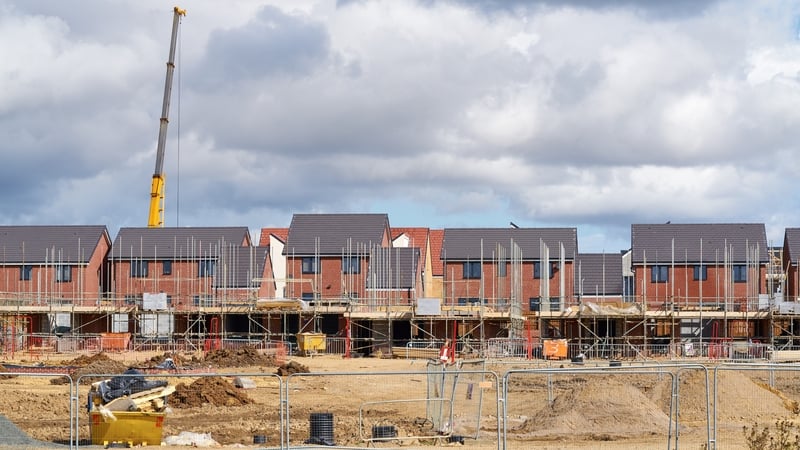

The Sinn Féin plan's defining characteristic is that it proposes to significantly increase State spending to tackle the housing crisis.
Two weeks ahead of the Dáil's return and months or maybe weeks before a general election, party leader Mary Lou McDonald is seeking to put homelessness and property top of the political agenda.
Sinn Féin presents a case for spending €39 billion in total over five years, of which €25bn would come from the Exchequer.
The current Coalition has pencilled €20bn of Exchequer funding for its Housing for All strategy over the same period.
It may not be an exact comparison, but it does illustrate that Sinn Féin envisages ramping up State intervention.
So, is this the right thing to do?
Already a plethora of supports for housing are being provided by the State.
Some estimates suggest more than half of the homes being built in Ireland at present benefit from some form of government support.
Officials in the Department of Public Expenditure and Reform have written a paper questioning whether some of the measures are displacing private construction and distorting the market.
That's an issue Sinn Féin's Mary Lou McDonald is likely to face if her party does get into office and increases expenditure.
Read more: Sinn Féin pledges €39 billion for housing over five years
If State funding creates cheaper housing than the market can deliver, it means private developers can't compete at the same price on other sites in the locality.
That could discourage some development and affect the supply of houses and apartments.
But for any party committed to the supply of cheaper homes, that's a difficult political message to sell in the months before a general election.
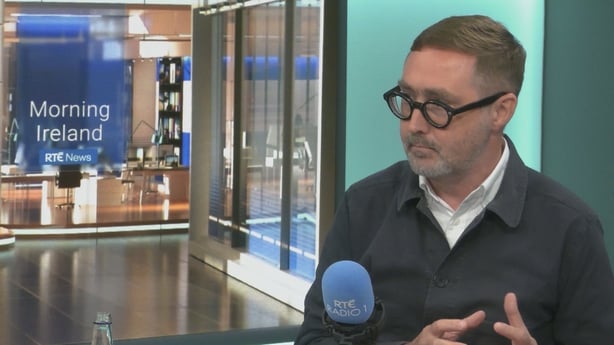
Sinn Féin has set a target of building 300,000 homes over the lifetime of the next government if it enters office.
Under its plans, around 125,000 of that would be social rental, affordable purchase or affordable rental, while 175,000 would be delivered privately.
One interesting aspect of Sinn Féin's plan is confirmation that it is willing to drop some of the current Government's schemes, which have been criticised by economists.
Top of that list is the Help to Buy scheme (where the purchaser of a new home can claim back €30,000 of income tax to fund a deposit).
The concern is that this may be adding to house prices, according to experts.
Consultancy firm Mazars was commissioned to review the scheme. It concluded that the scheme may be driving up prices, while a third of those who availed of the initiative did not need it.
Sinn Féin has also committed to halting the First Homes scheme (where the State buys a share in a home to make it easier for a buyer to get on the property ladder).
This initiative has been criticised by both the Central Bank and the ESRI.
Sinn Féin argues this scheme also puts upward pressure on property prices and may create a significant risk for buyers.
Possibly the biggest impediment to solving the housing crisis is the planning system.
Property developers, lobbyists, politicians and officials alike agree that the current regime is a significant obstacle to building more homes.
Thousands of planning applications are in limbo: Delayed by appeals or waiting to be resolved by the courts.

As I write this in RTÉ’s offices in Donnybrook, Dublin, the site next door, acquired by Cairn Homes in 2017 for €107m and earmarked for 600 apartments, still doesn't have planning permission. There are many similar examples across the country.
Developers' plans aren't always perfect - far from it. But some legitimate plans are being held up by objections in a seemingly endless cycle of legal appeals.
The current Coalition has introduced a mammoth piece of legislation aimed at sorting this out.
Sinn Féin says it will keep some parts of this plan and ditch others.
Importantly, the party has set timelines for planning permissions to be approved or rejected.
It promises to "introduce statutory timelines for all stages of the planning process".
It also commits to a "timeline for judicial review decisions".
The party wants three additional full-time planning and environmental judges on the High Court.
No-one can tell who will run the country after the next election or if Sinn Féin will be part of that administration.
If Mary Lou McDonald’s party does form part of a coalition, it's likely Sinn Féin will be obliged to compromise on some or much of its agenda. That's the nature of coalitions.
There is a long road ahead before anyone can assume Sinn Féin’s housing policy will be put into effect.
In the meantime, Mary Lou McDonald's strategy is to keep public attention on housing.
She believes this is where Sinn Féin can score well against Fine Gael, Fianna Fáil and the Greens, who are trying to keep the carve-up of budget largesse in the headlines.