
History shows that in many Budgets, there has been an unexpected banana skin of some sort.
A measure – big or small - that comes back, either quickly, or over time, to take the feet out from under the Government of the day.
The plan to impose VAT on children’s shoes in 1982, which led to the collapse of the coalition Government at the time, is perhaps the most memorable and often cited example.
But there are plenty of other incidences down through the years of governments having to row back on a policy change announced in the Budget, in the hours, days, weeks and months that followed, owing to a public furore about it.
This year, Budget 2024 seems to have passed off without any ministers ending up on their backside having slid on the proverbial fruit peel – so far at least.
There are some issues that show some potential to come back and haunt the collective cabinet though.
Health is one, with the opposition claiming that the Minister for Health had been left to "hang out to dry" by colleagues because of a €22.5bn budgetary allocation that some claim is far lower than what may actually be needed to run the health service next year.
Another point of possible trouble are the two funds that are to be set up to cater for future health and pension needs as the population ages, and for spending on infrastructure during economic downturns, as well as climate measures.
The plan has generally been welcomed as prudent, long-sighted and a responsible way of dealing with our buoyant but unpredictable corporation tax take in the years ahead.
But the proof of the pudding will be in the eating and in whether this and subsequent governments can live up to the promise to divert cash this way, in the event of an unexpected squeeze on revenue or spending, or in the face of an impending election.
When it comes to the finances of ordinary people, however, perhaps the trickiest measure for the Government is the "targeted" mortgage interest relief.
For many months prior to the Budget, Sinn Féin had been talking up the need for some sort of assistance for hard-pressed households who have seen their mortgage repayments soar since the European Central Bank began hiking rates in July 2022.
Monthly repayments on an outstanding €220,000 tracker mortgage with 15 years remaining have risen nearly €500 a month in the last 15 months, or €6,000 a year, for example.
Variable mortgage rates haven’t increased quite so much, but have started from a much higher base than the trackers.
For those who currently or in the past experienced repayment difficulties and have had their mortgages sold by banks to investment funds and credit servicing firms, the situation is even trickier.
Because of their chequered credit histories, they cannot move their mortgages to another lender, as none will take them on.
But these funds and credit servicing agents typically do not offer fixed rates on their mortgages.
As a result, some 32,000 borrowers in such a circumstance have been stranded with ever increasing tracker or variable rates, which in some cases now top 9%.
These are the people that were most in need of assistance from the Budget, not only to relieve their financial pressure but also to prevent their arrears problems recurring or getting worse, further perpetuating their difficulties.
Sinn Féin’s persistent calls for wider action to help these and other struggling borrowers did lead to increased questions of and pressure on the Government to do something of a more catch all nature.
At the beginning of the year, the coalition said it had "no plans" for mortgage interest relief.
But that stance had softened by May, before ministers began gradually joining in on the "temporary and targeted" narrative proposed by Sinn Féin.
The expectation come Budget day though was that what would be announced would be extremely targeted, like at those who cannot shift their mortgages away from investment funds and credit servicers.
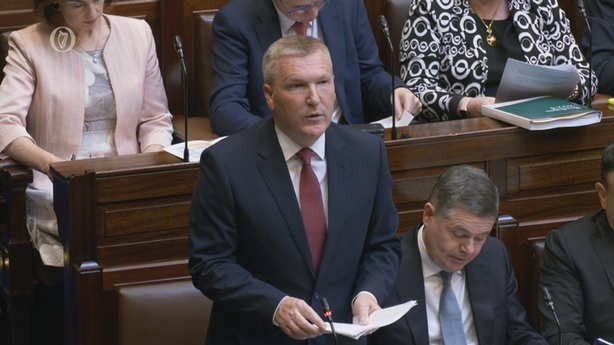
When Michael McGrath made the announcement though it became obvious that it was far more wide-reaching than that.
The assistance will be available to all mortgages on principal private residences in the State, where the outstanding balance was between €80,000 and €500,000 at the end of December and where the borrowers are compliant with Local Property Tax requirements.
The relief will come in the form of a credit in early 2024 and around 125,000 people are expected to benefit from it. And therein lies the problem for the Government.
Costing the State €125m, the relief will be at the standard rate of tax and apply to the increase in interest paid between the calendar year of 2022 and the calendar year of this year, with a maximum of €1,250 per property.
To claim it, the taxpayer has to file a tax return – something many people will not know how to do, or want to do.
The relief will come in the form of a credit in early 2024 and around 125,000 people are expected to benefit from it.
And therein lies the problem for the Government.
Most of those will be tracker or variable rate mortgage customers who are not in financial distress, have paid down a large portion of their loans and have benefited for many years from exceptionally low interest rates.
Whereas those more than 500,000 borrowers who saw the writing on the wall and opted for fixed rates last year or before – in some cases also at elevated levels - will not benefit.
While the many tens of thousands of mortgage holders due to exit a fixed rate arrangement in the months after the end of this year and who are facing into a big jump in repayments will also miss out.
This situation has been met with some irritation among those who won’t qualify – many of whom are in the so-called "squeezed middle" that the Government particularly wanted to help in the Budget - who can argue with some justification that the Government is helping the wrong people.
Another problem facing the Government is how it ends this relief. It is supposed to be timebound, to address only interest rate increases in 2023.
But the ECB will not be cutting its rates for a while and so the Government may face renewed pressure next year to do the same again to help mortgage holders, or more.
Failure to do so may not be a good look ahead of a general election.

Back in 2008, eligible borrowers were able to claim mortgage interest relief of up to €2,000 a year for the first seven years of the loan.
For many borrowers, that is the benchmark.
And then there is the argument that mortgage interest relief is counterproductive to what the ECB is trying to achieve – a reduction in inflation.
Mortgages are one of the few aspects of the economy where the pass through of changes to ECB monetary policy are more or less direct.
Repayments on mortgages are also the biggest single monthly outlay for most households.
By dampening down the pressure caused by rising rates, the Government is in essence setting itself against the ECB’s actions and at best could be slowing the speed at which inflation will fall.
So returning to where we began, the mortgage interest relief may not be an instant banana skin in the VAT on children’s shoes sense.
But nonetheless, by yielding to the pressure from Sinn Féin and others, the Government may have made a rod for its own back that it may yet live to regret.