



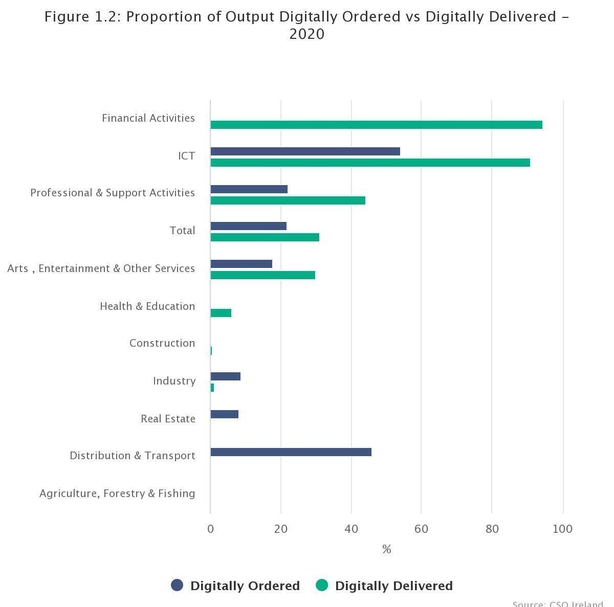
A new report from the Central Statistics Office reveals that 22% of the economy's output in 2020 was digitally ordered - representing €154 billion of transactions.
The majority of that was services, including online banking and video streaming services.
The survey found that nearly half of products in the distribution and transport sector were digitally transacted - largely due to services like food delivery apps and online hotel bookings.
Today's CSO figures show that 94% of transactions in the Financial Services sector in 2020 were conducted digitally.
These online transactions include the provision of insurance, pensions, fund management and online banking.
Over 95% of transactions in the Information & Communication Technology (ICT) sector took place online. This sector includes computer programming, publishing, film and broadcasting or digital streaming services.
Meanwhile, 46% of products in the Distribution and Transport sector were digitally transacted, mostly composed of digital ordering.
Examples of such transactions include hotel bookings, food delivery apps or airline tickets.
But only 10% of products in the Industry sector were digitally transacted, the CSO said.
It said the low figure for this sector is explained by the fact that goods can be digitally ordered but not digitally delivered. For example, fuel can be ordered online but cannot be delivered digitally.
The CSO said this is the first time it has produced this data and it is among the first national statistical institutes in Europe to make estimates of the digital economy through the supply and use framework.
"The results are experimental at this stage. However, they demonstrate the impact digitalisation has had on the Irish economy," the CSO added.
