


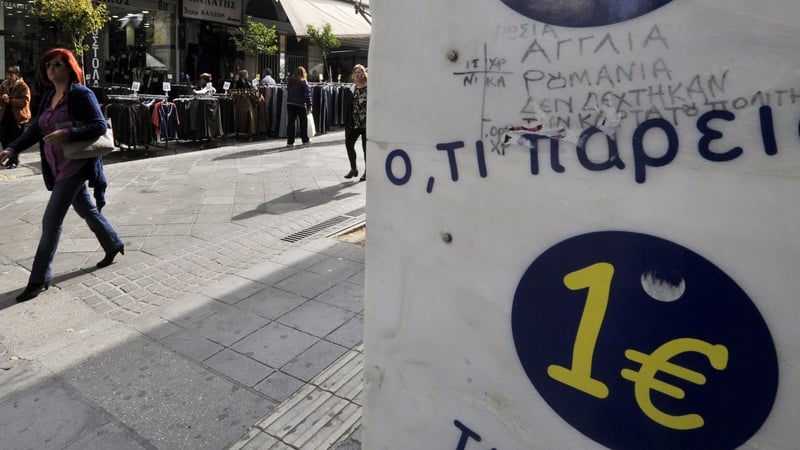
Fitch ratings agency has downgraded crisis-hit Greece by one notch to CCC, citing the "heightened risk" that the country may be forced to abandon the euro currency union.
In a statement today, Fitch said the downgrade followed the strong showing of anti-austerity parties in Greece's May 6 general elections and the subsequent failure to form a government.
Earlier, the head of the European Commission said the European Union will honour its commitments to Greece in an effort to make sure it remains within the euro area, but Athens, too, must meet its obligations to the EU.
"As far as Greece is concerned, I would like to reaffirm very clearly that we want Greece to stay in the euro area. And the European Union will do all it takes to ensure it," Jose Manuel Barroso, president of the European Commission, the EU's executive body, said in excerpts from a speech distributed for publication prior to formal delivery at the United Nations.
However, when Mr Barroso delivered his speech before the 193-member body, he stayed largely to his prepared remarks but, in an odd twist, completely left out his comments about Greece.
"It was a last-minute change. The UN delegation wasn't aware of it," the EU's UN delegation spokesman told Reuters.
In the excerpts, Barroso made reference to upcoming Greek elections after attempts to form a government failed following an inconclusive vote on May 6.
New elections are set for June 17. The rising leftist leader of the SYRIZA party, 37-year-old Alexis Tsipras, is calling for an end to "barbaric" austerity policies he said were bankrupting the nation.
"We will honor our commitments toward Greece and we expect the Greek government - current and future - to fulfill jointly agreed conditions for financial assistance," Mr Barroso said.
Mr Barroso said that while the EU respects the will of the Greek people and their vote, it also must bear in mind the will of the 16 other euro zone nations that have agreed on conditions for giving Greece financial assistance.
Greece's long-running economic crisis turned into a full political crisis after parties opposed to the terms of a €130 billion bailout made strong gains in the May 6 vote, leaving the country without a government and raising the chances that it would renege on terms of the deal.
In his remarks, Mr Barroso said the EU has responded robustly to the crisis over the last two years with a twin-track approach of promoting stability and growth.
"We need to stay the course, without being blind to an evolving economic situation," he said.
Mr Barroso is taking part in the United Nations General Assembly High-Level Thematic Debate on the State of the World Economy and Finance in 2012. It is bringing together high level ministers, mainly from emerging market nations in Europe, Middle East, Africa and Latin America.
IMF keeps Greece mission frozen until new vote
The IMF said today that it would hold off on contacts with Greece until new elections, despite the formation of an interim government in Athens.
"We take note that elections have been called, and we look forward to being in contact with the new government once it has been formed," spokesman David Hawley to reporters.
The next IMF mission to inspect progress on reforms "would follow the elections" expected June 17, Mr Hawley said, adding that he did not have a specific date.
The International Monetary Fund's policy and disbursements under a €130 billion IMF-EU bailout program have been on hold since a May 6 election failed to produce a stable coalition government after weeks of haggling between parties over economic and social policy.
The IMF spokesman made clear at the regularly scheduled press briefing that the global emergency lender would wait to deal with whatever new government comes into power.
Yet the new election expected on June 17 offers no guarantee of a viable government able to implement an EU-IMF bailout that has divided the country.
