


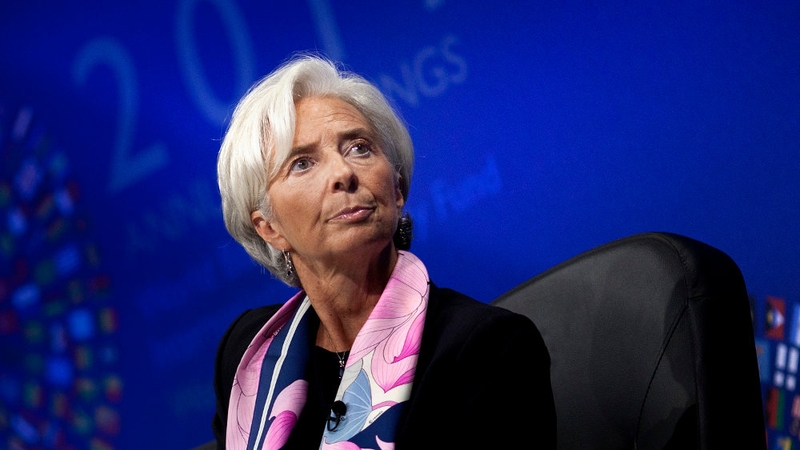
International Monetary Fund chief Christine Lagarde today warned the world risked plunging into a "downward spiral" of financial instability and urged Asian economies to be on their guard.
Lagarde said Asia was not immune to problems currently sweeping the euro zone, as she began a two-day visit to China likely to focus on the deepening debt crisis in Europe.
"If we do not act together, the economy around the world runs the risk of a downward spiral of uncertainty, financial instability," she said at the International Finance Forum in Beijing.
Lagarde has so far held talks with Chinese central bank governor Zhou Xiaochuan on the "global economic situation", the People's Bank of China said in a brief statement. A Foreign ministry spokesman said Lagarde would also meet with "state leaders" but did not specify who they would be.
Any discussions are expected to touch on China's possible contribution to a bail-out fund - the European Financial Stability Facility - set up to provide support to the bloc's struggling economies. European leaders have called on China, which has the world's largest foreign exchange reserves at $3.2 trillion, to invest in the fund.
The head of the fund, Klaus Regling, has travelled to Beijing for talks about a possible contribution, but China has so far made no firm commitment to provide financial assistance for the troubled euro zone.
Europe has been discussing with China and other investors how to structure a special purpose investment vehicle and is exploring the possibility of linking it to the IMF. "We are all in it together and our fortune will rise or fall together," said Lagarde, fresh from a visit to Russia where she warned Moscow against complacency, given the budget crises in euro zone states.
"Asia is not immune. Whether it is the trade channel or whether it is the financial sector which can operate as a crisis accelerator, Asia needs to be prepared," she added.
Lagarde added to pressure on Beijing for a faster appreciation in the yuan, saying that while China was on the "right path" in terms of boosting domestic demand, a stronger Chinese currency "in real effective terms" was needed.
The US and Europe - major buyers of Chinese products - have accused Beijing of deliberately keeping its currency undervalued to give its exporters an unfair advantage. Beijing has rejected the charges.
At the G20 summit last week, China pledged to promote greater flexibility in the currency, but analysts do not expect to see a dramatic change in the value of the yuan given the importance of exports to the Chinese economy.
A move to help developed European countries out of the current crisis would be a hard sell for leaders of a country where millions of people still live in poverty, and inflation and housing costs are straining household budgets.
China has also been burned before on risky overseas investment. It bought stakes in investment bank Morgan Stanley and asset management firm Blackstone only to see values collapse in the 2008 global financial crisis. The losses led to severe criticism of the investment choices made by the $400 billion sovereign wealth fund - China Investment Corp (CIC) - only a year after it was established in 2007.
