


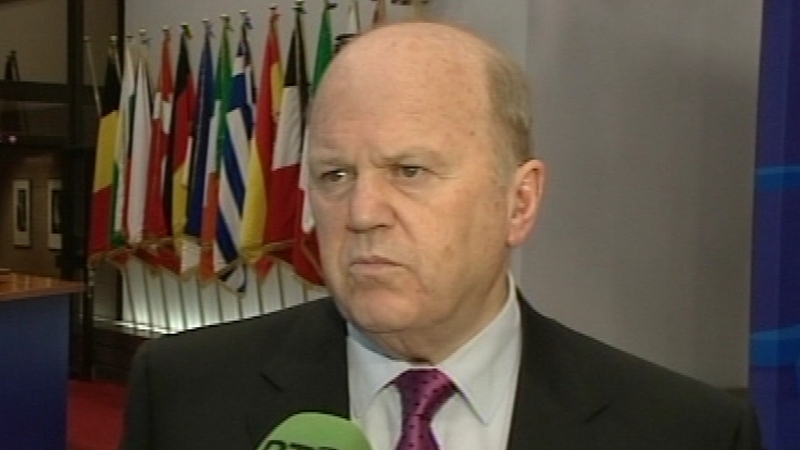
Finance Minister Michael Noonan has said that the Government would bring out a three to four year plan - sometime in October - that would show people what kind of expenditure cuts and tax increases will be required from the start of 2012 until the Government gets to its target of a deficit of less than 3% in 2015.
He said the Government would hope that once we hit 2014 most of the pain will have been endured and the country will have a strongly growing economy again, with people going back to work.
But, he said, it is important that people have certainty so they can make decisions. He said there were quite a lot of savings in the economy and he added that if people had certainty they would be in a better position to know if they could do the kind of purchasing that they need to do in their personal lives.
He said that there are a lot of people in their 30s who are putting off buying houses but have quite significant savings. He said those people do not know whether they are at the bottom of the market or not and they do not know what kind of charges will be imposed on them.
He said the Government would hope to clarify all of this in October in a three to four year plan. It would then be more specific in the one year budget which would be introduced in very early December.
The Finance Minister also said that the Government would probably have to mark down growth rates for 2012. He said that this would make the Budget more difficult.
Speaking at Fine Gael's parliamentary meeting in Galway today, he said the country has had a reasonably good summer taking into account the difficulties of the economy.
He said the interest rate reduction on the country's IMF/EU bail-out deal and the fact that the bank restructuring was costing a lot less than initially thought were both positive. But he said that on the downside the international situation is now running against us.
The Minister said there were no soft options and he said it is better that everybody in Fine Gael are fully aware of the kind of decisions that have to be taken in the Budget and for the next few years.
ESRI expects lower Irish debt levels
The Economic and Social Research Institute has said July's EU agreement to reduce interest costs on the EU-IMF bail-out funds means Ireland’s debt-to-GDP ratio will be significantly lower than previously estimated, while the budget deficit could fall below 3% in three years’ time.
Ireland's debt position is also helped by lower than anticipated bank recapitalisation costs.
In its new analysis, the ESRI says the gross-debt-to-GDP ratio should now peak at about 113% of GDP in two years' time.
Before the deal done at the EU summit in July, the Government and the EU-IMF forecasted a peak of between 118% and 121%.
The ESRI also notes that Ireland will have a large cash balance in 2013, and, taking this into account the net debt ratio will peak at 103% of GDP.
This compares with a previous net peak of 111% of GDP back in 1987.
The lower costs of the bail-out deal should mean Ireland outperforms its target of getting the budget deficit below 3% of GDP by 2015 - assuming the austerity programme is implemented in full and there is decent growth in the economy.
As Ireland's new debt outlook becomes more widely known, the ESRI says it should increase market confidence in Ireland's ability to ride out the current crisis, and improve prospects of returning to borrowing from the markets in two years’ time.
