


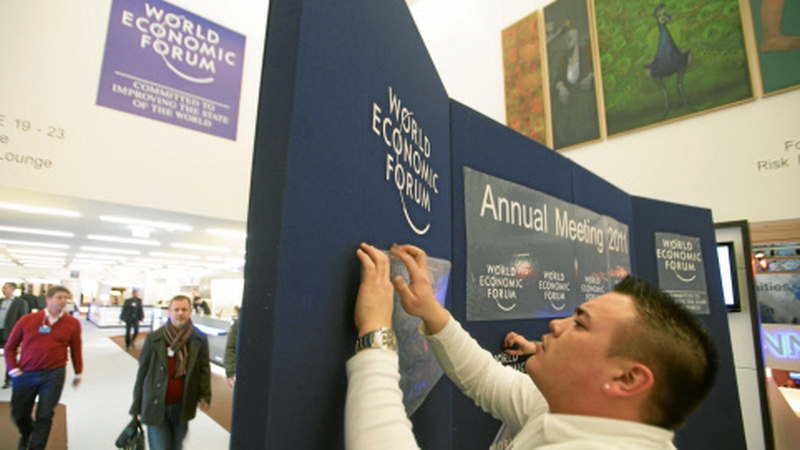
Rising inflation and its impact on the fast-growing developing world are major risks to the economic recovery this year, CEOs gathering for the annual Davos meeting said today.
Business leaders said rising food prices could spark fresh social unrest and pointed to worries over tensions between North and South Korea and Iran and Israel.
'Interest rates are zero today but they can only go up and higher interest rates will drive financing costs up as well,' John Krenicki, chairman and chief executive of GE Energy and vice chairman of GE said. 'It's not just inflation in energy but steel, cooper and general commodities,' he added.
A PricewaterhouseCoopers survey on the eve of the World Economic Forum showed optimism among chief executives has bounced back to almost the same level as before the financial crisis.
But CEOs at Davos struck a more cautious tone, pointing to the numerous risks which could yet derail the fragile global recovery.
The four-day forum in the Swiss Alps brings together at least 35 national leaders, including the presidents of Russia and France, and over 1,400 business chiefs.
Bankers are keen to show their industry emerging successfully from the wreckage of the global financial crisis and politicians want to dispel the gloom hanging over the euro zone. Both will emphasise how important rapid growth in developing countries is to the global recovery.
'This year, we think we'll see western Europe continuing to be tepid, America more U-shaped and the fast-growing emerging markets will continue to be V-shaped,' Martin Sorrell, chief executive of advertising group WPP, told the opening session at Davos.
Resurgent inflation is stalking the emerging markets on which world business is pinning its hopes for growth. Reports in China this week that suggested new bank lending has surged in January, defying state efforts to restrain it.
India raised interest rates yesterday, warning that higher food prices could become entrenched if steps to boost output are not taken.
But the threat is not confined to the emerging world. Euro zone inflation exceeded the European Central Bank's 2% target for the first time in two years last month and Bank of England Governor Mervyn King has warned that UK inflation could hit 5% soon.
Sorrell put global economies into four divisions: the BRICS - Brazil, Russia, India and China - in the top category, followed by the US and Germany, then Western Europe and Japan last.
The forum's official theme 'Shared Norms for the New Reality' reflects a desire to ensure that the new big players on the global stage share the values of the existing major powers.
With emerging economies accounting for almost 40% of global consumption, a slowdown in these economies 'would deal a serious blow to the global recovery', the IMF said in an updated World Economic Outlook released earlier this week.
Europe's festering debt crisis is another threat not just for policymakers but also for otherwise chipper company bosses.
