


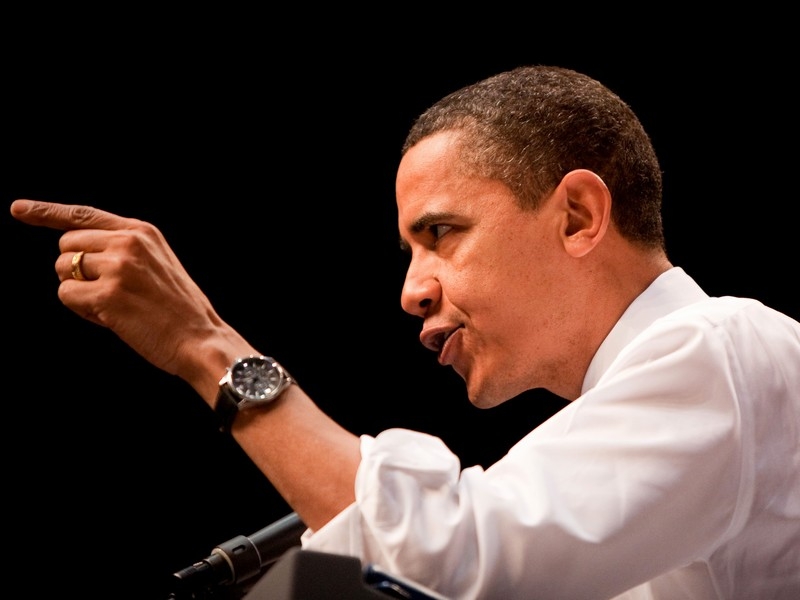
President Barack Obama said today that the US has an obligation to future generations to tackle huge budget deficits, as his bipartisan debt commission met for the first time.
Obama said the 18-member National Commission on Fiscal Responsibility should be free to do its work without limitations and said he would not speculate on what the bipartisan panel should consider.
'It is a lot easier to spend a dollar than to save one,' Obama said, but warned the US economy faced a 'day of reckoning' without serious action.
Meanwhile Federal Reserve Chairman Ben Bernanke warned that resurgent economic growth alone would not be sufficient to cut the massive fiscal gap.
Bernanke suggested that tax rises, or deep spending cuts - both of which would be politically perilous for Obama - would be needed to address the deficits.
'No credible forecast suggests that future rates of growth of the US economy will be sufficient to close these deficits without significant changes to our fiscal policies,' Bernanke said, as the commission opened for business.
The White House has warned that the deficit for the 2010 fiscal year that ends September 30 could swell to $1.555 trillion, eclipsing the prior year's record of $1.415 trillion, because of spending to stimulate recovery from the worst recession in decades.
Under Obama's latest budget projections, the cumulative deficit over the decade after 2011 would be $8.532 trillion, or 4.5 % of gross domestic product.
The Congressional Budget Office has estimated the deficit will snowball to $9.761 trillion or 5.2% of GDP.
Obama called on both parties to work together towards fiscal responsibility, saying that huge deficits had been inflated by emergency measures needed to save the US economy during a historic crisis.
But he also blamed years of government profligacy, in an apparent reference to spending on wars and programs piled up under the former Bush administration and an era of Republican control of Congress.
'For years, folks in Washington deferred politically difficult decisions and avoided telling hard truths about the nature of the problem," Obama said.
'We have an obligation to future generations to address our long-term structural deficits which threaten to hobble our economy and leave our children and grandchildren with a mountain of debt.'
Obama called on the National Commission on Fiscal Responsibility and Reform to comb over government programs to look for savings and deficit cutting moves.
The panel, co-led by former Republican senator Alan Simpson and veteran Democratic operative Erskine Bowles, is due to report by December 1 - well after mid-term elections in November.
Both Houses of Congress are expected to bring the non-binding recommendations of the commission to a vote.
As the US economy begins to recover from the deepest recession in decades, Bernanke warned that future long-term US prosperity was on the line.
'History makes clear that failure to achieve fiscal sustainability will, over time, sap the nation's economic vitality, reduce our living standards, and greatly increase the risk of economic and financial instability.'
American consumer confidence swells
Meanwhile, a widely-watched US poll brought some positive economic news. Americans are increasingly positive about the state of the economy and optimistic about the future, according to a leading poll published today.
After months in the doldrums and amid the worst economic crisis in a generation, Americans are now more positive than they have been in around a year and a half, according to the latest monthly survey by the Conference Board.
The poll asks 5,000 US households a series of questions about their level of confidence in the economy. The results produce an index where 100 points would signify total confidence and zero represents absolute pessimism.
The research firm's consumer confidence index for April stood at 57.9, up from 52.3 in March.
Expectations about the health of the economy in the coming six months also improved.
The board's 'expectations index' was up to 77.4 from 70.4 in March.
The monthly figure is a widely watched indicator that often is linked to US consumer spending, which has long driven around two-thirds of the country's economy.
Boosting consumer confidence is considered a key factor in sustaining the economic recovery.
