


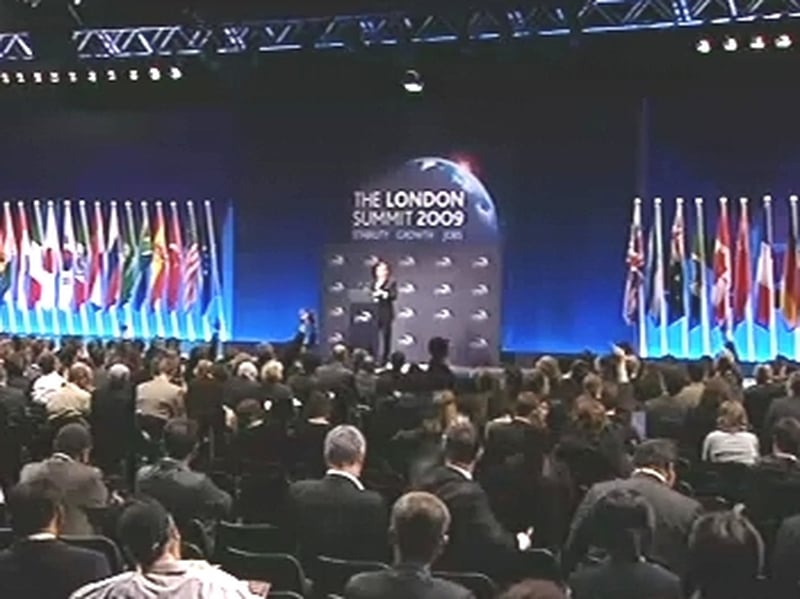
World leaders pledged a huge raft of new spending yesterday and a crackdown on tax havens and excess corporate pay to step up the battle against the economic crisis.
The Group of 20 summit said more than $1 trillion would go to the International Monetary Fund and other finance and trade institutions to help struggling countries through the turmoil.
British Prime Minister Gordon Brown said that by the end of 2010, the Group of 20 developed and developing nations would have spent $5 trillion fighting the crisis and hailed what he called the start of a 'new world order'.
US President Barack Obama also called the London summit accord a hoped for 'turning point' but acknowledged there was no guarantee that the recession would not become depression.
Outside the summit, there was no repeat of yesterday's violent clashes by protesters angry at the economic crisis, but police made 32 arrests and four people were charged over an attack on a bank during the riots.
Obama said the G20 had agreed 'an unprecedented set of comprehensive and coordinated actions,' and stock markets shot up in response to the deal.
Even French President Nicolas Sarkozy, who had threatened to walk out of the summit, said the results were ''more than we could have hoped for'. German Chancellor Angela Merkel said a historic compromise had been made.
Before the summit, the US and Britain had pushed for bigger stimulus spending while France and Germany had called for the focus to be put on greater regulation of the financial sector. Neither side got everything they wanted.
The summit promised $1.1 trillion of 'resources' for the IMF and other global finance bodies. There will be $500 billion of funding, $250 billion in special drawing rights and $250 billion in trade credit. But much of the new funding has already been promised by individual members, including $100 million each from Japan and the European Union.
After the summit, the Organisation for Economic Cooperation and Development published a list of non-compliant tax havens which Brown said would face immediate action, adding that 'we have agreed tough standards and sanctions for use against those who don't come into line in the future.'
Costa Rica, Malaysia, the Philippines and Uruguay were among the countries named by the OECD as tax havens which had not made any commitment to respecting international standards on exchanging tax information.
Brown said there would also be new rules on corporate bonuses to discourage bankers who take short term risks. The leaders also ordered the IMF to sell billions of dollars of gold reserves to help the world's poor countries, Brown said.
He also said that the IMF and World Bank would undergo major reforms to reflect world changes which have seen the rise of China, India, Brazil, South Africa and other new powers.
