


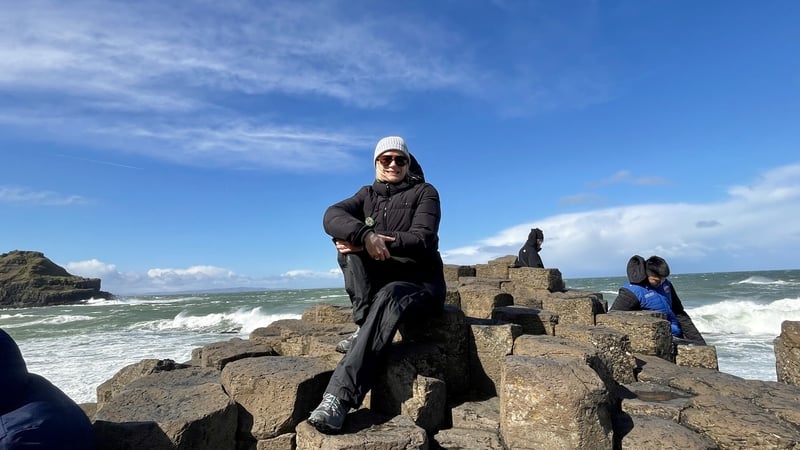

On the invitation of Discover Northern Ireland, travel writer Deirdre Mullins explored the Causeway Coast, from the Giant's Causeway to the cliffs at Fair Head.
One minute, Rathlin Island is crystal clear, its pale limestone cliffs sharp against the grey-blue sea. Five minutes later, it's gone entirely, swallowed by mist. This is the rhythm of the Causeway Coast, where the landscape never quite settles.
During my visit, Storm Dave rolled in off the Atlantic, compressing "four seasons in a day" into four in 10 minutes. Light shifted without warning, clouds closed in, and the view you thought you had disappeared as quickly as it arrived.
For my long weekend, I based myself in Ballycastle, Co. Antrim, resisting the urge to "do" the entire 200km Causeway Coastal Route, from Belfast to Derry, in one sweep. Instead, I stayed put and explored the area around Ballycastle.
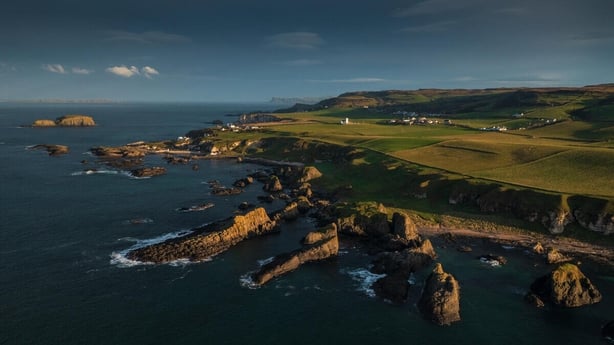
The Salthouse Hotel was my base, perched on a hill above town with views of an ever-changing seascape: Rathlin Island hovering offshore, the cliffs of Fair Head rising sharply, and the Mull of Kintyre sitting so near it's hard to believe you're looking at Scotland.
At just 19 kilometres across the water, it's no wonder we have such a connection with the Scots. The four-star Salthouse hotel is one of a few in Ireland that's carbon-neutral, powered by its own wind turbine and solar panels, and drawing water from an on-site well.
Staff are happy to refill water bottles, and there's a quiet satisfaction in knowing your stay leaves a lighter footprint. The following day, I packed both sunglasses and rain gear and headed down to Ballycastle Harbour, where I met Charles, a skipper with Kintra Boat Tours, who had kindly rescheduled our trip to avoid the worst of Storm Dave.
A Scotsman, he came to Ballycastle 30 years ago to buy a boat and never went back. As we pulled out of the harbour, the daily ferry to Rathlin Island was already making its way across. Among the passengers was a full-sized bin lorry, part of a weekly run to collect rubbish from the island's population of around 140 residents. It's a slightly surreal sight, but a practical one.
From mid-April to August, puffins outnumber people here, with 2,500 birds nesting along the cliffs. Dawn, a marine biologist from Louth, was also on board, bird book in hand, adding another layer to the experience. As we traced the shoreline, Charles shared stories over the PA on local history and smuggling routes, while Dawn pointed out seabirds overhead and nesting along the cliffs.
This is the largest seabird colony in the north of Ireland, home to guillemots, razorbills and kittiwakes, all packed tightly onto narrow ledges. We weren't lucky enough to spot dolphins this time, but they do pass through these waters later in the summer, along with whales and basking sharks.
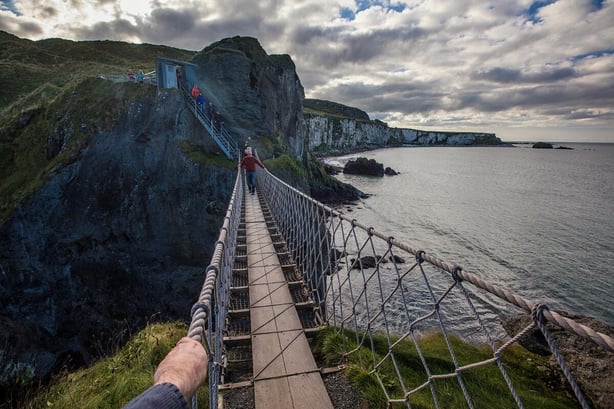
From the sea, the coastline feels even more dramatic. We passed Carrick-a-Rede Rope Bridge, first erected by salmon fishermen over 250 years ago to reach the small island where they worked their nets. Seeing the 30-metre drop and the rough swell below did nothing to settle my nerves ahead of our planned crossing the following day.
We cruised past sea stacks and the Mermaid's Waterfall, while Charles pointed out small, almost hidden caves carved into the rock, once used to quietly move contraband, mostly whiskey, between Scotland and Ireland.
That afternoon, I got out of the storm's way and headed to Old Bushmills Distillery, the oldest licensed distillery in the world. Whiskey had been distilled here long before, but it was officially granted a licence in 1608.
The tour follows the process from grain to glass, making clear just how much patience is involved. It ends, as it should, with a tasting, warm, smooth, and well-earned after the morning on the sea. After the distillery, we made a quick stop at The Dark Hedges, the atmospheric avenue of beech trees made famous as the King's Road in Game of Thrones. I'd seen it countless times on Instagram, but in reality, it felt underwhelming. The trees were bare, more skeletal than cinematic. It's one for summer.
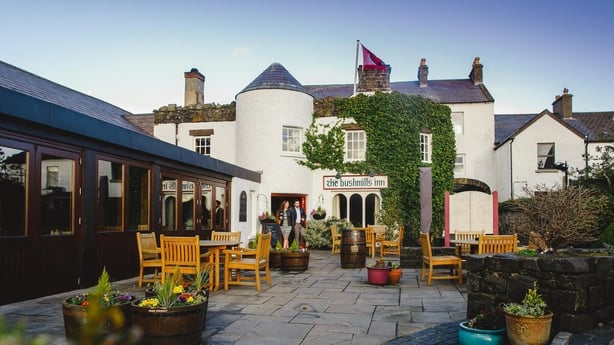
Dinner that evening was at Bushmills Inn, where the dining room sits in the old coach house and stables. Timber tongue-and-groove ceilings and wooden Victorian booths create a warm, intimate space to enjoy local seafood.
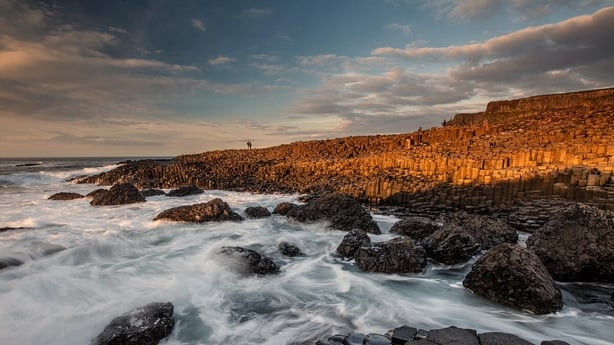
The next day, I made my way to the Giant's Causeway, the undeniable centrepiece of this stretch of coast. Before stepping out onto the stones, I stopped at the visitor centre, an attraction in its own right. Designed by Heneghan Peng Architects in Dublin, the building draws from the jagged basalt formations of the Causeway.
I joined one of the guided tours and followed our guide down towards the sea as the wind whipped in off the Atlantic. He began with the legend: the Causeway was built by the Irish giant Fionn Mac Cumhaill as a bridge to Scotland to challenge his rival. Then came the science, around 60 million years ago, volcanic activity cooled and fractured to form these interlocking basalt columns, a process that is just as awe-inspiring as the myth.
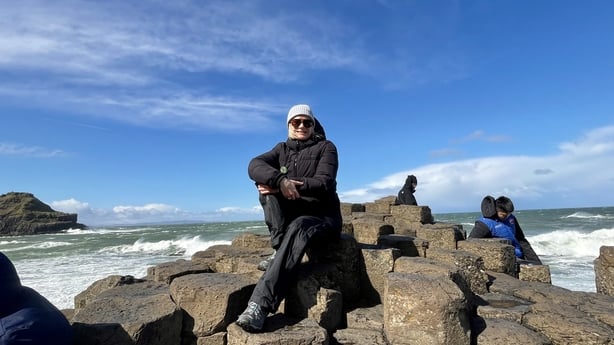
It's a striking landscape, thousands of tightly packed columns spilling towards the sea, like a natural game of Tetris, each one locked into the next. After the tour, I wandered at my own pace, stepping across the hexagonal stones as the elements put on a show. The wind came in cold and hard while the sun held its ground. Waves crashed against the rocks, occasionally sending up bursts of salt spray that caught me off guard. It was wild, exposed, and dramatic.
Afterwards, we retreated to the nearby Causeway Hotel, a stately Victorian building just a short walk from the site, where lunch felt well-earned after battling the elements. The rest of the afternoon unfolded in shorter, quieter stops. At Dunluce Castle, the ruins cling dramatically to the edge of a cliff.
At Whitepark Bay, I walked along a wide, empty strand. And at Ballintoy Harbour, familiar to many as a Game of Thrones filming location. Later, I made my way to Carrick-a-Rede Rope Bridge, fully intending to test my nerve on the swaying crossing I'd seen from the boat the day before. But the weather had other ideas. High winds forced the bridge to close. I stood at the edge, looking across at the small island just out of reach, disappointed, but not surprised.
Instead, I drove back towards Ballycastle along the coast road, approaching the town from above, where sweeping views opened out over the beach and the 200-metre-tall monolith that is Fair Head. By the following day, the worst of Storm Dave had passed. The gusts had softened just enough, and I made my way to Fair Head, set on a privately owned working farm that has been in the McBride family for close to 300 years.
I pulled into their small car park, a simple setup that felt a world away from the more polished stops along the coast.
From there, I followed what could loosely be described as signposts before they gave way to well-worn tracks across open farmland. Members of the McBride family zipped by on quad bikes, tending to sheep, and it felt less like visiting an attraction and more like being welcomed into someone's home.
The further out I walked, the wilder it became. Storm Dave had mostly moved on, but its tail still lingered in the steady wind pushing against me. At the cliffs, there are no barriers, and I didn't go too close. Instead, I stood back and took it all in: Rathlin Island just offshore, and the Mull of Kintyre, closer now than it had felt at the beginning of the trip.
A fitting end to a weekend shaped by wind, sea, and wide open space.
The details
Deirdre Mullins was a guest of Discover Northern Ireland. For more information on The Causeway Coast, please visit www.discovernorthernireland.com.
You can follow more of Deirdre's travels on @deirdremullins.
The views expressed here are those of the author and do not represent or reflect the views of RTÉ.
Read more: A wild escape at The Lodge at Ashford Castle
