


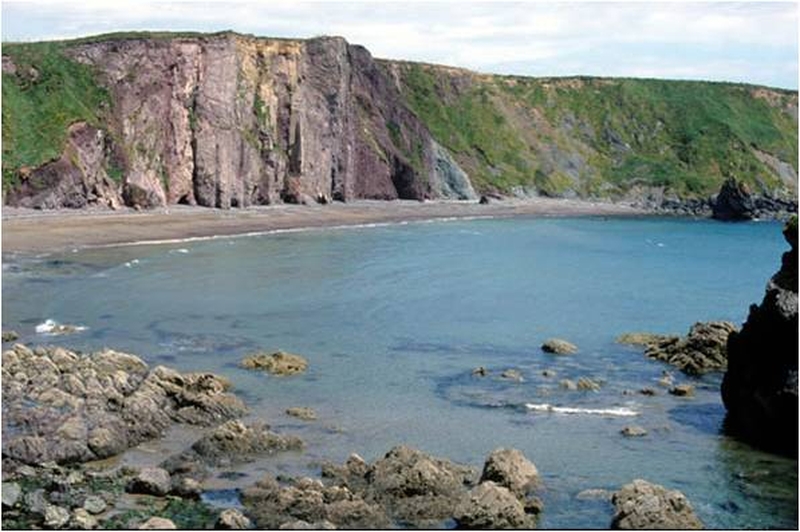

While the topography of our landscape is perhaps the most familiar to us, we seldom get to delve into what lies beneath that landscape and was formed over geological time. Beneath our feet lie formations that yield clues to how this country Ireland evolved over millions of years into what it is today.
Once we were completely part of the European land mass and Ireland only became an island about 125,000 years ago – a short hop in terms of geological progress. And and did you know 460 million years ago that the North and South of Ireland were close to the South Pole but 3,000 kilometres apart ? It may be a challenge to take it in and to see the significance of such evolutionary developments but at least now we have an area that yields much in helping us to understand their importance.
The Copper Coast Geopark in County Waterford has emerged as an area recognised by UNESCO as having a particular geological heritage of international significance, which also has a sustainable development plan. It joins the Cliffs of Moher in having the designation and some 120 other sites in 33 countries.
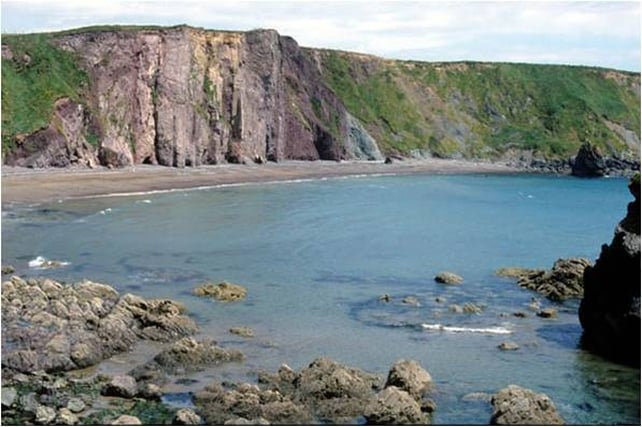
Thanks to a very dedicated and enthusiastic band of volunteers the Waterford Geopark is now able to take people across “80 million years of time”; provide access to features of ancient Ireland, such as dolmens and forts; see a castle that sits on a volcano and – perhaps most fascinating – discover the remnants of a copper mining industry that once employed 5,000 people and was the Royal Navy’s biggest supplier of copper to line the bottoms of ships.
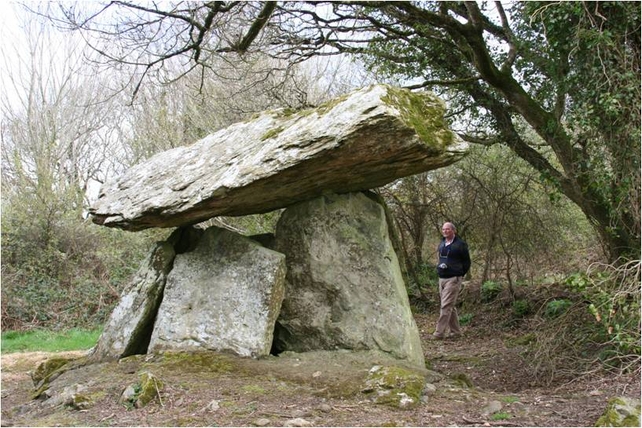
The Geopark Centre is located in Bunmahon and the Copper Coast itself stretches from just east of Tramore to Stradbally on the road Dungarvan. It also stretches inland, where many of the ancient sites can be visited easily. I remain in awe of the dolmen I saw – still perfectly intact – and standing like Ozymandias as a reminder of what could be physically achieved in a pre-mechanised age.
First stop should be the Geopark Centre, where a modest but engaging display of interactive features can begin your journey. Much has been done to simplify the story of geological and social development in the area to combine the history of “humanity and the earth”, says Mike Sweeney of the Centre. He was a mining engineer so it’s not any great surprise that he began to look down instead of ahead when he examined the potential for local tourism enterprise.
After a coffee or something more substantial you will be ready for a journey of discovery and the best thing about the area is how it combines this hidden history with about ten lovely beaches in sheltered coves, although during my visit the winds blew and the rain lashed the coastline but it added to the experience of something hidden; wild and pre-historic.
You can take an easy walk through a little park in Bunmahon, where cleverly, the group behind the Geopark has mapped out in little flag stones micro-stories such as when the first four-legged animals emerged from the sea. And about when the first horses emerged or when man began walking. Kids will love it and it is one of the most accessible little tours of its kind – not too much information but enough to create fascination in little imaginations.
The group has also laid out some very beautiful pieces of free-standing sculpture that add to the landscape and will generate a curiosity as to their meaning and origins. But it is the story of mining that is at the heart of the Copper Coast experience. I was genuinely intrigued to discover that in the 1800’s this part of County Waterford was a jewel in the empire’s crown.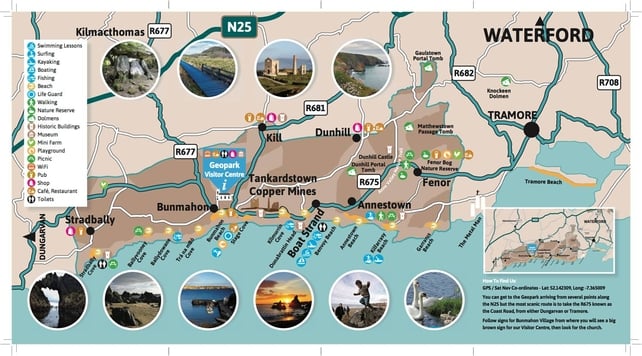
At the mine in Tankardstown, for instance, miners who came originally from Cornwall and formed their own community dug shafts 300 metres deep to extract some 58,000 tons of copper – a commodity much in demand in the burgeoning industrial age. They used explosives to blast their way into cliffs and they even went so far as to tunnel out to sea to mine more. Of course, Irish people were employed but they were not part of the formal English community established to mine and exploit.
The remains of that colony are still evident and you can see how this industrious community established itself and developed. The little railway line that carried the ore from mines to the ships that transported it away from a specially-constructed pier is still in evidence, as are the ruins of buildings that formed this new community.
Sadly, you cannot access the mines but that is the ambition of the volunteers in Bunmahon. They say the mines can be opened again but it will take some 2.3 million Euros – a rather modest figure were they to achieve their aim of 30,000 visitors a year. Opening the mines would open up a truly unique experience because a part of an older world would become a pretty unique visitor experience.
Already the Copper Coast offers plenty in the way of ancient history. As I came away, I was grateful for exposure to something new, something hidden and new knowledge of a world we can only imagine. Thanks to the Geopark group in Bunmahon it can be imagined and even re-told. That’s why there has been the coveted recognition from UNESCO.
Hopefully, the next time I visit the opportunity to get underground will have moved a step closer and it won’t take another geological age to do so.
ACCOMODATION: The Copper Coast is well served with B and B’s and Dungarvan and Waterford City have ample accommodation at different levels and prices. The Cliff House Hotel in Ardmore is not cheap but it is an excellent option with sea view rooms and a spa. Known for its highly imaginative menus, it also offers outstanding bar food, which is what the locals tend to opt for on a regular basis. It makes for an ideal base on the Waterford coast and is also on the edge of an outstanding cliff loop walk. www.thecliffhousehotel.
View the Copper Coast website on www.coppercoastgeopark.com
