


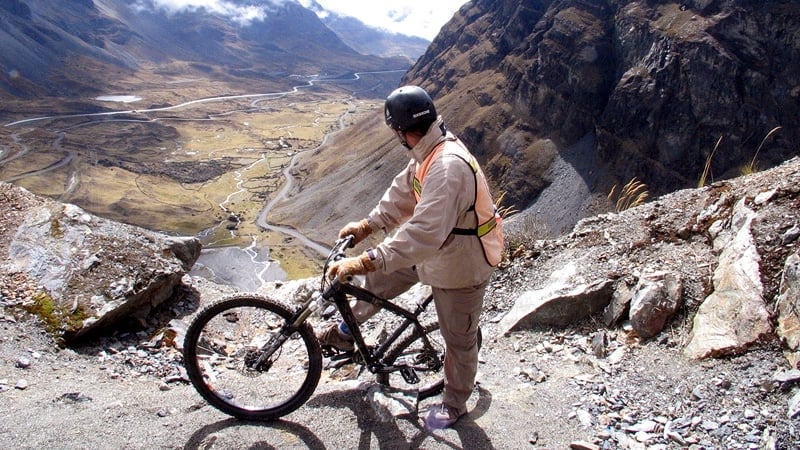
In 1983, a bus crashed over the edge of 'Death Road', killing over 100 people, and in 1997, 26 vehicles went over the edge in just two weeks. Death Road is the name given to the mountain road which runs east from La Paz, Bolivia's capital city, to Coroico. Before a new, paved road opened in 2007, an average of 200 people died on the road each year. The deaths usually happened when Bolivian buses plunged off its cliffs.
But over the last 10 years not only have buses, cars and lorries been involved in Death Road crashes: at least 13 cyclists have also died. These cyclists were among the tourists who have taken to cycling down the 64 kilometres in their thousands.
 The road starts in the Bolivian Andes at 4,700 metres above sea level and descends a steep 3,600 metres. It snakes around a steep mountain side and twists beneath waterfalls and rocky outcrops until you arrive at the lush tropical town of Coroico. The most dangerous parts of the road are the areas where it narrows and winds around acute hairpin bends with sheer drops of over 1,000 metres. In parts, it can be muddy from the rain and waterfalls, making cycling conditions more treacherous. It's a white knuckle ride, and tourists flock to it for an adrenaline hit.
La Paz, the world's highest capital city, has dozens of companies which take groups on this one-day excursion. Companies vary in prices considerably, with prices often being proportionate to the quality of the safety equipment, so beware! Bikes should be equipped with hydraulic disc breaks and front suspension. Ensure that your guide is a fluent English speaker, so that you understand all their instructions.
 The journey starts with a one-hour jeep ride from La Paz to a chilly 4,700 metres at the summit of the road. Before we set off, there was a safety briefing, explaining how to use the bikes - and they dished out helmets, knee and elbow pads. Our guide told us that the trick is to put the bike in top gear and to leave it there.
With a few pushes of the peddles the bikes are swept away by gravity on a smooth, tarmac road for the first 20 kilometres. After that the good road ends abruptly and becomes a dirt track. And the world's most dangerous road begins. Cycling, often at speeds too fast for comfort, with brakes squeezed around hairpin bends that are no more than 10-feet wide with a steep drop to the side is guaranteed to scare you and get the adrenaline pumping.
 The most disconcerting part of the journey is the sight of car wrecks and crosses where someone has gone over the edge. At intervals along the road there are memorials and fading flowers. These include a plaque commemorating the life of a 23-year-old Israeli tourist who lost control of her mountain bike and plummeted over the edge. Just a year ago a British cyclist was killed when he hit a Land Cruiser with 13 people inside it. They rolled down a rocky embankment, eight people died and five were injured.
I found cycling Death Road scarier than doing a bungee jump or a sky dive. Rather than that moment of jumping being over in a matter of seconds, with Death Road the 'moment' lasts for hours.
There are certain areas of the road where all cars and trucks use their horns to signal the oncoming traffic. Cyclists must stop and get off their bikes to let trucks by. At six hairpin bends there are volunteers who act as human traffic lights. They hold red or green flags up to shepherd the traffic and survive on tips from grateful drivers. Timetoe, a Bolivian man in his fifties, started this in 1978 in an attempt to curb the death toll after he lost his entire family in an accident.
Lorry and bus drivers pour beer on the ground to pacify Pachamama (Mother Earth) and keep the road safe. This is another reminder that death is a constant companion down the 64 kilometres. Aside from the worry of crashing, the chances of surviving a crash are slim due to the poor emergency services.
A safer alternative to Death Road was built in 2007, but many locals still use Death Road as it's the shorter option. I cycled Death Road just before the alternative route opened. I did it because it was one of the main tourist attractions in La Paz and it sounded like fun. While spending the day pounding downhill, I started to think about why tourists cycle it and whether it was the right to do.
As much as I enjoyed the amazing views and the adrenaline kick, I did feel a certain amount of embarrassment and shame about doing it. I realised that many of the local people don't have a choice to travel Death Road and the last thing they needed were groups of tourists pounding down on their bikes cheering. It felt disrespectful to them and the dead to treat a road with a huge death toll as a recreational experience.
As the road gets closer to Coroico, the thick fleeces are stripped off in favour of t-shirts. The road is now bone dry, meaning that visibility is lost behind a cloud of dust just before you find yourself in the tropical hillside town of Coroico, where hot showers and good food await you.
In just one day this cycle takes you on a thrilling trip. Not only do you cycle from the snow covered peaks of the Andes to the tropical forests of the Amazon basin, but you also psychologically journey through questions of mortality and issues around the ethics of dark tourism.
Deirdre Mullins
